



Content Curator
Fleas are a kind of hematophagy parasite that sucks blood from their hosts such as mammals and birds. Fleas are fond of dirty places, infected wounds where they lay their eggs. These parasites have a holometabolous life cycle. Fleas aren’t fully capable of reproduction until they complete the whole cycle of becoming an adult. It takes them to suck their first blood as an external parasite to be able to form eggs for reproduction.
| Table of Content |
Keyterms: Flea, Hematophagy parasite, Blood, Reproduction, Holometabolous life cycle, Hemimetabolous, Metamorphosis
What is Metamorphosis?
The biological process where the physical structure of animals goes through various stages of cell growth and division which brings about rapid changes in its body is called Metamorphosis. Complete metamorphosis is known as holometabolous and Incomplete metamorphosis is known as hemimetabolous.
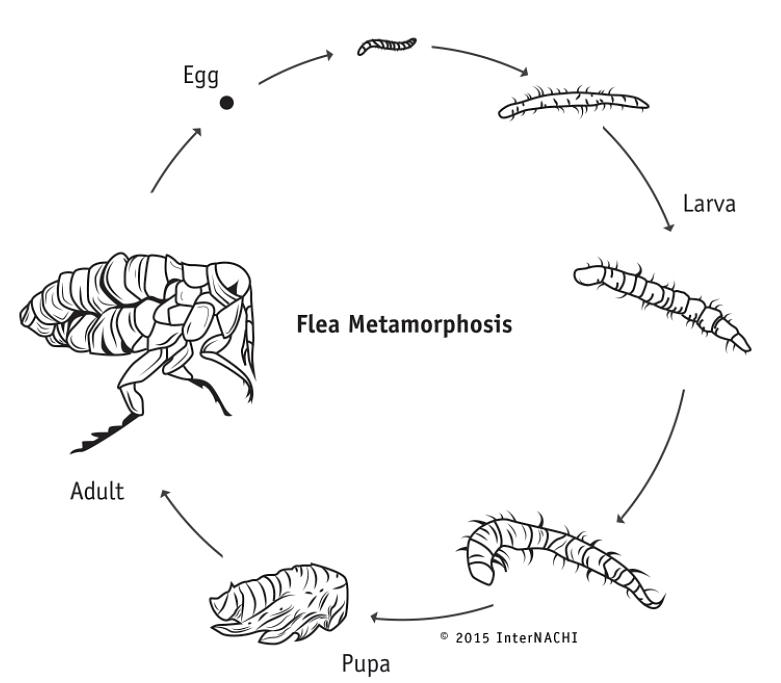
Metamorphosis
Read Also:
| Cockroach Life Cycle | Termite Life cycle | Haplontic Life cycle |
| Ant Life cycle | Fungi life cycle | Grasshopper life cycle |
Complete Flea Metamorphosis
The life cycle of a flea goes through a complete metamorphosis. Thus, it is called holometabolous. The metamorphosis usually depends on flea to flea. The process might take 2-3 weeks to several months to make up a fully adult flea. Environmental factors are the reason for this inconsistency in a flea’s metamorphosis. Their life-cycle consists of a total of four stages, which are,
- Eggs
- Larvae
- Pupa
- Adult flea
The population of fleas have more eggs (50%) and less adults (5%). Larvas are 35% and pupa are 10% of the population.
Read Also: Erythrocytes
Life Cycle of a Flea
The different stages of the flea life cycle are given below.
Egg Stage
The life cycle starts when a female flea lays eggs. Fleas mostly prefer dirty places like dustbins or humid, waterlogged spaces. A female flea is capable of laying 200–300 or more eggs in a life cycle. With the utmost capacity after their meal, they lay 7-8 eggs. Flea eggs are capsule-shaped and aren’t sticky. Therefore, when laying eggs on a host’s lair, these eggs fall off to the ground immediately. The egg needs 7–14 days to hatch into maggots or larvae.

Flea Eggs
Larval Stage
Flea larvae come out of eggs with a 3 mm long whitish appearance with no legs. Larvae have quite a similar appearance to maggots. But, unlike maggots, larvae don’t have eyes, so they avoid being in places with light. If any larvae are on a host’s body, they fall off onto the ground to find shaded places.
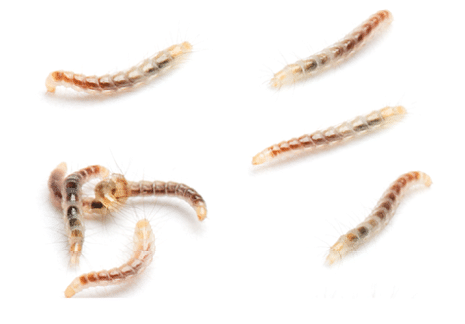
Flea Larvae
Larvae cannot survive in the absence of suitable conditions (such as humidity of more than 45% and temperature less than 90 degrees). Survived larvae aren’t capable of sucking blood. Therefore, they consume organic debris like-dry skin, pre-digested blood from adult fleas, wasted food particles etc. They also use these dirt materials to protect themselves.The larva stage is of 18-20 days before they spin cocoons to get transformed into Pupa.
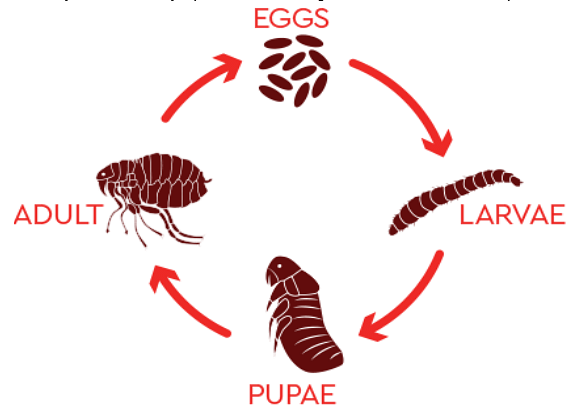
Flea Life cycle
Pupa Stage
Pupa stays within their cocoon, which is weaved throughout the three larval stages. These three larval stages require adequate nutrition for fleas. The cocoon of a pupa is dark in color. The darker the cocoon, the quicker the pupa becomes an adult flea. Now, a host's lair is very much needed for this pupa to be transformed into an adult flea.

Flea Pupa
A pupa needs certain conditions like vibration, heat, temperature, etc to break its exterior. Pupae usually start to break their cocoon with their heads and slowly come out of it as adult fleas. It takes 4-5 days to break out of the cocoon.
Adult flea Stage
Adult fleas look flat-bodied in shape with a dark appearance in their first stage of transforming into adults with eyes and legs. They are about 3 mm long with no wings. The flat body helps them to move in a host’s fur with ease. Sequentially, it becomes larger in size. It is the light coloured flea we get to see in general.

Adult flea
Adult fleas are less in number when compared to their total population because they have a lifetime of pretty much 2-3 months. Adult fleas mainly suck blood from mammals as an external parasite. They find a perfect host to rely on for blood. Without blood, adult fleas are much shorter-lived than usual. A blood meal is required for a female and a male flea to mate. The Female fleas have widely separated eyes, while the eyes of a male flea are close to each other.
With blood, the ovaries of females and the testicles of males get mature for reproduction. One female flea can lay thousands of eggs in a life cycle.
Things to Remember
- Fleas are holometabolous parasites.
- Adult fleas get mature after a blood meal from their hosts.
- An adult flea is the least number of their population, while eggs are the most.
- An adult flea can live up to 2-3 months with adequate food.
- The flea life cycle consists of four stages: egg, larvae, pupa, and adult.
- Larvae can’t be in places with light because of their lack of eyes.
- The dark cocoon of the Pupa proves that it is ready to come out of the cell as an adult flea.
Read Also:
Sample Questions
Ques: Define Metamorphosis. What kind of metamorphosis does a flea have in its life cycle? [2 marks]
Ans: Metamorphosis is a biological process whereby, through various cell growth and division, an animal transforms into a specific physical structure. The life cycle of fleas goes through complete metamorphosis, so it is called holometabolous.
Ques: How to differentiate between a female and a male flea? [2 marks]
Ans: To differentiate a female and a male flea, the structure of and placement of their eyes can be considered as a parameter. Both eyes of a male flea are close to each other. On the other hand, female fleas have wide eyes.
Ques: Write down the appearance of an adult flea. [2 marks]
Ans: Adult fleas are about 3 mm long. It has a long, flattened body shape, which helps to move through the host's body. During the pre-mature state of adult fleas, they are much darker or dark brown in color. They have eyes and legs. But, fleas don’t have wings in any of their life stages. Gradually, these fleas turn into larger fleas with lighter colour in appearance.
Ques: What is flea infestation? [2 marks]
Ans: Fleas are mostly fond of dirty places with high humidity. They either prefer wounds in a host’s body or unhygienic conditions to live in. Due to living in places like these and completing their nutrition with debris and blood, fleas can spread diseases. The ability to spread diseases by fleas is called "flea infestation."
Read Also: Plasmodium Life cycle
Ques: What are the four life stages of a flea? [2 marks]
Ans: The four stages of a flea's life cycle are-
- Eggs
- Larvae
- Pupa
- Adult stage
Ques: How to prevent flea infestation? [2 marks]
Ans: Preventing flea infestation is quite easy and isn’t uncommon at all. To prevent flea infestation, routinely clean waterlogged plant pots and surroundings. Cleaning pets' houses with anti-insect shampoo is necessary. To clean your wounds, use antiseptic creams and lotions. These simple steps of maintaining hygiene is enough to prevent flea infestation.
Ques: Explain the larva and pupa stages of a flea's life cycle. [3 marks]
Ans: Larvae and pupae are the middle stages of a flea’s life cycle. These 2 stages take a total of approx. one month to transform into an adult flea. The stages are as follows-
- Larvae: A larva takes 18–20 days to become a pupa. In their larvae stage, fleas come out of eggs with a 3 mm long whitish appearance. It has no legs. Larvae avoid being in places with light because they are blind. It needs humidity of more than 45% and a temperature of less than 90 degrees Celsius to survive. Consuming dry skin, pre-digested blood from adult fleas and dead insects, wasted food particles helps larvae to be alive.
- Pupa: Pupa stays within their cocoon. Cocoon of a Pupa is dark in colour. The darker the cocoon, the quick pupa becomes an adult flea. With a host's lair Pupa gets transformed into an adult flea. Pupa needs vibration, heat and temperature etc. to break their cocoon with their head and it comes out of it as adult fleas. 4-5 days of adverse conditions complete the transformation of pupa to adult flea.
Ques. Comment on the life cycle and nature of a fern prothallus. [3 marks]
Ans: The diploid sporophyte is represented by a dominant, independent, photosynthetic, vascular plant body. It alternates with multicellular, saprophytic/autotrophic, independent but short-lived haploid gametophyte. called prothallus. Such a pattern is known as haplo-diplontic life cycle. All pteridophytes exhibit this pattern.
These gametophytes require cool, damp, shady places to grow. Because of this specific restricted requirement and the need for water for fertilisation, the spread of living pteridophytes is limited and restricted to narrow geographical regions. The gametophytes (prothallus) bear male and female sex organs ‘ called antheridia and archegonia, respectively.
Water is required for the transfer of antherozoids—the male gametes released from the antheridia to the mouth of the archegonium. Fusion of male gamete with the egg present in the archegonium results in the foundation of the zygote. Zygote thereafter produces a multicellular well-differentiated sporophyte which is the dominant phase of the pteridophytes.
Ques. How are the male and female gametophytes of pteridophytes and gymnosperms different from each other? [2 marks]
Ans: Male and female gametophytes of pteridophytes are free-living while in gymnosperms male and female gametophytes do not have free-living existence. They remain within the sporangia retained on sporophytes.
Read Also: Gemmule Formation
Ques. Endoparasites are found inside the host body. Mention the special structure, possessed by these and which enables them to survive in those conditions. [2 marks]
Ans: The life cycles of endoparasites are more complex because of their extreme specialisation. Their morphological and anatomical features are greatly simplified while emphasizing their reproductive potential.
In accordance with their lifestyle parasites evolve special adaptations such as:
- Loss of unnecessary sense organs.
- Loss of digestive system.
- High reproductive capacity.
- Presence of adhesive organs or suckers to cling on to the host.
Ques. What is the relationship between germinal layers and the formation of body cavity in case of coelomates, acoelomates and pseudocoelomates? [3 marks]
Ans: The presence or absence of a cavity between the body wall and the gut wall is very important in classification. The body cavity, which is lined by mesoderm, is called coelom. Animals possessing coelom are called coelomates, e.g., annelids, molluscs, arthropods, echinoderms, hemichordates and chordates. In some animals, the body cavity is not lined by mesoderm, instead, the mesoderm is present as scattered pouches in between the ectoderm and endoderm. Such a body cavity is called pseudocoelom and the animals possessing them are called pseudocoelomates, e.g., aschelminthes. The animals in which the body cavity is absent are called acoelomates, e.g., platyhelminthes

Platyhelminthes
Ques. Differentiate between a diploblastic and a triploblastic animal. [2 marks]
Ans: (i) Diploblastic: Animals in which the cells are arranged in two embryonic layers, external ectoderm and internal endoderm, are called diploblastic animals, e.g. Porifers, coelenterates and ctenophores.
(ii) Triploblastic: Those animals in which the developing embryo has a third germinal layer, mesoderm, in between the ectoderm and endoderm, are called triploblastic animals. E.g.: Platyhelminthes to Chordates.



Comments