



Content Curator
Erythrocytes, the scientific name of Red Blood Cells (RBCs), also referred to as red cells, red blood corpuscles, or haematids, are anucleate, biconcave cells containing haemoglobin that transfer oxygen and carbon dioxide between the lungs and tissues.
- Erythrocytes absorb oxygen in the lungs, or gills in fish, and then release it into tissues as they squeeze through the body's capillaries.
- They develop in the red bone marrow through a process known as erythropoiesis.
- During this process, stem cell-derived erythroid precursors go through a series of morphological changes before becoming mature erythrocytes.
- These mature RBCs are discharged into the bloodstream, where they can survive for 100 to 120 days.
| Table of Content |
Key Terms: RBCs, Erythrocytes, Carbon dioxide, Oxygen, Red blood corpuscles, Component of blood, Human body, Cell membrane, Cytoplasm
What are Erythrocytes?
[Click Here for Sample Questions]
Erythrocytes, often known as Red Blood Cells (RBCs), are a major cellular component of blood.
- These cells circulate in the blood, transporting oxygen from the lungs to all tissues in the body.
- It is responsible for giving blood its characteristic colour.
- Mature human erythrocytes are spherical, tiny, and biconcave, like dumbbells.
- Because the cell is flexible, it can rearrange to form a bell shape as it goes through the extremely small blood arteries.
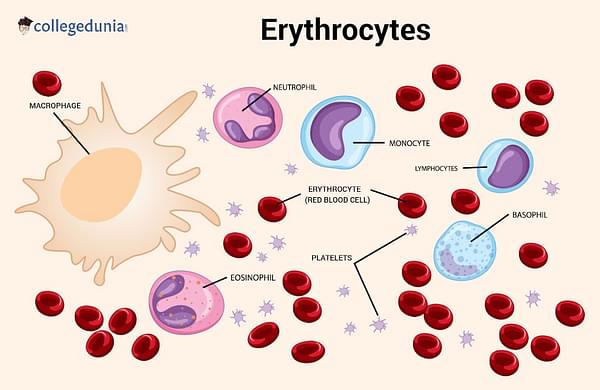
Erythrocytes
Also check:
| Related Concepts | ||
|---|---|---|
| Ear Ossicles | Pons | Body Fluids and Circulation |
| Inclusion Bodies | Difference between RBC and WBC | Difference between Blood and Lymph |
Structure of Erythrocytes
[Click Here for Sample Questions]
Erythrocytes are 7-8 µm in diameter and have a unique structure compared to other human body cells.
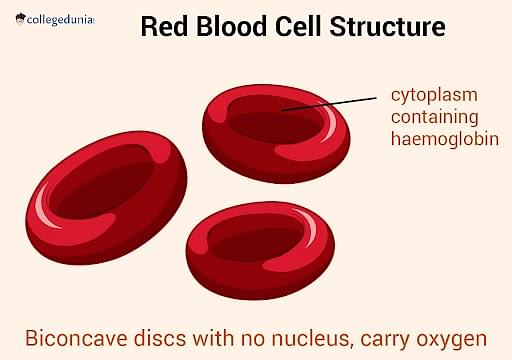
- The RBC structure resembles a donut; it is biconcave, with a thicker periphery than the central region.
- This characteristic maximizes the overall surface area of the cell membrane, allowing for gas exchange and transport.
- These cells are anuclear and do not have any additional intracellular organelles, as they are lost during erythropoiesis.
There are two main structures in a cell: the cytoplasm and the cell membrane.
Cytoplasm
It contains haemoglobin, which includes acidophilia, making erythrocytes stain bright red with eosin on tissue samples stained with hematoxylin and eosin.
Cell Membrane
This membrane is a lipid layer composed of two types of membrane proteins: peripheral and integral.
- The RBC membrane is a two-dimensional structure that consists of a cytoskeleton and a lipid bilayer joined together.
- The lipid bilayer contains several forms of cholesterol, phospholipids, sphingolipids, and integral membrane proteins such as glycophorin.
Peripheral Membrane Proteins
The peripheral membrane proteins only reach into the cytoplasm because they are found on the plasma membrane's inner surface.
- Several intracellular filaments connect the proteins, forming a complex mesh-like cytoskeletal network that covers the inner cell membrane.
- This network is essential for providing RBCs with strength and elasticity, allowing them to pass through even the thinnest and tiniest capillaries without breaking or leaking.
Integral Membrane Proteins
Integral membrane proteins are numerous and stretch across the cell membrane's thickness.
- It binds to haemoglobin and serves as an anchor points for RBCs' cytoskeletal network.
- They also express antigens from the ABO blood groups.
- Blood transfusions require the presence of erythrocyte surface antigens.
Functions of RBCs
[Click Here for Sample Questions]
The important functions of red blood cells are
- It transports oxygen from the lungs to tissues throughout the body, facilitates carbon dioxide transport
- Acts as a buffer to control hydrogen ion concentration.
- Contributes to blood viscosity.
- Carries blood group antigens and the Rh factor.
Erythrocytes have a membrane composed of proteins and lipids. While the nucleus is absent, it contains a red iron-rich protein called haemoglobin, which binds to oxygen.
- In addition, red blood cells absorb carbon dioxide from your body and transport it to your lungs, where it is expelled.
- Red blood cells are produced in the bone marrow, where they are generally found.
- Their lifespan is around 120 days, after which they die.
- The basic role of these red cells, along with their haemoglobin, is to transport oxygen from the gills/lungs to all tissues of the body before carrying carbon dioxide (a byproduct of metabolism) to the lungs for expiration.
- Invertebrates' oxygen-carrying pigment circulates freely in the plasma.
- The concentration of this pigment in vertebrates' red cells is higher, indicating substantial evolution.
- The biconcave form of the cells facilitates the exchange of oxygen at a constant rate over the largest surface possible.
- Erythrocytes also help to determine the type of blood group.
Exchange of Gases
Haemoglobin in lung capillaries combines with inhaled oxygen to generate oxyhaemoglobin, which gives cells a red colour.
- The oxygen-rich erythrocytes then pass through the arteries until they reach the tissue capillaries.
- Here the oxygen is separated from the haemoglobin and diffuses into the tissues of the body.
- On the other hand, CO2 binds to haemoglobin, generating oxyhaemoglobin, which gives them its colour.
- Erythrocytes high in carbon dioxide move to venous circulation, then to the heart, and eventually to the lungs.
- Carbon dioxide is released from the lung capillaries in exchange for fresh oxygen.
Life Cycle of Erythrocytes
[Click Here for Sample Questions]
The life cycle of erythrocytes has three stages: Production, Maturation, and Destruction.
Erythropoiesis, or the formation of erythrocytes, is a haematopoiesis subprocess that occurs in the red bone marrow.
- The first phases of haematopoiesis result in the formation of an erythroid stem cell known as the Colony Forming Unit - Erythroid (CFU-E).
- It signals the start of this process, which is driven by the hormone erythropoietin.
- These cells reside in erythroid islands in the bone marrow, where they multiply and develop into adult RBCs.
- Differentiation produces cells such as erythrocytes, erythroblasts, proerythroblasts, and reticulocytes.
Stages of Erythropoiesis
The different stages of Erythropoiesis are
| Stage of Erythropoiesis | Corresponding events |
|---|---|
| Proerythroblast | Initiation of haemoglobin synthesis |
| Early normoblast | Disappearance of nucleoli |
| Intermediate normoblast | The stage at which haemoglobin begins to appear. |
| Late normoblast | Disappearance of nucleus |
| Reticulocyte | Formation of reticulum. From its place of production, the cell enters the capillary. |
| RBC matures | A distinct donut-shaped biconcave cell is achieved. The disappearance of reticulum |
Also Check:
| Biology Related Concepts | ||
|---|---|---|
| Productivity in Ecosystem | Disadvantages of Dams | Our Environment |
| Enzymes | Excretion in Human Beings | Hypertension |
| Sucrose | Excretion | Excretion in Plants |
Things to Remember
- Erythrocytes, often known as Red Blood Cells (RBCs), are a major cellular component of blood.
- They develop in the red bone marrow through a process known as erythropoiesis.
- The biconcave cells contain haemoglobin that transfers oxygen and carbon dioxide between the lungs and tissues.
- Erythrocytes are 7-8 µm in diameter.
- There are two main structures in a cell: the cytoplasm and the cell membrane.
- The RBC membrane is a two-dimensional structure that consists of a cytoskeleton and a lipid bilayer joined together.
Sample Questions
Ques. What are the major types of blood cells? (2 Marks)
Ans. The three main types of blood cells are erythrocytes (RBC), leukocytes (WBC), and thrombocytes (platelets). These three make up 45% of blood volume, with plasma accounting for the remaining 55%.
Ques. What are red blood cells? (2 Marks)
Ans. Red blood cells (RBC), also known as red blood corpuscles or erythrocytes, are the most common form of blood cell that transports oxygen to vertebrate body tissues via the bloodstream.
Ques. Define the terms blood and lymph. (2 Marks)
Ans. The human body's two essential fluids are blood and lymph. Plasma, cells, blood and platelets make up blood, which is a fluid connective tissue. Lymph is a colourless fluid that circulates within the lymphatic vessels, which are made up of lymph nodes and vessels.
Ques. How does the biconcave shape of the cells help? (2 Marks)
Ans. Invertebrates' oxygen-carrying pigment is released into the plasma. The concentration of this pigment in red cells is higher in vertebrates, indicating that evolution has progressed significantly. The biconcave shape of the cells allows for consistent oxygen exchange over the largest possible area. Erythrocytes also aid in the identification of blood groups.
Ques. Why is the blood vascular system considered more efficient in animals than the water circulatory system? (2 Marks)
Ans. The percentage of dissolved nutrients and oxygen in H2O is decreasing. In higher animals, oxygen is delivered via the oxygen carrier molecule haemoglobin, which is found in plasma or cells. Animals with a blood vascular system receive oxygen and nutrients quickly and in large amounts, making them comparatively efficient.
Ques. What are glycolipid and glycoprotein coatings? (3 Marks)
Ans. The glycolipid and glycoprotein coatings on red blood cells are lipids and proteins that have carbohydrate molecules attached to them. Individuals' surface glycoproteins and glycolipids on red blood cells differ in humans, resulting in blood types such as A, B, and O. Red blood cells have a lifespan of 120 days, after which they are recycled by phagocytic macrophages, which is a type of white blood cell, in the spleen and liver.
Ques. How does the exchange of gases take place? (3 Marks)
Ans. Haemoglobin in lung capillaries combines with inhaled oxygen to form oxyhaemoglobin, which gives red colour to cells. The oxygen-rich erythrocytes then travel through the arteries until they reach the capillaries in the tissue.
The oxygen is released from haemoglobin and diffuses into the body tissues at this point. CO2 binds to haemoglobin, forming oxyhaemoglobin, which gives them their colour. Carbon dioxide-rich erythrocytes travel through venous blood to the heart and then to the lungs. In exchange for fresh oxygen, the carbon dioxide in these lung capillaries is released from the capillaries.
Ques. What is the role of NO when the exchange of gases takes place? (3 Marks)
Ans. Red blood cells' small size and large surface area allow oxygen and carbon dioxide to diffuse quickly across the plasma membrane. Carbon dioxide is exhaled and oxygen is taken in by the blood in the lungs.
Oxygen is released from the blood in the tissues, while carbon dioxide is bound for transport back to the lungs. Hemoglobin also binds nitrous oxide, according to studies (NO). It acts as a vasodilator that relaxes capillaries and blood vessels, which may aid red blood cell passage through narrow vessels and gas exchange.
Ques. How can you describe the presence of the colour of a red blood cell? (3 Marks)
Ans. Haemoglobin, which contains four iron-binding heme groups, is found in red blood cells. The heme groups of haemoglobin are bound by oxygen.
Haemoglobin has a cooperative oxygen-binding affinity. The oxygen saturation of the molecule increases it. The shape of the other binding sites is influenced by the shape of the initial oxygen molecule. This makes it easier for additional oxygen molecules to bind.
Ques. Why are thrombocytes required for blood clotting? (3 Marks)
Ans. Platelets, also known as thrombocytes, are blood cells that are formed in the bone marrow and have a one-week lifespan. When our bodies are injured, blood oozes out, and platelets are released, producing the clotting factor known as thromboplastin.
Pro-thrombokinase is activated by the presence of calcium ions. A cycle of reactions causes a blood clot to shape, plugging the injured blood vessel and preventing further blood loss.
For Latest Updates on Upcoming Board Exams, Click Here: https://t.me/class_10_12_board_updates
Also Read:



Comments