



Content Curator
A four-stroke engine is an internal combustion engine. It completes one operational cycle with four distinct piston strokes that are intake, compression, power, and exhaust. In a four-stroke engine, a whole operation involves two crankshaft rotations (7200).
| Table of Content |
Keyterms: Piston, flywheel, Four Stroke, Types of strokes
What is Four Stroke Engine?
[Click Here for Sample Questions]
A Four Stroke Engine is also known as a four-cycle engine. It is an internal combustion engine in which the piston rotates the crankshaft four times. The whole journey of the piston along the cylinder in each direction is referred to as a stroke. There are four-stroke used in a four-stroke engine that are intake, compression, power, and exhaust. A complete cycle in a four-stroke engine needs two crankshaft revolutions (7200).
Also read: Reversible and Irreversible Processes
Parts of Four Stroke Engine
[Click Here for Sample Questions]
The parts of a Four-Stroke Engine are:
- Piston: The piston in a four-stroke engine transfers the expanding forces of gas to mechanical rotation of the crankshaft in an engine through a connecting rod.
- Connecting Rod: The connecting rod acts as a lever arm. It sends motion from a piston to the crankshaft.
- Crankshaft: A crankshaft in a four-stroke engine turns reciprocating motion into rotating motion.
- Flywheel: The flywheel is a mechanical device; it stores energy produced by rotation.
- Valves for the inlet and outlet: It allows us to inject fuel into new air while simultaneously removing the spent air-fuel combination from the cylinder.
- Spark Plug: It's a method of sending an electric current across the combustion chamber, that ignites the air-fuel mixture and expands the gas rapidly.
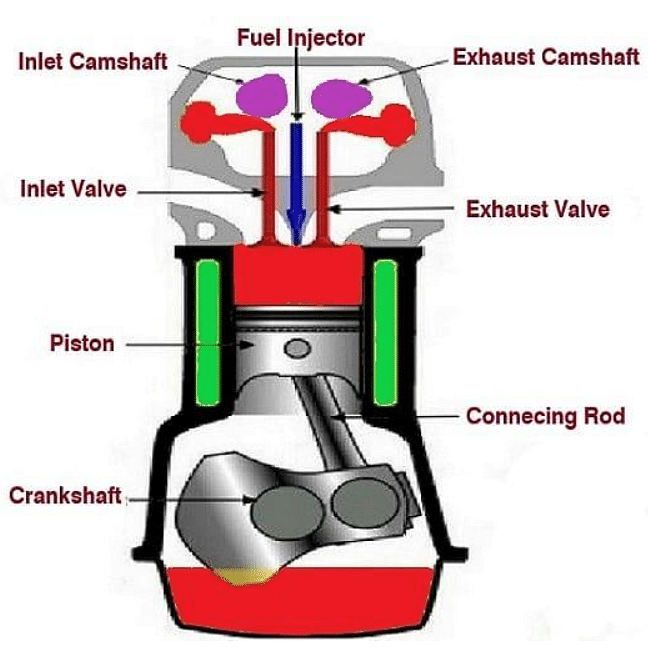
Different strokes in Four Stroke Engine
The four-stroke engine has four strokes which are explained below:
[Click Here for Sample Questions]
Intake Stroke: Intake Stroke is also known as Suction Stroke. In intake stroke, the air-fuel combination is introduced to the combustion chamber. During this stroke, the piston moves from the Top Dead Center, which is the piston's furthest distance from the crankshaft to the Bottom Dead Center, the piston's closest distance from the crankshaft. The cylinder's low-pressure zone is caused by the piston's push toward the Bottom Dead Center. After Bottom Dead Center, the inlet valve remains open for a few degrees of crankshaft rotation. The intake valve closes after that, sealing the air-fuel mixture inside the cylinder.
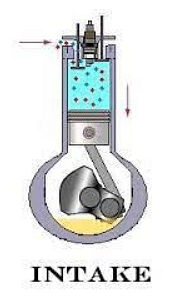
Intake Stroke
Also read: First Law of Thermodynamics
Key Points of Intake Stroke:
| Inlet Valve | Open |
| Outlet Valve | Closed |
| Crankshaft Rotation | 1800 RPM or 180° |
Compression Stroke: During the compression stroke, the trapped air-fuel combination within the cylinder is compressed. During the stroke, the piston moves from Bottom Dead Center to Top Dead Center, compressing the air-fuel combination. The pistons’ forward motion is aided by the flywheel's momentum. When the charge is ignited, the air-fuel mixture is compressed, allowing the release of more energy. The charge is the quantity of compressed air-fuel combination that has been trapped and is ready to be ignited within the combustion chamber. Both the inlet and exhaust valves must be closed to guarantee that the cylinder is closed and compressed.

Compression Stroke
Key Points of Compression Stroke:
| Inlet Valve | Closed |
| Outlet Valve | Closed |
| Crankshaft Rotation | 1800 RPM or 180° (Total 3600 RPM or 360°) |
Combustion Stroke: Combustion Stroke is also known as Power Stroke. The second rotation starts immediately when the crankshaft finishes a full rotation during the compression stroke. During the power stroke, the compressed air-fuel mixture is ignited with the help of a spark plug. Ignition or combustion is a quick, oxidizing chemical process in which a fuel chemically reacts with oxygen in the environment to generate energy in the form of heat. The hot expanding gases produced during the combustion stroke push the piston head away from the cylinder head.

Combustion Stroke
Key Points of Combustion Stroke:
| Inlet Valve | Closed |
| Outlet Valve | Closed |
| Crankshaft Rotation | 1800 RPM or 180° (Total 5400 RPM or 540°) |
Exhaust Stroke: The combustion process is complete when the piston reaches Bottom Dead Center during the power stroke, and the cylinder is filled with exhaust gases. In the exhaust stroke, the exhaust valves open, as a result the inertia of the flywheel and other moving parts pushes the piston back to Top Dead Center, compelling the exhaust gases through the open exhaust valve. The piston is at Top Dead Center at the end of the exhaust stroke, and one operating cycle has been finished.

Exhaust Stroke
Key Points of Exhaust Stroke:
| Inlet Valve | Closed |
| Outlet Valve | Closed |
| Crankshaft Rotation | 1800 RPM or 180° (Total 7200 RPM or 720°) |
Difference Two Stroke vs Four Stroke Engine
[Click Here for Sample Questions]
The major difference between the Two Stroke and Four Stroke Engine is explained in the table given below:
| S No. | Two Stroke Engine | Four Stroke Engine |
|---|---|---|
| 1. | The two-Stroke Engine is lighter in weight. | The four-stroke engine is comparatively heavier than the two-stroke engine. Four-stroke engine weighs 50% more than a two-stroke engine. |
| 2. | The two-Stroke Engine creates more noise | The four-stroke engine has less noise than two stroke engines. |
| 3. | The two-Stroke Engine produces more torque at higher RPMs | The four-stroke engine produces more torque at lower RPMs. |
| 4. | The two-Stroke Engine wear out fast as they run at higher RPMs. | The four-stroke engine do not wear out fast as they run at lower RPMs. |
| 5. | The two-Stroke Engine has a simple structure. Hence, they are easier to fix. | The four-stroke engine has more parts and a much more complex structure, which makes the repair cost high. |
| 6. | Two-stroke engines are usually used in small applications such as boat motors, chainsaws, and dirt bikes. | Four-stroke engines are majorly used in lawnmowers, car combustion engines, and go-karts. |
Points to Remember
[Click Here for Sample Questions]
- A Four-Stroke Engine is also known as a four-cycle engine. It is an internal combustion engine in which the piston rotates the crankshaft four times.
- The whole journey of the piston along the cylinder in each direction is referred to as a stroke. There are four-stroke used in a four-stroke engine that are intake, compression, power, and exhaust.
- A complete cycle in a four-stroke engine needs two crankshaft revolutions (7200).
- The different parts of the Four-Stroke Engine are: Piston, Connecting Rod, Crankshaft, Flywheel, Valves for the inlet and outlet, and Spark Plug.
- Intake Stroke, also known as Suction Stroke. During the intake stroke, the air-fuel combination is introduced to the combustion chamber. During this stroke, the piston moves from the Top Dead Center, which is the piston's furthest distance from the crankshaft to the Bottom Dead Center, the piston's closest distance from the crankshaft.
- During the compression stroke, the trapped air-fuel combination within the cylinder is compressed. During the stroke, the piston moves from the Bottom Dead Center to Top Dead Center, compressing the air-fuel combination. The piston's forward motion is aided by the flywheel's momentum. When the charge is ignited, the air-fuel mixture is compressed, allowing the release of more energy.
- Combustion Stroke is also known as Power Stroke. The second rotation starts immediately when the crankshaft finishes a full rotation during the compression stroke. During the power stroke, the compressed air-fuel mixture is ignited with the help of a spark plug.
- The combustion process is complete when the piston reaches Bottom Dead Center during the power stroke, and the cylinder is filled with exhaust gases.
- The four-stroke engine is heavier than the two-stroke engine. A four-stroke engine weighs 50% more than a two-stroke engine.
- The four-stroke engine produces more torque at lower RPMs.
- The four-stroke engine has more parts and a much more complex structure, which makes the repair cost high.
- Four-stroke engines are majorly used in lawnmowers, car combustion engines, and go-karts.
Important Questions
Question 1. What are the advantages of Four Stroke Engine over Two Stroke Engines? (3 marks)
Answer. The advantages of Four Stroke Engine over Two Stroke Engines are:
- The four-stroke engine has less noise than two stroke engines.
- The four-stroke engine produces more torque at lower RPMs.
- The four-stroke engine do not wear out fast as they run at lower RPMs.
Question 2. What are the different parts of Four Stroke Engine? Also explain their functions. (4 marks)
Answer. The different parts of Four Stroke Engine are:
- Piston: The piston transfers the expanding forces of gas to mechanical rotation of the crankshaft in an engine via a connecting rod.
- Connecting Rod: The connecting rod acts as a lever arm. It transfers motion from a piston to the crankshaft.
- Crankshaft: A crankshaft in a four-stroke engine turns reciprocating motion into rotating motion.
- Flywheel: The flywheel is a mechanical device; it stores energy produced by rotation.
- Valves for the inlet and outlet: It allows us to inject fuel into new air while simultaneously removing the spent air-fuel combination from the cylinder.
- Spark Plug: It's a method of sending an electric current across the combustion chamber, that ignites the air-fuel mixture and expands the gas rapidly.
Question 3. What is compression Stroke? Explain in detail. (3 marks)
Answer. During the compression stroke, the trapped air-fuel combination within the cylinder is compressed. During the stroke, the piston moves from Bottom Dead Center to Top Dead Center, compressing the air-fuel combination. The pistons’ forward motion is aided by the flywheel's momentum. When the charge is ignited, the air-fuel mixture is compressed, allowing the release of more energy. The charge is the quantity of compressed air-fuel combination that has been trapped and is ready to be ignited within the combustion chamber. Both the inlet and exhaust valves must be closed to guarantee that the cylinder is closed and compressed.
Question 4. Explain some of the characteristics of Two Stroke Engine. (4 marks)
Answer. The characteristics of Two Stroke Engine are:
- The two-Stroke Engine is lighter in weight.
- The two-Stroke Engine creates more noise
- The two-Stroke Engine produces more torque at higher RPMs
- The two-Stroke Engine wear out fast as they run at higher RPMs.
- The two-Stroke Engine has a simple structure. Hence, they are easier to fix.
- Two-stroke engines are commonly found in smaller applications like boat motors, chainsaws, and dirt bikes.
Question 5. What is exhaust stroke? Explain in detail. (3 marks)
Answer. The combustion process is complete when the piston reaches Bottom Dead Center during the power stroke, and the cylinder is filled with exhaust gases. During this stroke, the exhaust valves open, and the inertia of the flywheel and other moving parts pushes the piston back to Top Dead Center, compelling the exhaust gases through the open exhaust valve. The piston is at Top Dead Center at the end of the exhaust stroke, and one operating cycle has been finished.
Read More: Born-Haber Cycle
Question 6. Mention the key points of Combustion Stroke. (3 marks)
Answer. The key points of combustion stroke are:
- The Inlet valve is closed.
- The outlet valve is closed.
- The total Crankshaft Rotation is 5400 RPM or 540°.
Question 7. When does the second rotation starts in the four-stroke engine? Explain the process in detail. (3 marks)
Answer. The second rotation starts during the combustion stroke which is also known as the power stroke. The second rotation starts immediately when the crankshaft finishes a full rotation during the compression stroke. During the power stroke, the compressed air-fuel mixture is ignited with the help of a spark plug. Ignition or combustion is a quick, oxidizing chemical process in which a fuel chemically reacts with oxygen in the environment to generate energy in the form of heat. The hot expanding gases produced during the combustion stroke push the piston head away from the cylinder head.
Question 8. What are the advantages of four stroke engine? Explain in detail. (3 marks)
Answer. The advantages of four stroke engine are mentioned as follows:
- The four stroke has good fuel efficiency as the engine consume fuel once in four strokes. Thus, less fuel is consumed.
- The four-stroke engine do not wear out fast as they run at lower RPMs.
- The four-stroke engine has less noise than two stroke engines.
- The four-stroke engine produces less pollution in comparison to the two-stroke engine because the power in four-stroke engine is generated once in four strokes.
Also check:



Comments