



Content Writer
A matrix is a rectangular array or table of numbers, symbols, or expressions organized in rows and columns that are used to represent a mathematical object.
- Square matrix, null matrix, diagonal matrix, scalar matrix, identity matrix and diagonal matrix are different types of matrix.
- Matrix addition refers to the operation of adding entries of two or more matrices together.
- The addition of matrices is possible only if the order of the matrices is the same.
- Matrices represent linear mappings of numbers and allow explicit calculations in linear algebra without any further requirements.
- Matrix addition is used in the fields of data analysis, image processing, cryptography, operations research and machine learning.
Key Terms: Matrix, Matrix Addition, Matrix Subtraction, Properties of Matrix Addition, Commutative Property, Associative Property, Additive Identity, Additive Inverse
What is Matrix Addition?
[Click Here for Sample Questions]
A matrix refers to a set of numbers arranged in rows (m) and columns (n) to form a rectangular array of m x n. The dimension or size of a matrix is the total number of rows and columns in an allocated matrix.
- Many operations, such as addition, subtraction, scalar multiplication and transposition may be performed on matrices.
- The action of adding equivalent elements of two or more matrices is known as matrix addition.
- Matrix addition can be done only for matrices of the same size (or dimension).
- The element-wise addition of matrices and the direct sum of matrices are two methods for adding matrices.
The matrix addition is defined by two requirements in general, which are as follows:
- Consider the following two matrices: A and B.
- These matrices can be combined if (and only if) their order is identical, that is, the two matrices have the same number of rows and columns.
- If, for example, matrix A has an order of 3*4, then matrix B can be added to it if its order is likewise 3*4.
- For matrices of variable sizes, the addition of matrices is not specified.
Consider two matrices A =[aij]m*n and B =[bij]m*n of order m * n, then the addition of A and B is given by the formula;
A + B = [aij]m*n + [bij]m*n = [aij + bij]m*n
How to add Matrices?
To add two or more matrices, the addition of a matrix is the most basic matrix operation. The addition of matrices is only feasible if the provided matrices are in the same order.
- Look at some specific examples to gain a better understanding.
2 x 2 Matrices AdditionThe most frequent matrices are 2 x 2 and 3 x 3 matrices. If we have two matrices, X and Y, having dimensions of 2 x 2, we may combine them as follows: 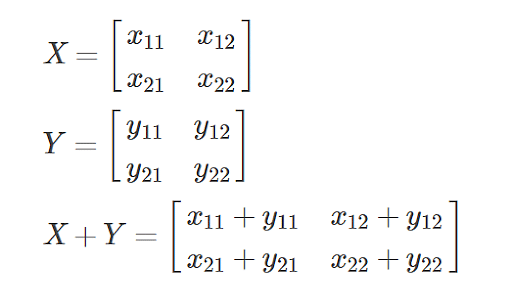 3 x 3 Matrices AdditionLet's move on to understanding the addition of 3 x 3 matrices now that we know how to add matrices in the 2 x 2 order. To add all relevant elements, the order of the matrices should be similar, as explained in the principles for matrix addition. The following is the typical form for adding 3 x 3 matrices.  |
Read More:
Properties of Matrix Addition
[Click Here for Sample Questions]
The fundamental features of matrix addition are comparable to those of real-number addition. Assume A, B, and C are three m*n matrices. The matrix addition operation has the following characteristics.
Commutative Property
When A and B are two matrices of the same order, such as m * n, then the addition of the two matrices is commutative only if A + B = B + A.
Associative Property
If A, B, and C are three matrices of the same order, such as m * n, then their addition is associative, i.e., A + (B + C) = (A + B) + C.
Additive Identity
There is an identity element in any m x n matrix. As a result, if A is a m x n order matrix, A's additive identity will be zero matrices of the same order, resulting in A + O = A ( where O is an additive identity)
Additive Inverse
If A is an m x n matrix, then B (= -A) of the same order is the additive inverse of A, resulting in A + B = O. Therefore, the total of the matrices and their additive inverses yields a zero matrix.
What is Matrix Subtraction?
[Click Here for Sample Questions]
Matrix subtraction or subtraction of matrix is defined as the process of addition of the negative of a matrix to another matrix. Like matrix addition, matrix subtraction is possible if order of both the matrix are similar.
- Suppose there are two matrices, A = [aij] and B = [bij] of the same order, then the subtraction of A and B, i.e., A – B is defined as: A – B = aij – bij
-
The matrix subtraction does not follow commutative law which means A – B ≠ B – A.
Example of Matrix SubtractionExample: Consider the following matrix: |

Solved Examples on Matrix Addition
[Click Here for Sample Questions]
The examples on Matrix addition are as follows:
 |
Read More:
Things to Remember
- A matrix is a two-dimensional rectangular array of integers or symbols organized in rows and columns.
- The number of rows and columns determines the matrix's order.
- The numbers in the matrix are the entries; each number is referred to as an element. Matrix is the plural form of a matrix.
- Matrix addition is a form of operation performed to add two matrices to get a single matrix.
- In electrical circuits, matrices are often employed to solve AC network equations.
- The elements of the matrices are added when matrices are of the same order.
Sample Questions
Ques. What is the potential ordering for a matrix with eight elements? (2 marks)
Ans: If a matrix is of order m n, it contains mn elements, as we know. To identify all possible orders of an 8-element matrix, we must first find all ordered pairs of natural numbers with a product of 8.
As a result, the only feasible ordered pairs are (1, 8), (8, 1), (4, 2), and (4, 3).
As a result, the feasible ordering is 1 * 8, 8 * 1, 4 * 2, 2 * 4
Ques. Can you combine a 2x3 and a 3x2 matrix, as well as matrices of other sizes? (3 marks)
Ans: When adding and subtracting two or more matrices, the most essential thing to remember is to make sure the matrices have the same dimensions. To put it another way, we may add or subtract a 2x3 matrix with a 2x3 matrix or a 3x3 matrix with a 3x3 matrix with a 2x3 matrix.
- A 3x2 matrix cannot be added to a 2x3 matrix or a 2x2 matrix to a 3x3 matrix.
- You can only add two matrices if their dimensions are the same; otherwise, you can't add any two matrices.
- To multiply two matrices M and N, the number of columns of M must be equal to the number of rows in matrix N.
Ques. What are the potential orders for a matrix with 24 elements? What happens if it has 13 elements? (2 marks)
Ans: A matrix of the order mx n contains mn elements, as we know. To determine all the possible orders of a 24-element matrix, we must first identify all the ordered pairs of natural numbers whose product is 24. The following are the ordered pairs:
(1, 24), (24, 1), (2, 12), (12, 2), (3, 5), (8, 3), (4, 6), and (6,4)
- As a result, the alternative ordering of a 24-element matrix is:
I * 2 ^ 4 , 24 * 1, 2 * 12, 12 * 2, 3 * 8 8 * 3.4 * 6 , and 6 * 4
The ordered pairs of natural numbers (1, 13) and (13, 1) have a product of 13. As a result, the alternative ordering of a 13-element matrix is 1*11 and 13 * 1.
Ques. What is the potential ordering for a matrix with 18 elements? What if it consists of five elements? (2 marks)
Ans: A matrix with the order m * n contains mn elements, as we know. To determine all the possible orders of an 18-element matrix, we must first find all the ordered pairs of natural numbers with a product of 18.
- The ordered pairs are: (1, 15), (18, 1), (2, 9), (9, 2), (3, 6,), and (6, 3)
- Hence, the possible orders of a matrix having 18 elements are: 1x15, 15 x 1,
- 2 x 9, 9 x 2, 3 x 6, and 6 x 3
- The ordered pairs of natural numbers (1, 5) and (5, 1) have a product of 5. As a result, the potential ordering of a five-element matrix is 1 x 5 and 5 x 1.
Ques. A school's bookshop includes ten dozen chemistry books, eight dozen physics books, and ten dozen economics books. Their respective selling prices are Rs 80, Rs 60, and Rs 40. Using matrix algebra, calculate the total amount the bookshop will earn from the sale of all the books? (3 marks)
Ans. There are ten dozen chemistry books, eight dozen physics books, and ten dozen economics books in the bookstore.
A chemistry book, a physics book, and an economics book are all priced at Rs 90, Rs 60, and Rs 40, respectively.
The entire amount of money that will be obtained from the sale of all these books may be expressed as a matrix as follows:

Thus, the bookshop will receive Rs 20160 from the sale of all these books.
Ques. The total number of conceivable 3 x 3 matrices with each element 0 or 1 is 15? (2 marks)
(A) 27
(B) 18
(C) 81
(D) 512
Ans: D is the right answer.
Explaination: There are 9 items in the provided 3 x 3 matrix, and each of these elements maybe 0 or 1 are the options.
Each of the nine components can now be completed in one of two ways. As a result, based on the multiplication principle, the needed number of matrices is 2^9=512.
Ques. Determine the value of x + y if  ? (4 marks)
Ans. The two matrices are equivalent if and only if the corresponding entries are equal, because their ordering are the same. As a result of comparing the components, we arrive at:
2x + y = 7 ---(1)
4x = 7y - 13 ---(2)
5x - 7 = y ---(3)
4x = x + 6
4x - x = 6
3x = 6
x = 2
By applying the value of x in the first equation, we get
2(2) + y = 7
4 + y = 7
y = 7 - 4 = 3
Hence the value of x + y is 5
Ques. What does the term "matrices" signify, and what are the different sorts of matrices? (2 marks)
Ans: A rectangular array of integers is referred to as a matrix. Rows and columns make up a matrix. The size or dimension of a matrix is determined by the rows and columns. Row matrices, column matrices, null matrices, square matrices, diagonal matrices, upper triangular matrices, lower triangular matrices, symmetric matrices, and antisymmetric matrices are some of the several forms of matrices.
Ques. What does a symmetric matrix imply? (2 marks)
Ans. A symmetric matrix is a square matrix with the same transpose as it. Furthermore, because equal matrices have equal dimensions, only square matrices may be symmetric. In terms of the main diagonal, a symmetric matrix contains symmetric entries.
Ques. What exactly is a scalar matrix? (2 marks)
Ans: The scalar matrix is like a square matrix in appearance. All off-diagonal elements in a scalar matrix are equal to zero, but all non-diagonal elements are equal. In other terms, a scalar matrix is the multiple of an identity matrix.
Ques. Perform matrix addition on 2 x 2 matrix where C =
∣8 6∣ and B = ∣28 16∣
∣7 7∣ ∣9 17∣ ? (2 marks)
Ans. Given C =∣8 6∣ and B = ∣28 16∣
∣7 7∣ ∣9 17∣
- A = C + B
- A = ∣8 6∣ + ∣28 16∣
∣7 7∣ ∣9 17∣
- A = ∣36 22∣
∣16 24∣
For Latest Updates on Upcoming Board Exams, Click Here: https://t.me/class_10_12_board_updates
Check-Out:
| Class 11 Maths Study Guides | ||
|---|---|---|
| NCERT Solutions for Class 11 Maths | Maths MCQs | Important Maths Formulas |



Comments