



Content Curator
Heptagon is a polygon having seven sides and seven vertices. It is a closed figure that is also sometimes known as a septagon. Any closed figure that has at least 3 sides and 3 interior angles is known as a polygon. It is a curve that is closed and simple, and is made up only out of line segments.
| Table of Content |
Key Terms: Polygon, sides, vertices, angles, heptagon, interior, exterior, sum, area
What is Polygon?
[Click Here for Sample Questions]
The word ‘polygon’ comes from the Greek word polús, meaning ‘many’, and g?nía, meaning ‘angle’ or ‘corner’. A polygon is a two-dimensional figure that has a finite number of sides and vertices. It is a plane figure, and it is a closed curve. This means it has no gaps or breaks, and is a continuous figure, enclosed from all of its sides. There are many different types of polygons, discussed below.
Classification of Polygons
[Click Here for Sample Questions]
Generally, for any polygon having ‘n’ sides, has ‘n’ interior angles as well. Further, the interior angles and exterior angles as well as their sum can be found by the following formulas –
- Sum of its exterior angles = \(360°\)
- Each interior angle = \((n - 2) \times 180°/n\)
- Sum of its interior angles = \((n - 2) \times 180°\)
Polygons are further classified into triangles, quadrilaterals, pentagons, hexagons, heptagons, octagons, nonagons and decagons. There are also other polygons with more than 10 sides, such as a dodecagon, which has 12 sides. This classification is based on the number of sides that they have.
1) Triangles – 3 sides, vertices and interior angles.
There are 3 kinds of triangles as well; scalene triangles have all different sides and angles, an isosceles triangle has two equal sides and angles with the third one being a different length, and an equilateral triangle has sides of equal length, its inside angles making a sum of 60°.
2) Quadrilateral – 4 sides and interior angles.
In a quadrilateral, the sum of all its internal angles equals 360°. There are many shapes that are quadrilaterals, such as rectangles, squares, trapezium, and parallelograms.
3) Pentagon – 5 sides and interior angles.
The sum of interior angles in the case of a pentagon is always 540°.
4) Hexagon – 6 sides and interior angles.
In a hexagon, all of its 6 sides have to be equal, which means their interior angles are equal as well. The sum of interior angles in a hexagon is always 720°.
5) Heptagon – 7 sides and interior angles.
The sum of interior angles in a heptagon is always 900°.
6) Octagon – 8 sides and 8 interior angles.
The sum of interior angles in a octagon is always 1080°.
7) Nonagon – 9 sides and interior angles.
The sum of interior angles in a nonagon is always 1260°.
8) Decagon – 10 sides and interior angles.
The sum of interior angles in a decagon is always 1440°.
Heptagons
[Click Here for Sample Questions]
The word heptagon is derived from the word ‘Hepta’, meaning seven, and ‘Gonia’ meaning angles. A polygon that has 7 sides, 7 vertices and 7 interior angles is known as a heptagon or septagon. It also has 14 diagonals.
If ‘a’ is the length of the side of a regular heptagon, then,
Area of a heptagon = \(\frac{7}{4} a^2 \cot \frac{\pi}{7}\) sq units, or \(3.634\ a^2\) square units
Perimeter of a heptagon = \(7a\) units
Types of Heptagons
[Click Here for Sample Questions]
Heptagons can be of many types, based on the properties of their angles and sides.
Based on the location of their diagonals, they can be convex or concave. A heptagon is convex when all its diagonals exist inside the polygon itself. None of its internal angles would be more than 180°. It is concave when some of its diagonals lie outside the polygon, and one of its interior angles would be more than 180°.
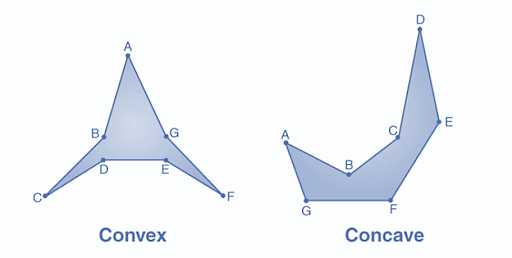
Convex and Concave Heptagons
Based on the equalness of its sides and angles, a heptagon can be regular or irregular. A heptagon is regular when all its sides and angles are equal. Each of its interior angles would equal 128.571° and each exterior angle would be 51.428°. It is irregular when its angles and sides are not equal.
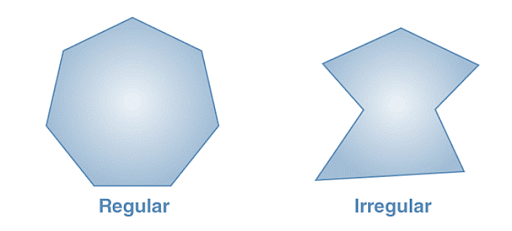
Regular and Irregular Heptagons
Things to Remember
- A polygon is a closed curve with a finite number of sides. Polygons can be triangles, quadrilaterals, pentagons, hexagons, heptagons, octagons, nonagons and decagons.
- A heptagon has 7 sides, 7 vertices and 7 interior angles.
- Based on the properties of its angles and sides, a heptagon can be regular or irregular, convex or concave.
- Area of a heptagon is \(3.634\ a^2\) sq units.
- Perimeter of a heptagon is 7a units.
Sample Questions
Ques. Classify polygons on the basis of the number of sides they have? (3 marks)
Ans. Based on the number of sides, polygons can be classified into triangles, which have 3 sides, quadrilaterals, which have 4 sides, pentagons, having 5 sides, hexagons, having 6 sides, heptagons, having 7 sides, octagons having 8 sides, nonagons having 9 sides, and decagons having 10 sides.
Ques. How many sides would a regular polygon have if each of its exterior angles measured 45°? What kind of polygon is it? (5 marks)
Ans. Given, the measure of each angle of the polygon is 45°.
Total sum of exterior angles = 360°.
Hence, the number of exterior angles present = 360/45 = 8.
Thus, this polygon has 8 sides and is an octagon.
Ques. Differentiate between convex and concave heptagons? (3 marks)
Ans. Based on the location of their diagonals, heptagons can be convex or concave. A heptagon is concave when some of its diagonals lie outside the polygon, and one of its interior angles would be more than 180°. A heptagon is convex when all its diagonals exist inside the polygon itself. None of its internal angles would be more than 180°.
Ques. Differentiate between regular and irregular heptagons? (3 marks)
Ans. Based on the properties of its sides and angles, a heptagon can be regular or irregular. A heptagon is regular when all its sides and angles are equal. Each of its interior angles would equal 128.571° and each exterior angle would be 51.428°. It is irregular when its angles and sides are not equal.
Ques. What are triangles? Elaborate on the types of triangles? (5 marks)
Ans. Triangles are polygons that have 3 sides, 3 vertices and 3 interior angles. The sum of all interior angles of a triangle is 180°. Triangles can be of 3 kinds. When all of a triangle's sides and angles are different and unequal, it is called a scalene triangle. When a triangle has two equal sides, and the third side is different in length, it is known as an isosceles triangle. Lastly, when all sides and angles within the triangle are equal, it is known as an equilateral triangle.
Ques. What is a kite? (2 marks)
Ans. A kite is a kind of quadrilateral. It has 4 sides, 4 vertices and 4 interior angles. In a kite, there are always two pairs of sides that are equal in length. A square is also a kind of kite.
Ques. Explain some properties of a polygon? (3 marks)
Ans. A polygon is a two-dimensional figure that has a finite number of vertices and sides. It is a closed curve. A polygon has no breaks or gaps, and it is a continuous figure that is closed from all ends. Polygons are further classified into triangles, quadrilaterals, pentagons, hexagons, heptagons, octagons, nonagons and decagons. This classification is based on the number of sides that they have.
Ques. Find the area of a heptagon having a side length of 7cm? (5 marks)
Ans. The side of a heptagon, a = 7 cm
We know that
The area of a heptagon, A = 3.634a2 square units
Substitute a = 7 cm in formula,
A = 3.634 (7)2
A = 3.634 (49)
A = 178.066 cm2
Therefore, the area of a heptagon having a side of 7 cm is 178.066 cm2
Ques. Find the perimeter of a heptagon having a side length of 4cm? (2 marks)
Ans. The side of a heptagon, a = 4 cm
We know that the perimeter of a heptagon, P = 7a units
P = 7(4)
P = 28 cm
Hence, the perimeter of a heptagon having a side of 4 cm is 28 cm.
Ques. Find the area and perimeter of a heptagon having a side measuring 6cm? (5 marks)
Ans. Given,
The side of a heptagon, a = 6 cm
We know that the area of a heptagon, A = 3.634a2 square units
Substitute a = 6 cm in formula,
A = 3.634
A = 3.634 (36)
A = 130.824
Therefore, the area of a heptagon having a side of 6 cm is 130.824 cm2
The perimeter of a heptagon, P = 7a units
P = 7(6)
P = 42 cm
Hence, the perimeter of a heptagon having a side of 6 cm is 42 cm.
Also read:



Comments