



Content Curator
Equilibrium can be classified into two types- Homogeneous Equilibrium and Heterogeneous Equilibrium. The reaction that takes place between the solutes belonging to the same phase is termed as Homogeneous Equilibrium or Homogeneous equilibria.
| Table of Content |
Homogeneous Equilibrium : An Introduction
[Click Here for Sample Questions]
A homogeneous equilibrium reaction can be of two types- one where the number of molecules of the product is same as the number of molecules of the reactants and another where the number of molecules of the products are not same as the number of molecules in reactants.
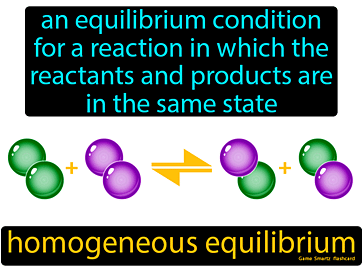
In such equilibrium all the reactants and the products are present in a similar phase, for example the gaseous reaction N2 (g) + 3H2 (g) ⇔ 2NH3 (g) is Homogeneous Equilibrium.

Examples of Homogeneous Equilibrium Reactions
[Click Here for Sample Questions]
- Reactions where the number of molecules in the products are same as the number of molecule in the reactants.
- N2 (g) + O2 (g) ⇔ 2NO (g)
Here in the above example it can be seen that the product obtained by the chemical reaction has the same number of molecules as the reactants in the equation i.e. one molecule of each nitrogen and oxygen.
- Reaction where the number of molecules in the product obtained is not the same as the molecules of the reactants.
- 2SO2 (g) + O2 (g) ⇔ 2SO3 (g)
Here in the above example it can be seen that the product obtained is not the same as the number of molecules in the reactant.
Download: Equilibrium Handwritten Notes
Law of Mass Action
[Click Here for Sample Questions]
The law of mass action states that the rate of a chemical reaction is proportional to the concentration of the reactants. Hence, if we have a reaction given below:
aA + bB → cC
According to the law of mass action, rc = k[A]a[B]b
This law will be applied further in calculation of the equilibrium constant for a homogeneous reaction, as described below:
Calculating the Equilibrium Constant
[Click Here for Sample Questions]
Let the equation be: wW + xX ⇔ yY + zZ
At equilibrium, the rate of forward reaction becomes equal to the rate of backward reaction. Hence,
k1[W]w[Z]z = k2[ Y]Y[Z]Z
The equilibrium constant in a reaction can be calculated using the following formula:
KC =[ Y]Y[Z]Z / [W]W[X]X
The above formula can be understood as; suppose W, X, Y and Z are the reactants and the product of an homogeneous reaction equation, let their coefficient be w, x, y, z.
Equilibrium constant of the above equation the product of the equation go in the numerator and the coefficients change as the exponents; therefore the equilibrium constant so obtained would be :
KC =[ Y]Y[Z]Z / [W]W[X]X
This formula could be used to calculate equilibrium constant of any other equation. An Example is given below:
Equilibrium Constant for a Homogeneous Reaction N2 (g) + 3 H2 (g) ⇔ 2NH3 (g)
In the equation above it is denoted that the gas Nitrogen reacts with gas Hydrogen to form Ammonia, now calculating equilibrium constant for the same we can write the molar concentration of the components of the given equation as –

Similarly, Kp is defined in the terms of partial pressure. It can be expressed as:
Kp = PNH3/(PN2 x P3H2)
Relation Between Kc and Kp
[Click Here for Sample Questions]
In every equation there are different concentrations and Kc and Kp represent the same thing: i.e. the equilibrium constant.
Kp represents equilibrium constant in terms of partial pressure of a reaction while Kc represents it as a whole. Let us consider an example reaction to derive the relation between these two constants.
N2 (g) + 3 H2 (g) ⇔ 2NH3 (g)
In the equation above it is denoted that the gas Nitrogen reacts with gas Hydrogen to form Ammonia, now calculating equilibrium constant for the same we can write the molar concentration of the components of the given equation as –

Similarly, Kp is defined in the terms of partial pressure of a gas instead of its concentration. It can be expressed as:
Kp = PNH3/(PN2 x P3H2)
Putting the ideal gas equation- PV= nRT in the given equation where P = Pressure of the system, V= volume of the system, n= Number of moles in the components of the system, R is the universal gas constant and T is the temperature of the system and concentration as n/V,
Kc = (PNH3/RT)2/(PN2/RT)((P3H2/(RT)3)
=Kp/(RT)2
Here,’2’ is nothing but the change in the number of moles of the overall reaction. So, this particular example can be generalized as:
Kp = Kc (RT) Δn
Where, Δn is the change in the number of moles in gaseous reactants/product.
The formula KP = KC(RT)Δn is used to figure out the relationship between the two equilibrium constants.
Points to Remember based on Homogeneous Equilibrium
[Click Here for Sample Questions]
- Equilibrium is of two types: Homogenous and Heterogenous equilibrium.
- In homogeneous equilibrium, the phase of the matter remains the same throughout the reaction
- For an equation of the form wW + xX ⇔ yY + zZ, the equilibrium constant is KC =[ Y]Y[Z]Z / [W]W[X]X
- Kp and Kc represent the same thing, i.e. equilibrium constant. The only difference is that K,p uses partial pressure as an indicator of concentration and kc uses molarity as an indicator of concentration.
- Relation between Kp and Kc is KP = KC(RT)Δn
Sample Questions based on Homogeneous Equilibrium
Question 1: What is a dynamic Equilibrium? (1 mark)
Answer: When the reaction of a particular product in closed vessel with a given reactant reacts the concentration of the same keeps on decreasing while that of the product keeps on increasing for some time and later there is no change in concentration of both the reactants and the products this phenomenon is termed as Dynamic Equilibrium.
Question 2: What is an Equilibrium Constant in an equation? (1 mark)
Answer: Equilibrium Constant of an equation can be referred to as an expression signifying the concentration of reactants and products of a chemical reaction when it reaches at the stage of equilibrium. Equilibrium Constant is represented as K or KC.
Question 3: What is the role of temperature in a homogeneous equilibrium? (1 mark)
Answer: Temperature plays a very important role in any reaction homogeneous or heterogeneous it helps in maintaining the equilibrium constant with the reactions.
Temperature and equilibrium go hand in hand, i.e. when the temperature is constant the equilibrium is also constant, when the temperature increases the equilibrium state also goes on increasing with it.
Question 4: What is an Ionic equilibrium? (1 mark)
Answer: The extent of reaction in an equilibrium depends on various experimental condition such as concentration of the reactants, temperature, optimizing the experimental condition is very important to obtain favorable product at desired equilibrium, ions play an important role in the same in an aqueous solution hence the equilibrium obtained in such a solution is termed as and Ionic Equilibrium.
Question 5: Obtain the equilibrium constant, Kp, expressions, for the reactions given below:
(a) CO(g) + H2O(g) ⇔ CO2(g) + H2(g)
(b) N2(g) + 3 H2(g) ⇔ 2 NH3(g)
(c) NH4HS(s) ⇔ NH3(g) + H2S(g) (3 marks)
Answer:


Question 6: Obtain the equilibrium constant expression (Kc) for the reactions given below:
(a)2 CO(g) + 2 NO(g) ⇔ N2(g) + 2 CO2(g)
(b) 5 O2(g) + 4 NH3(g) ⇔ 4 NO(g) + 6 H2O(g)
(c) 2 NaHCO3(s) ⇔ Na2CO3(s) + H2O(g) + CO2(g) (3 marks)
Answer: (a) 2 CO(g) + 2 NO(g) ⇔ N2(g) + 2 CO2(g)

(b) 5 O2(g) + 4 NH3(g) ⇔ 4 NO(g) + 6 H2O(g)

(c) 2 NaHCO3(s) ⇔ Na2CO3(s) + H2O(g) + CO2(g)

Question 7: Obtain the equilibrium constant expression (Kc) for the reactions given below:
(a) SO2Cl2(g) ⇔ SO2(g) + Cl2(g)
Kp = 2.9×10⁻² at 303 K
(b) 2 NO2(g) ⇔ 2 NO(g) + O2(g)
Kp = 0.275 at 700 K
(c) CO(g) + Cl2(g) ⇔ COCl2(g)
Kp = 22.5 at 395 °C (3 marks)
Answer: (a) Δn = [1 + 1] – [1] = 1
Applying the formula Kp = Kc (RT) Δn
Kp = 2.9×10⁻² at 303 K
Hence, Kc = Kp/(RT)1 = 2.9×10⁻²/(0.0821×303)1 = 1.2×10⁻³
(b)Applying the formula Kp = Kc (RT) Δn
Δn = [2 + 1] – [2] = 1
Kp = 0.275 at 700 K
Hence, Kc = Kp/(RT)1 = 0.275/(0.0821×700)1 = 4.8×10⁻³
(c)Applying the formula Kp = Kc (RT) Δn
Δn = [1] – [1 + 1] = –1
Kp = 22.5 at 395 °C = 668 K
Hence, Kc = Kp/(RT)–1 = Kp(RT)1 = 22.5(0.0821×668)1 = 1.23×10³
Question 8: Obtain the equilibrium constant expression (Kp) for the reactions given below:
(a) CO(g) + Cl2(g) ⇔ COCl2(g)
Kc = 1.2×10³ at 668 K
(b) 2 NO(g) + Br2(g) ⇔ 2 NOBr(g)
Kc = 1.32×10⁻² at 1000 K
(c) 2 COF2(g) ⇔ CO2(g) + CF4(g)
Kc = 2.00 at 1000 °C (3 marks)
Answer: In all three cases, we will directly be applying the formula : Kp = Kc (RT) Δn
(a) Δn = 1 – 2 = –1,
Hence, Kp = 1.2×10³(0.0821×668)–1 = 22
(b) Δn = 2 – 3 = –1,
Hence, Kp = 1.32×10⁻²(0.0821×1000)–1 = 1.61×10⁻⁴
(c) Δn = 2 – 2 = 0, T = 1000 + 273 = 1273 K
Hence, Kp = 2.00(0.0821×1273)0 = 2.00
Question 9: For the reaction N2(g) + O2(g) ⇔ 2 NO(g), Kc = 4.08×10⁻⁴ at 2000 K.
What is the value of Kc at 2000 K for the reaction NO(g) ⇔ ½ N2(g) + ½ O2(g)? (5 marks)
Answer: The given reaction is N2(g) + O2(g) ⇔ 2 NO(g), Kc = 4.08×10⁻⁴
First, we will reverse the reaction. If we reverse the reaction, the new Kc is equal to the inverse of the given Kc. However, the reaction obtained on reversing the Kc is also not having the right stoichiometric coefficients, as shown below:
2 NO(g) ⇔ N2(g) + O2(g) Kc = 1/4.08×10–4 = 2.45×10³
To obtain the correct stoichiometry (as given in the question), the reaction coefficients are to be divided by two. So, the new equilibrium constant will be the square root of the old equilibrium constant.
NO(g) ⇔ ½ N2(g) + ½ O2(g) Kc = (2.45×10³)½ = 49.5
Question 10: Determine Kc at 298 K for the reaction 2 CH4(g) ⇔ C2H2(g) + 3 H2(g), given the following data at 298 K.
CH4(g) + H2O(g) ⇔ CO(g) + 3 H2(g) Kp = 1.2×10⁻²⁵
2 C2H2(g) + 3 O2(g) ⇔ 4 CO(g) + 2 H2O(g) Kp = 1.1×10²
H2(g) + ½ O2(g) ⇔ H2O(g) Kp = 1.1×1040 (5 marks)
Answer: Since we do not have the Kp value of the reaction directly, we will have to calculate it by rearranging the reactions given above.
The reaction given in the question has 2 CH4(g) as one of the reactants and 1 C2H2(g) as a product. Hence, the first reaction given in the question should have double the stoichiometric coefficients and the new Kp will be the square of the old Kp. Similarly, the coefficients of the second reaction need to be halved and then the reaction reversed. The Kp will now become the inverse of the square root of the given reaction.
2 CH4(g) + 2 H2O(g) ⇔ 2 CO(g) + 6 H2(g) Kp = (1.2×10⁻²⁵)2 = 1.4×10–50
2 CO(g) + H2O(g) ⇔ C2H2(g) + 3 / 2O2(g) Kp = 1/(1.1×102)½ = 9.5×10⁻²
Adding the above two reactions eliminates CO(g). Kp for this reaction is calculated by multiplying the two equilibrium constants.
2 CH4(g) + 3 H2O(g) ⇔ C2H2(g) + 6 H2(g) + 3 / 2O2(g) Kp = (1.4×10–50)( 9.5×10⁻²) = 1.3×10–51
Even this is not the desired reaction. To reach the desired reaction, the reaction given above must have its stoichiometric coefficients multiplied by three. Hence, equilibrium constant must be cubed.
3 H2(g) + 3 / 2O2(g) ⇔ 3 H2O(g) Kp = (1.1×1040)3 = 1.3×10120
Now, adding the last two reactions gives us the desired reaction. Kp for this new reaction is found by multiplying equilibrium constants.
2 CH4(g) ⇔ C2H2(g) + 3 H2(g) Kp = (1.3×10–51)( 1.3×10120) = 1.7×1069
Finally, to find Kc for the final reaction, Δn = [1 + 3] – [2] = 2
Hence Kc = Kp/(RT)Δn = (1.7×1069)/(0.0821×298)2 = 2.8×1066



Comments