



Content Curator
Inelastic collision is a type of collision in which the momentum is conserved but kinetic energy does not remain conserved as a bit of it is lost in the collision of two bodies. The loss of the kinetic energy is in the form of some other type of energy such as thermal energy or sound energy. For example, the car crashing against the tree and the car stops completely. There are two types of inelastic collision which are named as perfectly inelastic collision and partially inelastic collision.
Also Read: Inelastic collision
| Table of Content |
Key Terms: Perfectly inelastic collision, elastic and inelastic collision, inelastic collision examples, inelastic collision formula, Mass, Initial Velocity
Types of Inelastic Collision
[Click Here for Sample Questions]
There are mainly two types of inelastic collision:
Perfectly Inelastic Collision
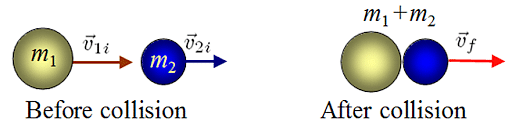
When two bodies collide and one sticks to the other completely, then the collision is called a perfectly inelastic collision. In this, the maximum amount of kinetic energy is lost due to the energy loss in bonding of two bodies.

Momentum Transfer
Partially Inelastic Collision
Partially inelastic collisions are the most common form of collisions in the real world. In this type of collision, the objects involved in the collisions do not stick, but some kinetic energy is still lost. Friction, sound and heat are some ways the kinetic energy can be lost through partial inelastic collisions.
Also Read: Elastic collision
Formula of Inelastic Collision
[Click Here for Sample Questions]
Let us consider two bodies A and B with masses m1 and m2 respectively. Suppose that initially A moves with the velocity u1 and B is moving with the velocity u2.
So, the perfectly inelastic collision happens between both bodies and they stick together and move with the velocity v.
Law of conservation of momentum states that for a collision occurring between object A and object B in an isolated system, the total momentum of the two objects before the collision is equal to the total momentum of the two objects after the collision.
So, by the law of conservation of momentum
Momentum of object A + Momentum of object B = Momentum of the collided body
Here, momentum of object A = m1 × u1
momentum of object B = m2 × u2
momentum of collided body = (m1 + m1) × v
Putting the value gives,
m1 u1 + m2 u2 = (m1 + m2) v
v = m1U1+m2U2m1+m2
This formula is used to calculate the final velocity of the objects after the collision in one dimension if the collision is a perfectly inelastic collision.
Things to Remember
- In all types of collision, momentum remains conserved.
- In a perfectly inelastic collision, the two collided bodies stick together and move with the same velocity v.
v = m1U1+m2U2m1+m2
- Coefficient of restitution generally lies between 0 and 1.
- Coefficient of restitution is 0 for the perfectly inelastic collision.
- Most collisions in nature are inelastic collisions.
- Elastic and inelastic collision differs because of conservation of kinetic energy.
Also Read: Elastic and Inelastic collision
Sample Questions
Question 1: What is the difference between elastic and inelastic collision? (2 Marks)
Answer: Kinetic energy is the physical quality which differentiate the types of collision. In elastic collision, the kinetic energy remains conserved along with the momentum but there is some energy loss in the inelastic collision. This loss is in some form of energy such as thermal or sound energy.
Question 2: What is an elastic collision? (3 Marks)
(b)An elastic collision is one in which the objects after impact lose some of their internal kinetic energy.
(c)An elastic collision is one in which the objects after impact do not lose any of their internal kinetic energy.
(d)An elastic collision is one in which the objects after impact become stuck together and move with a common velocity.
Answer: (c)
Explanation: An elastic collision is an encounter between two bodies in which the total kinetic energy of the two bodies remains the same. In an ideal, perfectly elastic collision, there is no net conversion of kinetic energy into other forms such as heat, noise, or potential energy.
Question 3: What is coefficient of restitution for an inelastic collision? (2 Marks)
Answer: The coefficient of restitution (COR, also denoted by e), is the ratio of the final to initial relative speed between two objects after they collide. It normally ranges from 0 to 1 where 1 would be a perfectly elastic collision. A perfectly inelastic collision has a coefficient of 0, but a 0 value does not have to be perfectly inelastic.
Question 4: What is the equation for conservation of momentum for two objects in a one-dimensional collision? (3 Marks)
p1 + p1′ = p2 + p2′
p1 + p2 = p1′ + p2′
p1 − p2 = p1′ − p2′
p1 + p2 + p1′ + p2′ = 0
where p1 and p1′ is the initial and final momentum of object A and p2 and p2′ is the initial and final momentum of object B.
Answer: (b)
Explanation: Law of conservation of momentum states that for a collision occurring between object A and object B in an isolated system, the total momentum of the two objects before the collision is equal to the total momentum of the two objects after the collision.
Initial Momentum of object A + Initial Momentum of object B = Final Momentum of the object A + Final Momentum of object B.
So, p1 + p2 = p1′ + p2′
Question 5: Give an example of a perfectly inelastic collision? (2 Marks)
Answer: In a perfectly inelastic collision, the collided bodies stick together. The example of the perfectly inelastic collision is when a ball made of clay is dropped on the ground from some height. It does not bounce back but sticks to the floor. The loss of kinetic energy is in the form of the deformation of the ball shape.
Question 6: Why is energy loss in an inelastic collision? (2 Marks)
Answer: The most energy in an inelastic collision is lost if the two colliding objects stick together and act as one object with a mass that is the sum of the two masses. Such a collision deforms the objects, which causes the loss in kinetic energy and an equal increase in heat or sound.
Question 7: Two football players collide head-on in mid air while trying to catch a thrown football. The first player is 95 kg and has an initial velocity of 6.00 m/s, while the second player is 115 kg and has an initial velocity of 3.50 m/s. What is their velocity just after impact if they cling together? (3 Marks)
Answer: We know that, v = m1U1+m2U2m1+m2
Here, m1 = 95 kg, m2 = 115 kg
And u1= 6.00 m/s, u2 = 3.50 m/s
So, putting value in the equation
v = 95 ×6+115 × 3.5095+115 m/s
v = 570 + 402.50210 m/s
v = 972.5210 m/s
v = 4.63 m/s
Hence, the velocity just after the impact if they cling together is 4.63 m/s.
Question 8: What is the speed of a garbage truck that is 1.20 × 10⁴ kg and is initially moving at 25.0 m/s just after it hits and adheres to a trash can that is 80.0 kg and is initially at rest? (3 Marks)
Answer: Let us consider garbage truck as object A and trash can as object B.
So, m1 = 1.20 × 10⁴ kg, m2 = 80 kg
And u1= 25.00 m/s, u2 = 0 m/s (as trash can is at rest so u2 = 0 m/s)
We know that, v = m1U1+m2U2m1+m2
Putting the value in equation,
v = 12000 × 25+80 × 012000+80 m/s
v = 30000012080 m/s
v = 24.83 m/s
Hence, the speed of the truck after colliding with the trash can is 24.83 m/s.
Question 9: How change of kinetic energy is calculated in a perfectly inelastic collision? (2 Marks)
Answer: Two objects A and B with masses m1 and m2 respectively moving with the velocity of u1 and u2. The initial kinetic energy of the objects is:
KE1 = 12 m1 u12 + 12 m2 u22
After they collide, the kinetic energy is
KE2 = 12 (m1 + m2) v2
Where v is the final velocity when they stick together.
So, the change in kinetic energy KE is
KE = KE1 – KE2
KE = 12 m1 u12 + 12 m2 u22 - 12 (m1 + m2) v2
Question 10: During an ice show, a 60 kg skater leaps into the air and is caught by an initially stationary 75 kg skater. What is their final velocity assuming negligible friction and that the 60 kg skater’s original horizontal velocity is 4.00 m/s? Also, calculate the change in kinetic energy? (3 Marks)
Answer: We know that, v = m1U1+m2U2m1+m2
Here, m1 = 60 kg, m2 = 75 kg
And u1= 4.00 m/s, u2 = 0 m/s
So, putting value in the equation
v = 60 ×4+75 × 060+75 m/s
v = 240135 m/s
v = 1.78 m/s
Hence, the final velocity is 1.78 m/s.
Also, the initial kinetic energy is
KE1 = 12 m1 u12 + 12 m2 u22
KE1 = 12( 60 )× 42 + 12(75) × 02
KE1 = 12 (60) × 16 + 0
KE1 = 480 J
The final kinetic energy is
KE2 = 12 (m1 + m2) v2
KE2 = 12 (60 + 75) 1.782
KE2 = 12 (135) 3.1684
KE2 = 213.867 J
Hence, change in kinetic energy is
KE = KE1 – KE2
KE = 480 – 213.867 J
KE = 266.133 J
Also Read:



Comments