



Content Curator
Elastic Collision occurs when there is no loss of kinetic energy from the objects after the collision. Collision occurs when two or more bodies come in contact with each other simultaneously. In collision, at least two objects exhibit some force on each other in a short time, which leads to displacement.
| Table of Content |
Key Terms: Inelastic collisions, Elastic and inelastic collision, Elastic collision in one dimension, Elastic momentum
What is Elastic Collision?
[Click Here for Sample Questions]
An object that inherits the potential energy is considered a Stationary object. Whereas, the same object transformed the potential energy into kinetic energy when moving. The momentum exhibited by the body when changed into kinetic energy is known as momentum that is equal to the product of mass and velocity.
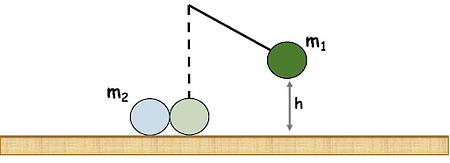
Elastic Collision
Elastic collision deals with the momentum and kinetic energy which a body exerts even after the collision. In the case of Elastic collision, the kinetic energy before the collision and after the collision remains the same. It didn’t change to any other form of energy.
| Frequently Asked Questions Ques. How does an elastic collision happen? (1 Mark) Ans. Elastic collisions take place when two objects collide and kinetic energy is retained. Objects rebound from each other and kinetic energy and momentum are also protected. Ques. Is mass conserved in an elastic collision? (1 Mark) Ans. Elastic collision covers momentum, mass, and energy. Ques. Are elastic collisions open or closed? (1 Mark) Ans. Momentum is conserved in all collisions in a closed system. Kinetic energy gets conserved in some collisions in a closed system. Elastic collision occurs when both momentum and kinetic energy are conserved. |
Examples of Elastic Collisions
[Click Here for Sample Questions]
Some of the examples of Elastic Collision are:
- When a ball is thrown on the floor, it bounces back. It is because the ball in motion preserves its overall momentum and kinetic energy.
- A simple example of elastic collision is the striking of balls when striking with a stick while playing pool or snooker.
- Two atoms when colliding with each other exert an elastic collision, but it is considered an elastic collision when there is no loss of energy.
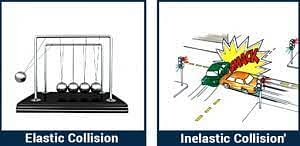
Examples of Elastic Collisions
Check out:
| Concepts Related to Elastic Collisions | ||
|---|---|---|
| Inelastic Collision Formula | Elastic and Inelastic Collisions | Inertia |
| Pulley | Scalar and Vector Quantities | Principle of Conservation of Energy |
Elastic Collision Formula
[Click Here for Sample Questions]
The formula of elastic collision is given below –
m1u1 + m2u2 = m1v1 + m2v2
Where-
- M1 – Mass of the first body
- M2 – Mass of the second body
- U1 – Initial Velocity of the first body
- U2 – Initial Velocity of the second body
- V1 – Final Velocity of the first body
- V2 – Final Velocity of the second body
The Formula of Elastic collision by kinetic energy is given below –
1/2 m1u12 + 1/2 m2u22 = 1/2 m1v12 + 1/2 m2v22
| Solved Example Example: A 10 kg mass traveling 2 m/s meets and collides elastically with a 2 kg mass traveling 4 m/s in the opposite direction. Find the final velocities of both objects. Solution: Velocity is a vector quantity and we need to distinguish the direction of the velocity vectors. Now, choose from left to right as the “positive” direction. Any velocity moving from right to left will then contain a negative value. Next, identify the known variables. We know that:
The negative sign is because the velocity is in the negative direction. Now we need to find VAf and VBf. Using the equations from above: \(V_{Af} = \frac{m_A - m_B}{m_A + m_B} V_{Af} + \frac{2m_B}{m_A + m_B} V_{Bf}\) For VAf –
VAf = 0 m/s The final velocity of the larger mass is zero. The collision completely stopped this mass. Now for VBf
|


Inelastic Collision
[Click Here for Sample Questions]
Inelastic Collision is the type of collision that occurs when both the collided bodies lose kinetic energy and Momentum. Similarly, the bodies when collided previously having kinetic energy and momentum lose, Inelastic Collision occurs.
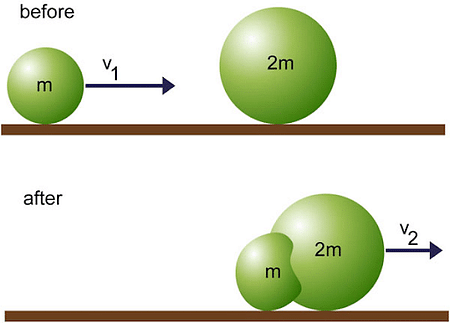
Inelastic Collision
Some examples of Inelastic collisions are as follows –
- When the clay ball is thrown at the wall, it doesn't bounce back because the clay ball lost the kinetic energy and momentum, which it exhibited previously.
- In the accident when two vehicles collide, they stop moving because the Inelastic Collision occurs.
Difference Between Elastic and Inelastic Collision
Difference Between Elastic and Inelastic Collision is elaborated below:
| Elastic Collision | Inelastic Collision |
|---|---|
| The total kinetic energy remains the same before and after the collision. | The total Kinetic energy gets altered before and after the collision. |
| Momentum remains constant. | Momentum gets changed. |
| The energy doesn’t convert to any form after the collision. | The energy gets converted to other forms after the collision. |
| Very little probability to occur in reality because there exists the change of energy at all times. | High chances of occurrence because there is a change of energy in most of the scenarios. |
Applications of Elastic Collision
[Click Here for Sample Questions]
Some of the applications of the elastic collision are given below-
- The time involved in the collision affects the amount of force that is experienced by the body during the collision. In other words, the higher the time involved in the collision, the lower the force acting on the body. So, to maximize the force, the time involved in the collision must be decreased.
- However, to minimize the force, the time involved in the collision must be increased. There are many examples of doing so. One of them is – The airbags present in the cars increase the time involved in the collision and minimize the effect of force on the object. The phenomenon behind this process is that the airbags minimize the force and increase the collision time for the object.
- An elastic collision can be considered in many places or scenarios, but inelastic collision is realistic and occurs in most cases.
Also read:
Things to Remember based on Elastic Collision
- Collision occurs when two or more bodies come in contact with each other simultaneously.
- Elastic Collision occurs when there is no loss of kinetic energy from the objects after the collision.
- A simple example of elastic collision is the striking of balls when striking with the stick while playing pool or snooker.
- The formula of elastic collision is – m1u1 + m2u2 = m1v1 + m2v2
- Inelastic Collision is the type of collision that occurs when both the collided bodies lose kinetic energy and Momentum.
Sample Questions based on Elastic Collision
Ques. When two bodies collide if the momentum is conserved then which collision is considered? (1 Mark)
Ans. If the momentum is conserved in the collision, then it is considered as the Elastic collision.
Ques. What is meant by the final and initial velocity mentioned in the formula of the elastic collision? (1 Mark)
Ans. The initial velocity of an object is the initial velocity it inherits before the collision whereas the final velocity of an object is the velocity it inherits after the collision takes place.
Ques. Three bodies form an isolated system. There are m1 = m2 = 2m and m3 = 3m. They have different directions, but all have the same initial speed V0. One or more elastic collisions between the pairs of the bodies where otherwise do not intersect. From the given data, find the possible maximum final speed of each of the three bodies. (2 Marks)
Ans. Total initial kinetic energy = (1/2)m1V02 + (1/2)m2V02 + (1/2)m3V02
Maximum speed will be considered if another particle's speeds are zero. So,
(1/2)m1(V1max)2 = 3mV02
Substituting the values for all m1, m2, m3 we get,
V1max = 2.45V0
V2max = 1.73V0
V3max = 1.41V0
Ques.An object having mass m moving with the velocity v collides head on another body of mass double than its mass at the rest position initially. The Kinetic energy ratio of the colliding body before and after the collision will be ______? (1 Mark)
Ans. 9:1
Ques. From the given options find the angle that is made with the horizontal – (2 Marks)
a)- tan-1(etanx)
b)- cot-1(etanx)
c)- tan-1(esinx)
d)- tan-1(ecosx)
Ans. From the given equation 1 and equation 2, we can say that;
Tanxf = evsinx/vcosx = etanx or in other words;
ð x = tan-1(etanx)
Hence, it can be concluded that option “a” is the correct answer.
Previous Year Questions
- Find the torque about the origin when a force of… [NEET 2020]
- A vertical spring with force constant k is fixed on a table… [NEET 2007]
- How much water a pump of 2 kW can raise in one minute to a height of… [NEET 1990]
- A ball is dropped from a height of 5 m on a planet where the acceleration… [NEET 1998]
- A shell, in flight, explodes into four unequal parts… [NEET 1998]
- Two bodies of masses m and 4m are moving with equal kinetic energies… [NEET 1998]
- A force F acting on an object varies with distance x as shown in the figure… [NEET 2005]
- Water falls from a height of 60 m at the rate of 15 kg/s to operate a turbine… [NEET 2008]
- A particle of mass M, starting from rest, undergoes uniform acceleration… [NEET 2010]
- A ball moving with velocity 2m/s collides head on with another stationary ball… [NEET 2010]
- Two masses of 1 g and 9 g are moving with equal kinetic energies… [NEET 1993]
- A batsman hits back a ball straight in the direction of the bowler without… [NEET 1989]
- A bullet of mass 10 g leaves a rifle at an initial velocity of 1000 m/s and strikes… [NEET 1989]
- On a frictionless surface, a block of mass M moving at speed v collides… [NEET 2015]
- Two particles of masses m1, m2 move with initial velocities u1 and u2… [NEET 2015]
- A moving body of mass mm and velocity 3km/hr. Collides with a body at rest… [NEET 1996]
- A particle moves from a point… [NEET 2016]
- The potential energy of a particle in a force field is… [NEET 2012]
- Two spheres A and B of masses m1 and m2 respectively collide… [NEET 2012]
- A ball is dropped from a height of 5 m on a planet where the acceleration due to… [NEET 1998]
Also check:



Comments