



Education Journalist | Study Abroad Lead
Radiation refers to the energy traveling through space to reach the Earth. Our most abundant source of radiation is the Sun. Radiations are found in the form of subatomic particles with high energy and they travel in the form of electromagnetic Waves. In this article, we will have a look at various types of radiation: ionizing and non-ionizing, and some related sample questions.
| Table of Content |
Keyterms: Radiation, Energy, Earth, Sun, Electromagnetic waves, Light, Heat, Emission
What is Radiation?
[Click Here for Sample Questions]
The energy or particles from a source that travels from space (or other media) to the earth is called radiation. It travels through a medium after its emission from a source and is absorbed by matter.
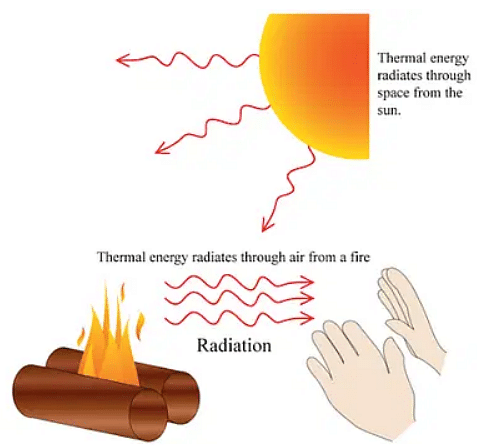
Radiation
Light, heat, wireless communications are all different forms of radiation. Sun is the richest source of radiation. However, the ultraviolet radiations from the sun are hazardous as they can lead to skin cancer and other skin-related diseases in case of overexposure to them.
Higher energy radiations are used in medical treatments like in the treatment of different types of cancer. The radiations travel in the form of electromagnetic waves and are found as highly energetic subatomic particles. The various forms of radiation are as follows:
- Particle Radiation- This includes the alpha (α), beta (β), and neutron radiations.
- Gravitational Radiation- This includes the radiation that takes the form of gravitational waves or as ripples in the curvature of space-time.
- Acoustic Radiation- This includes ultrasound, seismic and sound waves.
- Electromagnetic Radiation- This is inclusive of radio waves, gamma radiation (γ), x-rays, and visible light.
Also Read:
| Related Articles | ||
|---|---|---|
| Electromagnetic Radiation | Displacement Current | Electromagnetic Spectrum |
Types of Radiation
[Click Here for Sample Questions]
The types of radiation on the basis of energy of the radiated particles are:
Ionizing Radiation
- The ionizing radiations carry a charge that is more than 10 eV, which is enough to remove the electrons that are tightly bound from the outer orbit of an atom, thus resulting in the ionizing or charging of atoms and molecules and thus break the chemical bonds.
- It contains alpha, beta, and gamma particles.
- Radiations with higher frequency and shorter wavelengths have more energy than those with a lower frequency and larger wavelengths.
- X Ray and gamma rays that are present in the portion of higher frequency of the electromagnetic spectrum are ionizing.
- They are usually harmful to the human body as these radiations can damage the DNA and also cause the denaturation of proteins.
Non-Ionizing Radiation
- This consists of microwave radiation, radio waves, black body radiation, thermal radiation, UV rays, and infrared radiation.
- They do not cause ionization or charging of atoms.
- These radiations usually produce heat which can sometimes cause severe burns.
- Some non-ionizing radiations are visible to the naked human eye like infrared radiation and visible light.
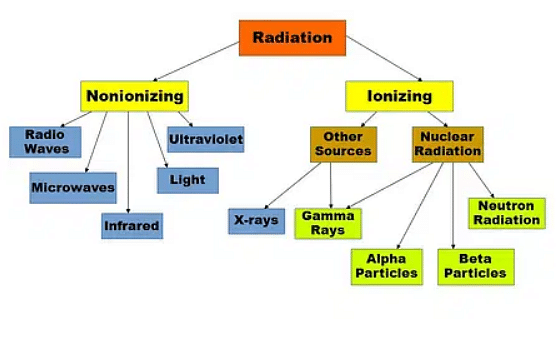
Types of Radiation
Ionizing Radiation
[Click Here for Sample Questions]
Nuclear Radiation
The energy that is released by the elementary particles of the atomic nucleus by the process of release of nuclear energy is called nuclear radiation.
Nuclear radiation can cause consequences for nature and human life significantly. Nonetheless, it can be both useful and harmful depending on its use.
Types of nuclear radiation
There are three types of nuclear radiation emitted from the radioactive atoms-
- Alpha radiation
- Beta radiation
- Gamma radiation
Alpha Radiation
- The alpha particles have 2 neutrons and 2 protons.
- They are the heaviest type of radiation particles.
- Alpha radiation is short-ranged.
- It is really an ejected helium nucleus. Alpha radiation is another name for alpha particles that are emitted in the type of radioactive decay known as alpha decay.

Alpha Radiation
Beta Radiation
- A beta particle is a particle that is not attached to an atom. It is of two types: beta-minus (β−) and beta-plus (β+).
- The beta particle has a small mass and high energy.
- β−radiation contains an energetic electron. It is more penetrating than alpha radiation but not more than gamma radiation.
- β+ radiation is the emission of positrons, antimatter of electrons.

Beta Radiation
Gamma Radiation
- The gamma rays or gamma radiation are emitted from the nucleus during a radioactive decay that occurs to get rid of an unstable nucleus of excess energy after most nuclear reactions.
- They are a packet of energetic photons with a wavelength less than 3×10⁻¹¹ meters.
- They do not have any charge.
- They are generally seen when uranium atoms split, or fission, in a nuclear reactor.

Gamma Radiation
X-Ray Radiation
- X-rays are a form of electromagnetic energy or radiation that is powerful in nature.
- Their wavelength generally ranges from 0.01 to 10 nanometers, with their frequencies ranging from 30 petahertz to 30 exahertz.
- They have their energy in the range of 100 eV to 100 keV.

X-Ray Radiation
Non-Ionizing Radiation
[Click Here for Sample Questions]
The non-ionizing radiations do not cause ionization or charging up of atoms. Some of the non-ionizing radiations are given below:
- UV rays
- Visible light
- Radio waves
- Microwaves
- Infrared radiation

Non-Ionizing Radiation
Radio Waves
- Radio Waves are produced as the result of the accelerated charge motion in conducting wires.
- These radiations are used in radio communication and television systems.
- Mobile phones also use radio waves to transmit voice communication in the ultrahigh-frequency (UHF) band.
- They have wavelengths that are longer than the infrared waves.
- The radio waves are also used for maritime and aircraft navigation.

Radio Waves
Microwaves
- They are short-wavelength radio waves with frequencies in the gigahertz (GHz) range, produced by special vacuum tubes (called klystrons, magnetrons, and Gunn diodes).
- They are suitable for use in radar systems for aircraft navigation because of their shorter wavelengths.
- Microwaves are also used in microwave ovens in the domestic set up to warm up food that contains water. The frequency of water molecules in these microwaves is selected to match the resonant frequency of water molecules so that the energy from the waves is efficiently transferred to the kinetic energy of the molecules.

Microwaves
UV Rays
- Sun is the most abundant source of UV rays. Extremely hot bodies produce these types of rays.
- UV rays/light in huge quantities are harmful to the human body leading to skin cancer.
- UV rays cause tanning on the skin as it increases the production of melanin.
- UV light is absorbed by ordinary glass.
- They have short wavelengths, therefore; the UV radiations can be focused into very narrow beams for high precision applications like LASIK (Laser-assisted in situ keratomileuses) eye surgery.
- In water purifiers, UV lamps are used for killing germs.

UV Rays
Infrared Waves
- Hot molecules or bodies produce infrared waves.
- They are sometimes called heat waves. It is because water molecules present in most materials absorb infrared waves readily. After this absorption, the thermal motion enhances that is, they heat their surroundings.
- Infrared waves are significant in maintaining the earth’s warmth or average temperature through the greenhouse effect.
- The incoming visible light gets absorbed by the earth’s surface and is radiated as infrared (longer wavelength) radiations. These radiations are then trapped by the greenhouse gases like carbon dioxide and water vapor.

Infrared Waves
Visible Rays
- They are the most familiar form of electromagnetic waves.
- They are detected by the naked human eye.
- Visible light reflected or emitted by the objects surrounding us provides us the information about the world.
- These types of rays are visible to us as our eyes are sensitive to this range.

Visible Rays
Also Read:
Things to Remember
- The energy or particles from a source that travels from space (or other media) to the earth is called radiation.
- The two main broad categories of radiation are ionizing and non-ionizing radiation.
- The ionizing radiations carry a charge that is more than 10 eV, which is enough to remove the electrons that are tightly bound from the outer orbit of an atom.
- The non-ionizing radiations do not cause ionization or charging up of atoms.
- As humans evolved with visions, their eyes became the most sensitive to the radiations of the strongest wavelength from the sun. Hence, the sensitivity center of human eyes coincides with the center of the distribution of wavelength of the sun.
- The various types of electromagnetic waves vary from each other on the basis of their frequencies and wavelengths.
- Gamma rays are used in the medical field to treat cancer as they destroy the cancer cells.
- The X- rays lie beyond the electromagnetic spectrum. They are used as a treatment for certain forms of cancer and also as a diagnostic tool in the medical field. They can also cause damage or destroy the living tissues and organisms thus, should not be overly exposed to.
Sample Questions
Ques. Which radiation travels with the speed of light? (1 mark)
Ans. Gamma radiation travels with the speed of light. This is because; it is more penetrating than the alpha and beta radiations. It can easily pass through body tissue.
Ques. What is radiation? How are they classified? (2 marks)
Ans. Radiation refers to the energy traveling through space to reach the Earth. Our most abundant source of radiation is the Sun. They are broadly classified as:
- Ionizing Radiation
- Non-Ionizing Radiation
Ques. Why do the alpha, beta, and gamma radiations come out of a radioactive substance spontaneously? (2 marks)
Ans. This is because the alpha and beta radiations contain matter and the gamma rays are bursts of energy. The type of radiation that is emitted depends on the type of radioactive substance. An alpha particle has 2 protons and 2 neutrons that are bound together while the beta particles are the high-energy electrons. Gamma rays are waves of electromagnetic energy or photons.
Ques. Why are infrared waves called heatwaves? (2 marks)
Ans. Infrared waves vibrate not only the electrons but entire atoms or molecules of a substance due to their frequencies being lower than those of visible light. This vibration increases the internal energy and as a result, the temperature of the substance. Hence, infrared waves are often known as heatwaves.
Ques. What are UV rays? (2 marks)
Ans. Sun is the most abundant source of UV rays. Extremely hot bodies produce these types of rays. UV rays in huge quantities are harmful to the human body leading to skin cancer. They cause tanning on the skin as it increases the production of melanin. They are absorbed by ordinary glass.
Ques. Write a short note on nuclear radiation. (3 marks)
Ans. The energy that is released by the elementary particles of the atomic nucleus by the process of release of nuclear energy is called nuclear radiation. It can be both useful and harmful depending on its use.
There are three types of nuclear radiation emitted from the radioactive atoms-
- Alpha radiation
- Beta radiation
- Gamma radiation
Ques. Differentiate between ionizing and non-ionizing radiations. (5 marks)
Ans. Ionizing Radiation
- The ionizing radiations carry a charge that is more than 10 eV, which is enough to remove the electrons that are tightly bound from the outer orbit of an atom, thus resulting in the ionizing or charging of atoms and molecules and thus break the chemical bonds.
- It contains alpha, beta, and gamma particles.
- Eg- X rays and gamma rays.
Non-Ionizing Radiation
- This consists of microwave radiation, radio waves, black body radiation, thermal radiation, UV rays, and infrared radiation.
- They do not cause ionization or charging of atoms.
- These radiations usually produce heat which can sometimes cause severe burns.
For Latest Updates on Upcoming Board Exams, Click Here: https://t.me/class_10_12_board_updates
Check-Out:



Comments