



Content Curator
Invertebrates are those organisms that lack backbone.vertebra in their bodies. Over 90% of animal species are invertebrates. Invertebrates play a significant role in the ecosystem.
Some invertebrates help in cleaning the unneeded bacteria and fungi from the environment and turning them into fertilizers to nutrify the soil. Also, invertebrates help to grow crops through pollination and maintain their quality.
| Table of Content 2.Characteristics of Invertebrates |
What are Invertebrates?
The term ‘Vertebrate’ is acquired from the Latin word "vertebra" which basically means a joint. In contrast to this, an invertebrate refers to animals without joints because the prefix "in" in invertebrate means "not" or "without".
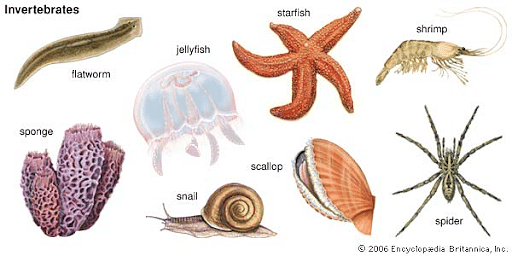
In simple words, "invertebrates'' are creatures which lack a spinal column in their body. These animals basically don't have a backbone and never in their lifetime does it evolve.This is the major difference between vertebrates and invertebrates. They are soft-bodied animals from inside but have a tough and rigid outer skeleton for protecting themselves.
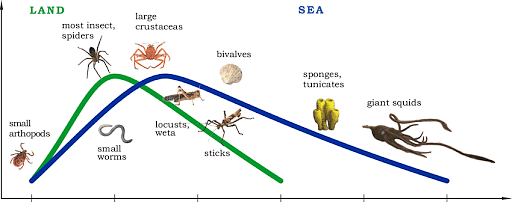
About 98% of the animal species or genera are invertebrates. They include sea stars, sea urchins, insects, crabs, spiders, snails, squid, jellyfish, sponges, octopus and many more. Invertebrates are ectothermic (cold-blooded) animals i.e., their body temperature keeps on changing with any change in the environment and therefore they can survive both on land and in water.
Also, invertebrates are the unrecognized heroes of the ecosystem as they provide numerous services such as pollination, decomposition, nutrient release and many more which are crucial for the survival of nature and human beings. Invertebrates are of different sizes which vary from 50um rotifers to 56 ft colossal squid.
Characteristics of Invertebrates
Invertebrates exhibit a number of characteristics unique to them:
Symmetry
All invertebrates have some sort of symmetry that can be radial, bilateral, biradial, spherical or even asymmetrical. Microscopic invertebrates and Macroinvertebrates are mostly bilateral, radial and biradial. But some invertebrates can be asymmetrical (having no symmetry) too, such as phylum Porifera (sponges), gastropods (sea snails, snails). Asymmetry can also be seen in fiddler and hermit crabs.

Size
All invertebrates are of different sizes ranging from microscopic Nematodes to 50 ft Platyhelminthes.
Shape
Invertebrates vary from shape to shape. Some invertebrates are plant-like such as Porifera and Cnidaria; some are vermiform such as Nematodes and Annelids; some are star-like such as starfish and some are leaf and ribbon-like such as flatworms.
Reproduction
Most of the invertebrates partly reproduce by sexual reproduction like vertebrates. Some of them reproduce through asexual mode and some reproduce through both the modes.
Classification of Invertebrates
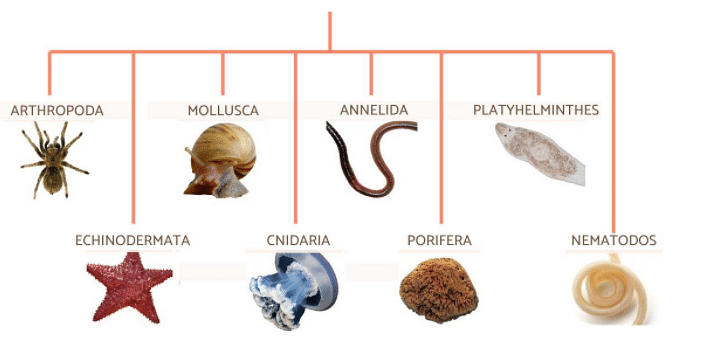
Invertebrates are classified and divided into 2 main categories— Microscopic invertebrates and Macroinvertebrates, having 9 phyla which are provided in the table given below with examples:
Microscopic Invertebrates
| Phylum | Examples |
| Nematoda | Threadworm, Whipworm, Eelworm |
Phylum Nematoda
Also called roundworms, Nematodes have bilaterally symmetrical, cylindrical and unsegmented bodies. They are mostly found in water bodies and soil. These organisms are mostly microscopic but some species can be up to 2 inches. Though having a minute size, they are capable of causing diseases like, filariasis, trichinosis.

Macroinvertebrates
| Phylum | Examples |
| Porifera | Sponges |
| Ctenophora | Comb jellies |
| Cnidaria | Sea anemones, Hydra, Jellyfish |
| Echinodermata | Starfish, Sea urchins, Sea cucumbers |
| Platyhelminthes | Flatworms, Tapeworms, Turbellaria |
| Annelida | Earthworms, Ragworms, Leeches |
| Arthropoda | Insects, Crabs, Centipedes |
| Mollusca | Octopus, Squid, Snails |
Phylum Porifera
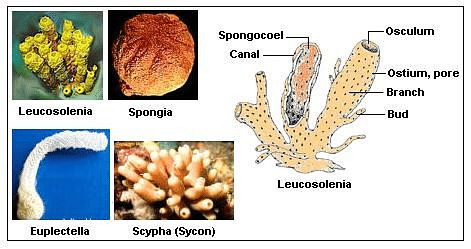
As the name "Porifera" suggests, these are multicellular organisms that have ostia (pores) all over their body. They are spongy in appearance and hence called sponges. They do not move as they are attached to the substratum. They can absorb and retain fluids. Initially, they were considered as plants because of their green colour but after observing their feeding habits and life cycle, they are referred to as animals. They are a few centimetres in size but can be as tall as 6.6 ft.
Phylum Ctenophora
Also called comb jellies or sea walnuts, ctenophores have jelly-like, transparent and biradially symmetrical bodies having comb-like ciliary plates for movement. They are mostly seen in shallow water bodies. They lack organs such as respiratory, circulatory, skeletal and excretory. Their size ranges from 0.04 inches to 5 ft.

Phylum Cnidaria
Also called coelenterata, Cnidarians have two cell layered, radially symmetrical bodies. Their size ranges from Hydra (less than a half mm) to the Lion's mane jellyfish (20 mm) which is the largest Cnidarian.

Phylum Echinodermata
These are colourful, unsegmented, multicellular marine organisms found in deep seas having calcium carbonate skeleton and ability to regenerate. Their size ranges up to 6.6 ft.

Phylum Platyhelminthes
These are bilaterally symmetrical organisms having an unsegmented body except in Cestoda class. They do not have endo and exoskeleton and therefore have a soft body. They have a complicated reproductive system. They have feeding habits of carnivores or scavengers. Trematodes' size are generally between 0.04 to 0.4 inches but few species have sizes even greater than 50 ft.

Phylum Annelida
These organisms have bilaterally symmetrical, segmented bodies which vary in size (below 1mm to 3m). They have a good digestive and circulatory system. Their blood contains haemoglobin which makes it red coloured.

Phylum Arthropoda
This phylum is the largest one in which organisms have bilaterally symmetrical bodies. Their body is divided into three parts namely, head, thorax & abdomen. They have a good digestive system and an open circulatory system. Their size ranges from 1mm to 4m.

Phylum Mollusca
These are amphibians having a bilaterally symmetrical body protected by a shell. Their body is divided into three parts namely, head, a visceral mass, ventral foot. Their size can vary from 1mm to 20m with few microscopic organisms too.

Things to Remember
- About 98% of the whole animal species are invertebrates.
- As mentioned earlier, invertebrates have a soft body as they do not possess a spinal column but octopus is the only invertebrate which has a hard body part, its hooked beak.
- Invertebrates are ectotherms— cold-blooded organisms. Most of them live most of their lives in water and if outside, they absorb heat from their surroundings.
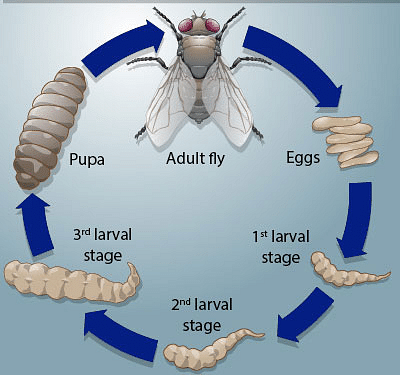
- Most invertebrates go through a process called metamorphosis i.e., their body changes their form as they develop.
Sample Questions
Ques. What are the major differences between vertebrates and invertebrates? (5 marks)
Ans. The major differences between invertebrates and vertebrates are:
- Vertebrates have a vertebral column whereas invertebrates do not.
- Vertebrates do not have an exoskeleton whereas invertebrates do.
- The former are generally bigger in size than the latter.
- Vertebrates have a closed circulatory system unlike invertebrates.
- Vertebrates have bilateral, radial, biradial and a few have asymmetrical bodies but invertebrates have asymmetrical bodies only.
Ques. Are invertebrates heterotrophic? (2 marks)
Ans. Yes, invertebrates are heterotrophic as they cannot make food on their own and need other plants and animals to feed upon.
Ques. How are invertebrates able to survive without bones? (3 marks)
Ans. Invertebrates are able to survive without bones because of their exoskeleton (outer body) which is made of shell, chitin etc. Their outer body provides protection to them against various dangers.
Ques. How can invertebrates be identified? (2 marks)
Ans. Invertebrates have a soft body with no bones. Most of them have 6-8 legs or not even a single one.
Ques. How are invertebrates helpful for our ecosystem? (1 mark)
Ans. Invertebrates are an important part of the food chain, they fulfil services like pollination, decomposition and many more.
Ques. Which is the smallest invertebrate? (1 mark)
Ans. The rotifer is the smallest invertebrate which cannot be seen without a microscope. Its size can be as small as 50um.
Ques. Which is the largest invertebrate? (1 mark)
Ans. The colossal squid is the largest invertebrate having eyes larger even than a whale. Its size ranges up to 56 ft and it weighs at least 500 kg.



Comments