



Content Curator
Iodic acid HIO3 can be obtained as a white solid. It dissolves in water very well but it also exists in pure state as opposed to chloric acid or bromic acid. Per-Iodic acid is HIO4. Iodic acid contains iodine in the oxidation state +5 and is one of the most stable oxyacids of the halogens in its pure state.
| Table of Content |
Key Takeaways: Iodic acid formula, Iodic acid, HIO3, Oxidation state, Iodine
Formation of ionic acid
[Click Here for Sample Questions]
Oxidation of I2 to HIO3 by concentric nitric acid i.e. HNO3
First we heat nitric acid and we get water, nitrogen dioxide and nascent oxygen.
2HNO3 → H2O +2NO2 + [O]
In the second step, iodine is reacting with nascent oxygen and gets iodine pentoxide.
I2 + 5[O] → I2O5
In third step, iodine pentoxide reacts with water and gets iodic acid
I2O5 + H2O → 2HIO3
Combine all these above reaction,
2HNO3 → H2O +2NO2 + [O] × 5
I2 + 5[O] → I2O5
I2O5 + H2O → 2HIO3
I2 + 10HNO3 → 4 H2O + 10 NO2 + 2HIO3
(Note- In red color, same reactant and product will be cancel, One H2O is canceled out from 5 H2O)
Oxidation of I2 to HIO3 by chlorine Cl2
Iodine ( I2 ) is oxidizing with chlorine (Cl2 ) with water (H2O) give iodic acid (HIO3 ) and hydrochloric acid (HCl)
I2 + 6 H2O + 5 Cl2 → 2 HIO3 + 10 HCl
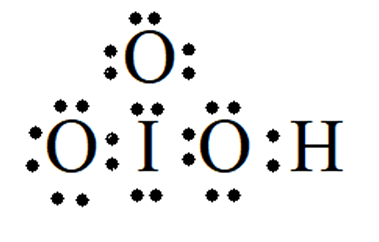
Lewis structure of ionic acid
[Click Here for Sample Questions]
To draw the lewis structure of HIO3, we need to realize that this is an acid. Whenever the hydrogen atom is in front that means we draw the lewis structure and put one of the oxygen outside. So , iodine in the center then oxygen and put the hydrogen outside. In HIO3 there are 26 valence electrons. Each atom has eight electrons and hydrogen has two electrons.
Properties of Iodic Acid
Given below are the properties of iodic acid formula:
- The chemical formula of iodic acid is HIO3.
- The molar mass is 175.91 g/mol.
- It looks like white solid and the density of iodic acid is 4.42 g/cm3.
- The melting point is 110ºC.
- It is corrosive in nature and non flammable and is strongly oxidizing in acidic solution and less in basic solution.
- The acid dissociation constant or acidity constant ( PKa ) is 0.75.
Uses of Iodic Acid Formula
It is used as a strong acid in analytical chemistry. It is used in the salt industry to increase the iodine content in salt.
Points to Remember
- The chemical formula of iodic acid is HIO3
- The iodic acid is a part of oxyacids
- The oxidation state of iodic acid is +5
- The iodic acid can be prepared by oxidizing iodine with strong oxidizers nitric acid, chlorine, chloric acid and hydrogen peroxide
- The main application of iodic acid in salt industry
Sample Questions
Ques - Calculate the molar mass of iodic acid. (2 marks)
Ans: HIO3
(1× H) = 1×1 = 1
(1 × I) = 1×126.90 = 126.90
(3×O) = 3× 16 = 48
Molar mass = 1 + 126.90 + 48 = 175.9 g
Ques- Calculate the percent iodine in iodic acid. (2 marks)
Ans: Formula of iodic acid – HIO3
Molar mass = 175.9 g
Mass of iodine = 126.90 g
% Iodine = (Mass of iodine/ molar mass) × 100
% Iodine = (126.90/ 175.9) × 100
% Iodine = 72.14 %
Ques- Calculate the oxidation number in HIO3 (2 marks)
Ans: The oxidation number of H is +1
The oxidation number of O is -2
H+1 Ix O3-2
(+1) + x + 3(-2) = 0
1 + x – 6 = 0
x = 5
Ques- Calculate the oxidation number in HIO4 (2 marks)
Ans: The oxidation number of H is +1
The oxidation number of O is -2
H+1 Ix O4-2
(+1) + x + 4(-2) = 0
1 + x – 8 = 0
x = 7
Ques- Calculate the valence electrons of iodic acid. (2 marks)
Ans: Valence electrons depends upon the group number of molecule in the periodic table
Iodic acid HIO3
Hydrogen belongs to group one, hence valence electron of hydrogen is 1
Similarly, valence electron of oxygen is 6 and iodine is 7
Valence electron = 1 + 7 + 3(6) = 26
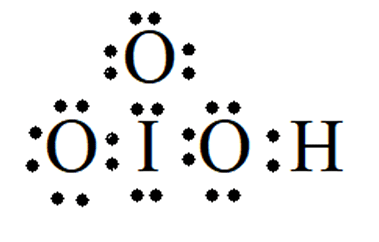
Ques- Calculate the formal charge of iodine from the following lewis structure of iodic acid. (3 marks)
Ans:
Valence electron = 7
Non bonding valence electron = 2
Bonding electron = 6
Formal charge = Valence electron – Non bonding valence electron – (Bonding electron)/2
I = 7 – 2 – 6/2
I = 2
Ques- Calculate the formal charge of the first oxygen atom from the following lewis structure of iodic acid. (3 marks)
Ans: Valence electron = 6
Non bonding valence electron = 6
Bonding electron = 2
Formal charge = Valence electron – Non bonding valence electron – (Bonding electron)/2
O = 6 – 6 – 2/2
O = -1
Ques- How is the iodic acid prepared ? Explain with reaction. (5 marks)
Ans: The iodic acid can be prepared by oxidizing iodine with strong oxidizers nitric acid, chlorine, chloric acid and hydrogen peroxide
Oxidation of I2 to HIO3 by concentric nitric acid i.e. HNO3
Step 1- Heat nitric acid and we get water, nitrogen dioxide and nascent oxygen.
2HNO3 → H2O +2NO2 + [O]
Step 2- Iodine is reacting with nascent oxygen and gets iodine pentoxide.
I2 + 5[O] → I2O5
Step 3- Iodine pentoxide reacts with water and gets iodic acid
I2O5 + H2O → 2HIO3
Combine all these above reaction,
2HNO3 → H2O +2NO2 + [O] × 5
I2 + 5[O] → I2O5
I2O5 + H2O → 2HIO3
I2 + 10 HNO3 → 4 H2O + 10 NO2 + 2HIO3
Ques– Explain iodic acid by lewis structure. Draw the structure also. (2 marks)
Ans: Whenever the hydrogen atom in front that means draw the lewis structure and put one of the oxygen outside. So , iodine in the center then oxygen and put the hydrogen outside. In HIO3 there are 26 valence electrons. Each atom has eight electrons and hydrogen has two electrons.
Ques– What are the properties and uses of iodic acid? (5 marks)
Ans: Properties of iodic acid:
- The chemical formula of iodic acid is HIO3.
- The molar mass is 175.91 g/mol. It looks like white solid.
- The density of iodic acid is 4.42 g/cm3, solid.
- The melting point is 110ËÂ\(\Box\)C. It is corrosive in nature and non flammable.
- Strongly oxidizing in acidic solution and less in basic solution.
Ques- What are the uses of iodic acid? (2 marks)
Ans. Uses of iodic acid are:
- It is used as a strong acid in analytical chemistry.
- It is used in the salt industry to increase the iodine content in salt.
Also Read:



Comments