



Education Journalist | Study Abroad Lead
Nomenclature of Organic Compounds can be defined as the systematic approach to name different organic compounds present in the world. In order to avoid some long and tedious common names in the general communication, the officials of the International Union of Pure and Applied Chemistry (IUPAC) have formulated some structured way of naming the organic compounds. Organic chemistry is a subdiscipline within chemistry involving the scientific study of the structure, properties, composition, reactions, and preparation (by synthesis or by other means) of carbon-based compounds, hydrocarbons, and their derivatives. An organic compound is any member of a large class of gaseous, liquid, or solid chemical compounds whose molecules contain carbon. The main purpose of the IUPAC system of nomenclature is to establish an international standard of naming compounds to facilitate communication. The aim is to give each of the structures a unique and unambiguous name and to correlate each name with a unique and unambiguous structure. In this article we will get to know about the method of naming an organic compound and also one will be able to write the structure of a compound just by observing the IUPAC name of the compound.
| Table of Contents |
Key Terms: History of Nomenclature, Trivial Nomenclature System, Organic Compounds, Carbon Allotropes, Wedge and Dash Formulas, Functional Groups, Resonance, Substituents, Functional Groups, IUPAC Nomenclature
History of Nomenclature
[Click Here for Sample Questions]
Earlier, the carbon compounds were named without any systematic nomenclature called the trivial nomenclature system. The trivial system of nomenclature does not depend on any fixed rules while naming the chemical compounds. The names mainly depend on the source of the organic compounds and their properties. There is no 'official' definition of an organic compound. The main disadvantage of the trivial nomenclature system is that each compound may have several trivial names associated with it. For example, the methane gas is also named marsh gas; methyl alcohol as a wood spirit under the trivial nomenclature. This gives confusion about the name of the methane gas. Also, Compounds with a greater number of atoms in some functional groups like the carboxylic acid group, however, do not possess any such trivial name.
The broader definition of 'carbon-containing molecules' involves the exclusion of carbon-containing alloys, a relatively small count of carbon-containing compounds such as metal carbonates and carbonyls, simple oxides of carbon and cyanides, as well as the allotropes of carbon and simple carbon halides and sulphides, which are usually considered to be inorganic compounds. Hence the IUPAC came with universally accepted structural formulas and nomenclature for all the organic compounds. This nomenclature has the advantage of giving a name to any newly discovered chemical compositions without any problem.
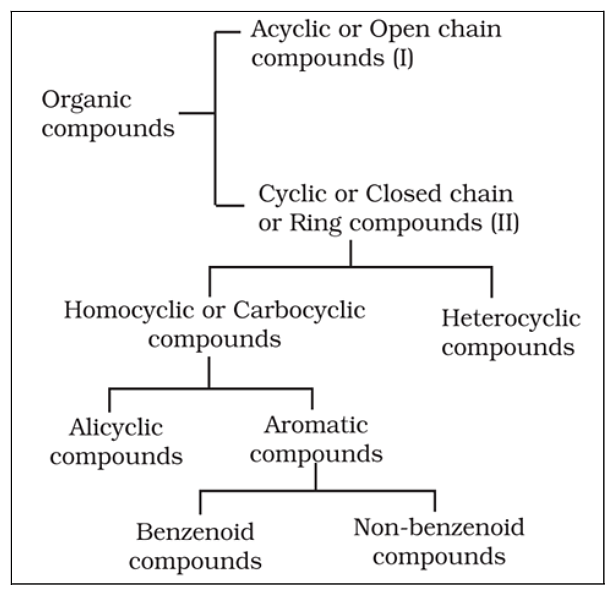
Classification of Organic Compounds
The video below explains this:
Nomenclature of Organic Compounds Detailed Video Explanation:
IUPAC Nomenclature
[Click Here for Sample Questions]
International Union of Pure and Applied Chemistry (IUPAC) introduced the classical nomenclature for the organic compounds systematically. Some rules were introduced such that every molecule has an individual name for its different structures.
A molecular formula simply counts the number of each sort of atom present in the molecule but tells you nothing about the way they are joined together. For example, the molecular formula of butane is C4H10 and the molecular formula of ethanol is C2H2O.
Molecular formulae are very rarely used in organic chemistry because they don't give any useful information about the bonding in the molecule. One must have come across them only in the equations for the combustion of simple hydrocarbons.
The way various atoms are bonded shows the structural formula. There are numerous ways for the same and one must be aware of them. One must remember that every line represents a pair of shared electrons.
The general skeleton of an IUPAC nomenclature is given as
Primary prefix + word root + primary suffix + secondary suffix
-
Root Word
The word root represents the number of carbon atoms in the parent chain. The general word root for different aliphatic compounds is alk-. The word root for different lengths of carbon chains is given below in Table.
| Number of carbons | Prefix |
|---|---|
| 1 | Meth |
| 2 | Eth |
| 3 | Prop |
| 4 | But |
| 5 | Pent |
| 6 | Hex |
| 7 | Hept |
| 8 | Oct |
| 9 | Non |
| 10 | Dec |
| 11 | Undec |
| 12 | Dodec |
| 13 | Tridec |
| 14 | Tetradec |
| 15 | pentadec |
-
Prefix
The primary prefix of the nomenclature of an organic compound indicates whether the compound is cyclic or acyclic etc.
The primary prefix cyclo- is used immediately before the root word.

For Example- Cyclohexane
The secondary prefix is used to represent the names of alkyl groups (branched chains) or some functional groups, which are regarded as substituents, are secondary prefixes. Some of the most common secondary prefixes are described in the table below
| Substituent Group | Secondary Prefix | Substituent Group | Secondary Prefix |
|---|---|---|---|
| −F | Fluoro | −NO2 | Nitro |
| −Cl | Chloro | −CH3 | Methyl |
| −Br | Bromo | –C2H5 | Ethyl |
| −I | Iodo | −OCH3 | Methoxy |
| --OH | Hydroxy | --CN | Cyano |
| --NH2 | Amino | --C=O | Keto/oxo |
| −NO | Nitroso | –OC2H5(R) | Ethoxy(alkoxy) |
-
Suffix
The primary suffix of the nomenclature of an organic compound generally describes the saturation of the carbon atoms. The saturation depends on the total no. of bonds between the carbon atoms present in the main chain considered.
| Nature Carbon Chain | General Name | Primary Suffix |
|---|---|---|
| Saturated (C–C) | Alkane | -ane |
| Unsaturated, having at least one double bond (C=C) | Alkene | -ene |
| Unsaturated, having two double bonds (C=C) | Di alkene | -diene |
| Unsaturated, having at least one triple bond (C≡C) | Alkyne | -yne |
The Secondary suffix is used to indicate the functional group in the organic compounds. The terminal 'e' of the primary suffix is dropped if it is followed by a suffix beginning with 'a', 'T', 'o', 'u' or 'y'. But it is retained if the secondary suffix begins with a consonant.
Secondary suffixes for various functional groups are given in the below table.
| Class of Organic Compound | General Formula | Functional Group | Suffix | IUPAC Name of the Family |
|---|---|---|---|---|
| Alcohols | R-OH | -OH | -ol | Alkanol |
| Thioalcohols | R-SH | -SH | -thiol | Alkanethiol |
| Amines | R-NH2 | -NH2 | -amine | Alkanamine |
| Aldehydes | R-CHO | -CHO | -al | Alkanal |
| Ketones | R-COR | >CO | -one | Alkanone |
Most of the functional groups come with preferences and they are generally placed in the secondary prefix in the nomenclature of an organic compound.
Check More:
Formation of Systematic Name by IUPAC
[Click Here for Sample Questions]
Whenever a compound is given, we have to write the structural name of the compound with the following standard rules proposed by IUPAC.
- The primary step is to select the parent chain containing the larger no of carbons or the chain including the major functional groups and assign the word root.
- Numbering is given to the carbons depending on giving the lesser number to the carbon having functional groups or saturation.
- If the molecule has functional groups, a secondary suffix is added to indicate the main functional group. This is optional and not necessary if the molecule has no functional group in the chain.
- Numbers are separated from the groups by hyphens. There is no space between the names.
- If the compound is a cyclic compound insert the cyclo or bicyclo as the primary prefix to the structural name.
- If there are any side chains then give the secondary prefixes to the root word by considering the order of the preferences for the substituents.
- The location of each point on which the substituent occurs is given in case the same substituent occurs more than once. The number of times a substituent group occurs is indicated by a prefix (di, tri, tetra, etc.).
- The substituents are listed in alphabetical order using the base name if there are two or more different substituents. The prefixes- “sec-” and”tert-” are not used in determining alphabetical order except when in comparison with each other.
- If two chains have equal no of carbon atoms, then the following are the preferences for choosing one as the main chain :
- The chain that has the highest number of side chains to the carbons in the main chain.
- The chain whose substituents are getting the lowest possible numbering.
- The chain that has the greatest number of carbon atoms in the smaller side chain.
- The chain that has the least branched side chains is considered mostly for the main chain numbering.
- The alkanes, alkenes and alkynes were added to the primary suffix based on the preference as alkyne>alkene>alkane.
- For a branched unsaturated acyclic hydrocarbon, the parent chain is the longest carbon chain that contains the maximum number of double and triple bonds. If there are two or more chains having the same no of carbon atoms for selection as the parent chain (chain with the most multiple bonds), the choice goes to (1) the chain with the greatest number of carbon atoms.
- Some of the substituents will behave as both substituents or functional groups according to the influence of the neighbouring groups in such a case they are written in the prefix and suffix as follows:
| Functional Group | Prefix | Suffix |
|---|---|---|
| Carboxylic Acids | - | -oic acid |
| Aldehydes | - | -al |
| Ketones | - | -one |
| Alcohols | hydroxy- | -ol |
| Amines | amino- | -amine |
| Ethers | alkoxy- | -ether |
| Fluorine | fluoro- | - |
| Chlorine | chloro- | - |
| Bromine | bromo- | - |
| Iodine | iodo- | - |
Consider a compound :

While giving the structural name to a compound, firstly consider the main chain by the longest chain rule. Then the remaining methyl group will remain as the substituent.
The numbering is given so that the substituent will get the least number.

The numbering should be given in such a way that if there are more than two substituents of the carbon they all will get the least number.

If there is a complex substituent, name it as a substituted alkyl group, and name the complex substituent is given in brackets.

Things to Remember
- Every compound has its unique structural name.
- There must not be any gaps between the characters in the IUPAC name except hyphens and commas.
- Locants (numbers and/or letters) are placed immediately before the part of the name to which they relate.
- The prefix’s name for a substituted substituent is considered to start with the first letter of its complete name.
- The priority for citation is given to the group that contains the lowest locant at the first point of difference in the case when two or more prefixes consists of identical roman letters.
- Simple prefixes such as methyl, ethyl, chloro, nitro, hydroxyl etc. are arranged alphabetically. The prefixes di, tri etc. are, however, not considered for comparison.
Sample Questions
Ques. What is nomenclature? How does it help to name an organic compound? (5 Marks)
Ans. According to organic chemistry, the nomenclature is the process of naming a substance. Most varied principles which are agreed upon internationally were considered for this naming. These principles enforce a standardization to the naming system and give a solution for this issue.
Generally, anyone who is studying the compounds must be able to visualize the structure of the compound by knowing the name of the structure, and by seeing the structure, one must be able to give a unique name to it.
Nomenclature gives a structural method to name a substance and also helps the chemists and druggists to classify them. Even nowadays, many organic compounds were being invented and discovered by scientists. All such compounds were being named hassle-free because of the most standardized IUPAC nomenclature.
Ques. What is the structure of the name of an organic compound? (5 Marks)
Ans. The general skeleton of an IUPAC nomenclature is given as
Primary prefix + word root + primary suffix + secondary suffix
- The word root represents the number of carbon atoms in the parent chain. The general word root for different aliphatic compounds is alk-.
- The primary prefix of the nomenclature of an organic compound indicates whether the compound is cyclic or acyclic etc. The primary prefix cyclo- is used immediately before the root word.
- The secondary prefix is used to represent the names of alkyl groups (branched chains) or some functional groups, which are regarded as substituents, are secondary prefixes.
- The primary suffix of the nomenclature of an organic compound generally describes the saturation of the carbon atoms. The saturation depends on the total no. of bonds between the carbon atoms present in the main chain considered.
- The Secondary suffix is used to indicate the functional group in the organic compounds. The functional groups were arranged in the preference issued by the IUPAC.
Ques. What is the preference of the functional groups in the branches for numbering? (5 Marks)
Ans. The priority of functional groups in IUPAC nomenclature is
– COOH > – SO3H > – COOR > – COCl > – CONH2 > – CN > HC = O > – CO > – OH > – NH2 > C = C > C – C.
- For amine derivatives: Amines > Imines > Hydrazine
- For acid derivatives: Anhydrides > esters > acid halides > amides
- For acids: Carboxylic acids > sulfonic acids > acid derivatives > sulfonic acid derivatives.
Acids > Acid derivatives.
Functional groups with more number of bonds with hetero atoms are more preferred.
Ques. Mention the Functional Group Name of these Organic Compounds: CH3Br, CH3NH2, CH3CH2OH, CH3OCH3 ? (3 Marks)
Ans. The functional groups are as follows:
- CH3Br (methyl bromide): Alkyl halide
- CH3NH2 (methylamine): Amine
- CH3CH2OH (ethanol): Alcohol
- CH3OCH3 (dimethyl ether): Ether
Ques. Give the IUPAC name of the compound. (3 Marks)

Ans. There is a keto group present in the compound so it is taken as the functional group and the chlorine is taken as a substituent.
Hence the name of the compound is 1-chloropropan-2-one.
Ques. Which of the following represents the correct IUPAC name for the compounds concerned: (5 Marks)
(i) 2, 2 dimethylpentane or 2-dimethylpentane.
(ii) 2, 3-dimethylpentane or 3, 4-dimethylpentane.
(iii) 2, 4, 7-trimethyloctane or 2, 5, 7-trimethyloctane,
(iv) 2-chloro-4-methylpentane or 4-chloro 2 methylpentane,
(v) But-3-yn-1-ol or But-4-ol-1-yne.
Ans. The correct IUPAC names are:
(i) 2,2-dimethylpentane
(ii) 2, 3-dimethylpentane
(iii) 2, 4, 7-trimethyloctane
(iv) 2-chloro-4 methylpentane
(v) But-3-yne-1-ol
Ques. Give the IUPAC name of the compound? (3 Marks)

Ans. 2,4,6-tribromo phenol. Is the IUPAC name. the given compound is the benzene compound. It is a brominated derivative of phenol. And used as a fungicide, as a wood preservative.
Check More:



Comments