



Education Journalist | Study Abroad Lead
Combustion refers to the process where a substance burns in the presence of Oxygen, giving off heat and light in the process. Not all things are combustible, combustible substances are the ones that get burnt and release heat energy. Oxygen is one of the most important requirements to carry out combustion, but not all compounds combine with oxygen to burn and undergo combustion, for example iron reacts with oxygen and undergoes rusting. Thus, the crucial difference between rusting and combustion is the presence of fuel. This article comprises the important topic Combustion, an overview on the topic, important points, and frequently asked questions.
| Table of Content |
Read More: Difference Between Galvanic Cell and Electrolytic Cell
What is combustion?
- Combustion is a scientific term used to explain burning. Combustion is a chemical process, which includes a reaction between two components:
- Fuel (source of Hydrocarbon) and
- Oxygen Source (Air, or an oxidant).
- Whenever fuel and oxygen react together, they release the heat and light energy. Heat and light energy then result in the formation of flame.
- Thus, combustion can be explained easily using the formula stated below, i.e., combustion is:
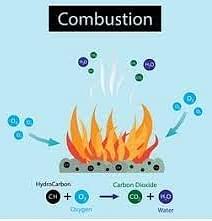
Hydrocarbon + Oxygen → Carbon Dioxide + Water + Heat Energy
- That is, when fuel combines with an oxygen source, it undergoes combustion with the release of carbon dioxide, water, and heat energy. The heat generated by combustion can be further used to carry out several domestic and industrial processes.
- Combustion requires a minimum temperature to reach before it can be carried out, i.e., the ignition temperature. The lowest temperature at which a substance catches fire is called its ignition temperature.
- The substances having very low ignition temperature, can easily catch fire with a flame are thus called inflammable substances. Examples of inflammable substances are petrol, alcohol, Liquified Petroleum Gas (LPG), etc.
- In order to carry out the combustion reaction, fuel and oxygen must be present along with an external source of energy to initiate the combustion cycle.
History of Combustion
- Combustion is considered as one of the oldest technologies of mankind, and is definitely one of our most important discoveries till date. There are several theories that would agree with the same, from the Middle Ages, fire with earth, water, and air is considered to be one of the four basic elements involved in the creation of the universe.
- Combustion, explosion, and flame have been seen, used, and recorded from the earliest ages. Each culture has its own significance for using fire. Fire has been used by mankind for a long time and for several purposes, such as cooking, steel and iron production and warfare production too.
- However, combustion is a complex phenomenon, and requires extensive study for efficient use of this chemical reaction, accompanied by the safety of all the people using it, domestically and industrially.
Read More:
Examples
Some examples of combustion are
- Burning of sulphur in the air
- An explosion of hydrogen in air
- Burning of Wax candle
- Combustion of petrol in a car’s engine
- Burning of natural gas in a bunsen burner
- Combustion of Natural Gas or LPG
- Burning of fireworks
- Burning of wood
- Burning of methane

What is fuel?
- Fuel is defined as a substance that provides heat and produces energy when it is burned. This energy that is released is in the form of chemical energy or heat energy. Fuel usually acts as a carbon source to burn.
- Example: Coal, wood, oil, or gas provides heat when they are burned. Methanol, Gasoline, Diesel, Propane, Natural gas, etc,. are other types of fuel.
Read More:
What is oxidant?
- As oxygen is essential to carry out combustion, a source of oxygen is essential to carry out the process. Oxidants such as pure oxygen, ozone, and air act as oxidants.
Read More: Collision Theory
What is flame?
- The substances which vaporise during combustion and in turn give off flames.
- For example, kerosene oil and molten wax rise through the wick and are vaporized during burning and form flames, whereas coal does not.
Also check:
Types of combustion
Combustion can be divided into 5 types; the types of combustion are:
1. Complete Combustion
- One of the five types of combustion is Complete Combustion. Complete combustion occurs when there is an unlimited supply of air, oxygen gas in particular. Complete combustion is also called clean combustion.
- In complete combustion the hydrocarbon burns out completely with the oxygen and leaves behind two by products, water and carbon dioxide.
- Example: Burning candle, the heat from the wick vaporizes the wax which then reacts with the oxygen in the air. The reaction results in the production of water and carbon dioxide.

2. Incomplete Combustion
- Incomplete combustion takes place when the air is in limited supply, thus may get short in amount to carry out the complete combustion. Incomplete combustion is also known as dirty combustion.
- Incomplete combustion produces less energy than complete combustion.
- Due to lack of oxygen (limited supply), the fuel will not react completely. This, in turn, would produce carbon monoxide and soot instead of carbon dioxide and water.
- Example: burning of paper. It leaves behind ash (a form of soot) as a by-product.

3. Rapid Combustion
- Another type of combustion is Rapid Combustion.
- Rapid combustion requires external heat energy for the reaction to carry out. This combustion produces a large amount of heat and light energy and takes place very rapidly. Thus, it is named so.
- Example: lighting a candle. The heat energy is provided when one lights the candle using a matchstick. The combustion will carry on till the wax burns out. Hence it is a rapid combustion
Read More:
4. Spontaneous Combustion
- As the name suggests here the combustion occurs spontaneously.
- It requires no external energy for the combustion to start or initiate. It happens due to self-heating or self-ignition.
- A substance with low-ignition temperatures gets heated quickly and this heat is unable to escape, resulting in spontaneous combustion.
- The temperature rises above ignition point and in the presence of sufficient oxygen combustion will happen. The reaction of alkali metals with water is an example, sodium metal with water, in the presence of air.
Read More:
5. Explosive Combustion
- Explosive Combustion also happens when the reaction occurs very rapidly.
- The reaction takes place when something ignites to produce heat, light and sound energy,
- That produces an explosion. Examples are burning of firecrackers or blowing up of dynamite.

Points to remember
- Combustion is a scientific term used to explain burning. Combustion is a chemical process, which includes a reaction between two components:
- Fuel (source of Hydrocarbon) and
- Oxygen Source (Air, or an oxidant).
- Hydrocarbon + Oxygen → Carbon Dioxide + Water + Heat Energy
- The lowest temperature at which a substance catches fire is called its ignition temperature.
- Fuel is defined as a substance that provides heat and produces energy when it is burned. This energy that is released is in the form of chemical energy or heat energy.
- The substances which vaporise during combustion and in turn give off flames.
- Types of combustion
- Complete
- Incomplete
- Rapid
- Spontaneous
- Explosive
Also Read:
Sample Questions
Ques. What is combustion?
Ans. Combustion is a scientific term used to explain burning. Combustion is a chemical process, which includes a reaction between two components:
- Fuel (source of Hydrocarbon) and
- Oxygen Source (Air, or an oxidant).
Whenever fuel and oxygen react together, they release the heat and light energy. Heat and light energy then result in the formation of flame. Thus, combustion can be explained easily using the formula stated below, i.e., combustion is:
Hydrocarbon + Oxygen → Carbon Dioxide + Water + Heat Energy
Ques. What is the ignition temperature?
Ans. Combustion requires a minimum temperature to reach before it can be carried out, i.e., the ignition temperature. The lowest temperature at which a substance catches fire is called its ignition temperature.
The substances having very low ignition temperature, can easily catch fire with a flame are thus called inflammable substances. Examples of inflammable substances are petrol, alcohol, Liquified Petroleum Gas (LPG), etc.
Read More:
Ques. Give some examples of combustion.
Ans. Some examples of combustion are
- Burning of sulphur in the air
- An explosion of hydrogen in air
- Burning of Wax candle
- Combustion of petrol in a car’s engine
Ques. What is flame?
Ans. The substances which vaporise during combustion and in turn give off flames. For example, kerosene oil and molten wax rise through the wick and are vaporized during burning and form flames, whereas coal does not.
Read More:
Ques. What are the different types of combustion?
Ans. Types of combustion
- Complete
- Incomplete
- Rapid
- Spontaneous
- Explosive
Ques. Write a short note on complete combustion.
Ans. One of the five types of combustion is Complete Combustion. Complete combustion occurs when there is an unlimited supply of air, oxygen gas in particular. Complete combustion is also called clean combustion. In complete combustion the hydrocarbon burns out completely with the oxygen and leaves behind two by products, water and carbon dioxide. Example: Burning candle, the heat from the wick vaporizes the wax which then reacts with the oxygen in the air. The reaction results in the production of water and carbon dioxide.
Read More:
Ques. Write a short note on incomplete combustion.
Ans. Incomplete combustion takes place when the air is in limited supply, thus may get short in amount to carry out the complete combustion. Incomplete combustion is also known as dirty combustion. Incomplete combustion produces less energy than complete combustion. Due to lack of oxygen (limited supply), the fuel will not react completely. This, in turn, would produce carbon monoxide and soot instead of carbon dioxide and water. Example: burning of paper. It leaves behind ash (a form of soot) as a by-product.
Ques. Why isn’t hydrogen gas used as a domestic or industrial fuel, although it has a very high calorific value? State three reasons for the answer.
Ans. Although hydrogen gas has a very high calorific value, it is not used as a domestic or industrial fuel due to the following reasons:
- It is expensive.
- It burns with an explosion.
- It is extremely inflammable, so it is risky to store and transport hydrogen
Read More:
Ques. Can the process of cellular respiration be called combustion? Why?
Ans. Yes. Cellular respiration is a set of metabolic reactions and processes that breaks large molecules into smaller ones with the release of heat. So, this is a slow combustion reaction.
Also Read:



Comments