



Content Curator
Chemical Properties of Carbon compounds elucidates its Combustion reactions, substitution reactions, addition reactions and oxidation reactions. Carbon has the unusual capacity to create bonds with other carbon atoms, allowing complex molecules to form. Alkanes, alkenes, and alkynes are hydrocarbons, which make up most of the carbon compounds. In this article, we will discuss the chemical properties of carbon compounds in detail.
| Table of Content |
Read More: Column chromatography
What Are Carbon Compounds?
Carbon has the unusual capacity to create bonds with other carbon atoms, allowing complex molecules to form. Catenation is the term for this characteristic. The tiny size of the atom allows it to easily form such complex molecules. Each of its atoms has four valence electrons in its outer shell, which can form chemical bonds with molecules and other atoms.
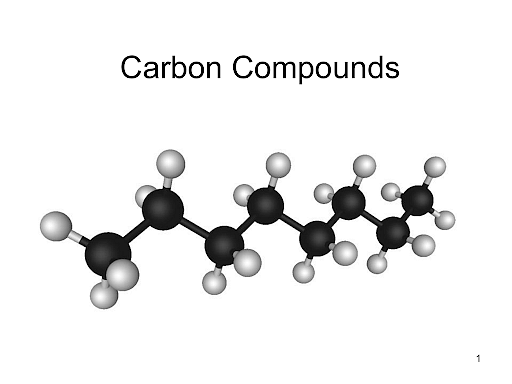
Carbon forms bonds with other carbon atoms
Saturated compounds are carbon compounds in which the carbon atoms are only linked by single bonds. Unsaturated compounds are carbon compounds with double or triple bonds between their carbon atoms. Carbon compounds are formed by combining oxygen, hydrogen, nitrogen, sulphur, chlorine, and a variety of other elements, resulting in compounds with unique properties that are dependent on the elements present in the molecule.
Read More:
Combustion of Carbon Compounds
Combustion is the process of burning a carbon compound in the air to produce carbon dioxide, water, heat, and light. Combustion is also referred to as burning. When carbon and its compounds are burned in the air, they produce carbon dioxide, vapour, heat, and light.
Hydrocarbon + Oxygen = Heat energy
The above formula represents combustion reaction. Most of the carbon compounds burn in the atmosphere, generating a lot of heat. Alkanes, for example, produce a lot of heat when they burn in the air, making them good fuels.

Burning of wood is an example of combustion
Burning of coal, burning of petrol, combustion of Natural Gas or LPG at homes to cook food, burning of firecrackers are a few such examples of combustion of carbon compounds.
Following are some of the equations of combustion reaction of organic compounds:
C + O2 → CO2 + heat and light
CH4 + 2O2 → CO2 + 2H2O + heat and light
CH3CH2OH + 3O2 → 2CO2 + 3H2O + heat and light
Note: Saturated hydrocarbons will generally give a clean flame on burning while unsaturated carbon compounds will give a yellow flame with lots of black smoke.
Read More: Carbonyl compounds
Oxidation of Carbon Compounds
A reaction in which an oxygen atom is added or a hydrogen atom is lost is known as an oxidation reaction. Not all oxidation reactions, however, involve the addition of oxygen or the removal of hydrogen atoms.
2Cu + O2 → 2 CuO
In the above reaction, copper (Cu) reacts with Oxygen and forms a new compound called copper oxide (CuO).
Oxidizing agents are substances that are capable of adding oxygen or removing hydrogen from other substances. Strong oxidising agents are potassium permanganate and acidified potassium dichromate.

Potassium permanganate
Note: Oxidation-reduction reactions, also known as redox reactions, occur when one reactant is oxidised while the other is reduced during the course of the reaction.

Redox Reaction
Read More:
Addition Reaction of Carbon Compounds
Addition reactions are those in which an unsaturated hydrocarbon reacts with hydrogen to generate a single product. In the presence of catalysts such as palladium or nickel, addition reactions take place. This reaction is commonly used in the hydrogenation of vegetable oils using a nickel catalyst.
CH2 = CH2 + H2 → CH3- CH3
In the above reaction, ethene reacts with hydrogen to form ethane.
Read More: Soaps And Detergents
What are Catalysts?
Catalysts are substances that cause a reaction to occur or proceed at a different rate without the reaction itself being affected. The presence of a metal catalyst, such as platinum, palladium, nickel, or rhodium, boosts the rate of addition reactions dramatically.

Effect of catalyst
Note: Addition reactions are undergone by all alkenes and alkynes containing either a double or a triple bond to generate single-bonded compounds.
Read More:
Substitution Reaction of Carbon Compounds
Substitution reactions are those in which a less reactive element or molecule is replaced with a more reactive element or molecule. Substitution reactions are most commonly seen in saturated hydrocarbons. These are single displacement reactions.

Substitution Reaction
A substitution reaction happens when saturated hydrocarbons react with chlorine in the presence of sunshine. Because chlorine is more reactive, it can displace hydrogen atoms from saturated hydrocarbons. Higher homologues of the same hydrocarbon are frequently generated in this process.

In this reaction, methane combines with chlorine gas to form chloromethane and hydrogen chloride in the presence of sunlight. The chlorine is broken down into free radicals by UV light, which starts the substitution reaction.
Also check:
Things To Remember
- Carbon is a unique element due to its small size and 4 valence electrons. This allows carbon to form complex bonds molecules.
- Saturated compounds are carbon compounds in which the carbon atoms are only linked by single bonds. Unsaturated compounds are carbon compounds with double or triple bonds between their carbon atoms.
- Combustion is the chemical property of carbon compounds to burn in the presence of oxygen and generate heat and light.
- Addition reaction is the chemical property of carbon compounds where unsaturated hydrocarbons react with hydrogen to generate a single product.
- Substitution is a chemical property of carbon compounds where there is a replacement of one or more hydrogen atoms of an organic molecule by another atom or group of the atom.
- Oxidation is the chemical property of carbon compounds in which an oxygen atom is added or a hydrogen atom is lost while in a reaction.
Read More:
Sample Questions
Ques. What is an oxidising agent? What happens when an oxidising agent is added to propanol? Explain with the help of a chemical equation. (CBSE 2016) (3 marks)
Ans.
- The substance that supplies oxygen in a reaction for oxidation is called an oxidising agent. Examples of oxidising agents are potassium permanganate, potassium dichromate etc.
- When propanol is heated with alkaline potassium permanganate solution (or acidified potassium dichromate solution), it gets oxidised to propanoic acid.

Ques. What is hydrogenation? What is its industrial application? (3 marks)
Ans. The process of adding hydrogen to an unsaturated hydrocarbon to form a saturated hydrocarbon is known as hydrogenation. The hydrogenation reaction takes place in the presence of a catalyst such as nickel (Ni) or palladium (Pd).

Application: The hydrogenation process has a wide range of industrial applications. It is used to make vanaspati ghee (vegetable ghee) out of vegetable oils.
Read More: Difference between baking soda and baking powder
Ques. Which of the following hydrocarbons undergo addition reactions: C2H6, C3H8, C3H6, C2H2 and CH4. (2 marks)
Ans. Addition reactions take place only in unsaturated hydrocarbons. Unsaturated compounds are carbon compounds with double or triple bonds between their carbon atoms.
So addition reaction will take place only in C3H6 and C2H2 as they both have double bonds between them.
Ques. Give a test that can be used to differentiate chemically between butter and cooking oil. (3 marks)
Ans. Cooking oil is an unsaturated carbon component, whereas butter is a saturated carbon compound. Bromine water can be decolourised by an unsaturated chemical, but not by a saturated compound. By using bromine water, we can tell the difference between frying oil and butter chemically. In separate test tubes, combine bromine water with a small amount of cooking oil and butter.
- Bromine water is discoloured by cooking oil, indicating that it is an unsaturated molecule.
- Because butter does not discolour bromine water, it is a saturated substance.
Ques. Name the oxidising agent used for the conversion of ethanol to ethanoic acid. Distinguish between ethanol and ethanoic acid on the basis of (i) litmus test, (ii) reaction with sodium hydrogen carbonate. (2 marks)
Ans. Alkaline potassium permanganate or Acidified potassium dichromate can be used as oxidising agents.
(i) Ethanol will not affect litmus paper. Ethanoic acid will turn blue litmus paper red.
(ii) Ethanol will not react with sodium hydrogen carbonate. Ethanoic acid will give brisk effervescence due to colourless, odourless carbon dioxide gas.
Read More:
Ques. Why are carbon and its compounds used as fuels for most applications? (2 marks)
Ans. Carbon burns with a clean flame and produces carbon dioxide and water. No smoke is produced during combustion. The evolution of heat and light is involved in this reaction. The same takes place for compounds of carbon. That is why carbon and its compounds are chosen as fuel in the majority of applications.
Ques. What are the three characteristics of carbon which result in huge amounts of carbon compounds? (3 marks)
Ans. Carbon forms a large number of compounds due to the properties listed below:
(a) Catenation: Carbon has the ability to make bonds with other carbon atoms, generating long chains, both branched and unbranched chains, and even rings.
(b) Tetravalency: Because carbon possesses valency 4, it can bond with four other carbon atoms or non-covalent element atoms, resulting in compounds with distinct properties depending on the elements present.
(c) Isomerism: Carbon compounds have the property of isomerism, which means they have the same molecular formula but different structural formulas.
Ques. Write the molecular formula for an (2 marks)
(I) Alkene and
(Ii) Alkyne with four carbon atoms.
Ans. The molecular formula for an alkane 4 carbon atom is C4H10. An alkene contains 2 hydrogen atoms less than the corresponding alkane and an alkyne contains 4 hydrogen atoms less than corresponding alkanes. Therefore, the molecular formula of
(i) alkene is C4H8
(ii) alkyne is C4H6
Read More:
Ques. What are the types of Covalent bond? (2 marks)
Ans.
- Single Covalent Bond: When a single pair of electrons are shared between two atoms in a molecule. For example; F2, Cl2, H2 etc.
- Double Covalent Bond: When two pairs of electrons are shared between two atoms in a molecule. For example; O2, CO2 etc.
- Triple Covalent Bond: When three pairs of electrons are shared between two atoms in a molecule. For example; N2 etc.
Ques. What are the three main Carbon Allotropes? (2 marks)
Ans.
- Diamond: In this, carbon, an atom is bonded to four other atoms of carbon forming three-dimensional structures. It is the hardest substance and is used as an insulator. It is used for drilling rocks and cutting. It is also used for making jewellery.
- Graphite: In this, each carbon atom is bonded to three other carbon atoms. It is a good conductor of electricity and is used as a lubricant.
- Buckminster Fullerene: It is an allotrope of the carbon-containing cluster of 60 carbon atoms joined together to form spherical molecules. It is dark solid at room temperature.
Read More:



Comments