




KBPE Class 12 exams are conducted by the Directorate of Higher Secondary Education (DHSE), Kerala. More than 4 lakh students are expected to appear in 2027, competing across 9 subjects in an offline, pen-and-paper exam projected to be held in March 2027. The Kerala Plus Two examination is conducted for Science, Commerce, and Humanities/Arts streams. Students generally appear for 6 papers, including 2 language papers and 4 elective subjects.
- The KBPE SSLC 2027 timetable is expected to be released in October-November 2026. Last year, the 2026 timetable was released in a similar window.
- The KBPE 2027 examinations are tentatively scheduled to begin from March 2, 2027. Practical examinations are expected to be conducted during January–February 2027.
- The KBPE SSLC 2027 hall ticket will be distributed through your school in February 2027. There is no separate online download for regular students.
- Each subject carries 100 marks, combining theory, practical and continuous evaluation components where applicable.
- The marking structure includes Terminal Evaluation (TE), Practical Evaluation (PE) and Continuous Evaluation (CE).
- Students must achieve a minimum D+ Grade (30% aggregate) in each subject to pass. There is no negative marking.
- Results are expected in May 2027, followed by SAY and Improvement examinations in June–July 2027. In 2026, results were declared on May 15, 2026 at 3:00 PM on keralaresults.nic.in and sslcexam.kerala.gov.in, with a pass percentage of 99.07%.
Related Links:
- Kerala Plus Two Registration 2023: Dates, Application Process & Fees
- Kerala Board Class 12 Exam Pattern 2023: Topic-wise Weightage, Syllabus and Marking Scheme
- Kerala Class 12 Syllabus 2026: PDF Download, Science, Commerce & Humanities Stream Details
Key Summary
- KBPE Class 12 exams cover Science, Commerce, and Humanities streams, with students appearing for 6 papers.
- Each subject carries 100 marks, assessed through theory, practicals (where applicable), and Continuous Evaluation (CE).
- The 2027 public theory exams are tentatively scheduled from March 2, 2027, with practicals expected in January–February 2027.
- Students must secure at least a D+ grade (30%) in each subject to pass the Class 12 examination.
What is the KBPE Class 12 Exam?
Kerala Board of Public Examinations is the state-level government education board responsible for defining the curriculum, prescribing syllabi, and conducting public board examinations for school students in Kerala, India.
- The exam covers Science, Commerce, and Humanities streams, with students appearing for 6 papers in total.
- Each subject carries 100 marks, with marks divided among theory, practicals (where applicable), and continuous/internal evaluation.
| Particular | Details |
|---|---|
| Conducting Body | Directorate of Higher Secondary Education (DHSE), Government of Kerala |
| Exam Name | Kerala Higher Secondary Examination (HSE), commonly referred to as the Kerala Plus Two Exam. |
| Subjects Covered |
|
| Exam Level | State-Level Intermediate Board Examination (Higher Secondary). |
| Exam Mode | Offline |
| Total Questions | Varies by subject; Question papers feature a blend of Multiple Choice (objective), short answer, and essay-type (subjective) formats. |
| Total Marks |
|
| Marking Scheme | Every paper is divided into three parts:
|
| Passing Score |
|
| Basic Eligibility |
|
| Age Limit | No upper age limit is specified by the board to appear |
| Application Mode | Offline via School for regular candidates |
| Official Website |
|
Also Check:
KBPE Exam Class 12: What’s New?
KBPE Students just wrapped up their First Terminal (Onam) Examinations, which took place from August 14 to August 20, 2026. Schools are currently evaluating answer sheets, issuing performance feedback, and restarting full-time board-level lectures.
- October 2026: Official Board Timetable Release for 2027
The Directorate of Higher Secondary Education (DHSE), Kerala, is expected to publish the definitive, subject-wise Plus Two Public Exam Timetable. Historically, this is released in late October or early November.
- November 2026 – January 2027: School Registration Tracking
Schools will begin collecting physical board registration applications and internal exam fees from students to bundle them for DHSE portal submission.
Also Check: Kerala Plus Two Question Paper 2026 (Available): Download Subject-wise Question Paper with Solutions PDF
KBPE Exam Class 12: Changes Over the Years
The Kerala board examination system has evolved through several key changes in grading, evaluation, and student-friendly exam practices.
- Grading and Continuous Evaluation: The percentage-based system was phased out in 2004–05, with a 9-point grading scale (A+ to E) and Continuous Evaluation introduced.
- Student-Friendly Exam Changes: A 15-minute cool-off period was introduced in 2016, while the SAY (Save A Year) system provides students with an opportunity to reappear in selected subjects.
| Year/Period | Development | Key Changes |
|---|---|---|
| 1965 | Board Formation |
|
| 2004–2005 | Grading & Continuous Evaluation Shift |
|
| 2016 | Introduction of Cool-Off Time |
|
| Recent Years (Ongoing) | SAY System Normalization |
|
KBPE Class 12: Important Dates 2027 (Tentative)
The Kerala Plus Two 2027 exam schedule covers the major stages from the timetable release to the final public exams, results, and SAY/improvement exams.
- DHSE Kerala is expected to officially release the Class 12 (Plus Two) exam date sheets in October 2026.
- According to the Kerala state educational calendar, the main public theory exams for Class 12 are slated to begin on March 2, 2027, with practical exams running ahead of them in February 2027.
| Event / Milestone | Tentative Date |
|---|---|
| Official Timetable Release | October 2026 |
| Second Term (Terminal) Exams | From December 11, 2026 |
| Admit Card / Hall Ticket Release | January 2027 |
| Practical Examinations | January – February 2027 |
| Model Examinations | From February 10, 2027 |
| Final Public Theory Exams | From March 2, 2027 |
| Board Exam Result Declaration | May 2027 |
| SAY (Save A Year) & Improvement Exams | June – July 2027 |
KBPE Class 12 Exam Eligibility Criteria 2027
To appear for the KBPE Class 12 (Plus Two) Board Examinations in 2027, candidates must fulfill the official eligibility criteria established by the Directorate of Higher Secondary Education (DHSE), Kerala
- Class 11 Qualification: Students must pass Class 11 (Plus One) from a DHSE Kerala-affiliated or recognized equivalent school, with at least a D+ grade in all subjects.
- School Requirements: Regular students must complete Continuous Evaluation (CE) and required practical work, maintain the prescribed attendance, and complete registration and fee formalities through their school.
| Eligibility Component | Requirement |
|---|---|
| Class 11 Qualification | Must have passed Class 11 (Plus One) from a DHSE Kerala-affiliated school or a recognized equivalent board. |
| Class 11 Passing Grade | Must secure at least D+ grade in all individual subjects. |
| Continuous Evaluation (CE) | Must complete school-based projects, assignments, and internal/terminal assessments during the academic year. |
| Practical Work | Students in practical-based subjects must complete lab work and journal records as required. |
| Attendance | Regular students must maintain the prescribed minimum attendance, typically 75% of working days. |
| Attendance Condonation | Shortage may be considered on certified medical or authorized sports/co-curricular grounds, subject to approval. |
| Age Limit | No upper age limit is specified for appearing in the higher secondary public examinations. |
| Registration | Regular students are registered through their affiliated school via the official school portal. |
| Fee Clearance | Students must pay the required examination and registration fees within the prescribed deadline to complete registration and receive the hall ticket. |
Kerala Plus Two Question Paper 2026 with Solution PDF
| Subject | Question Paper PDF | Solution PDF |
|---|---|---|
| English | Download PDF | Check Solutions |
| Mathematics | Download PDF | Check Solutions |
| Psychology | Download PDF | Check Solutions |
| Chemistry | Download PDF | Check Solutions |
| Business Studies | Download PDF | Check Solutions |
| Home Science | Download PDF | Check Solutions |
| Computer Science | Download PDF | Check Solutions |
| Statistics | Download PDF | Check Solutions |
| History | Download PDF | Check Solutions |
| Islamic History & Culture | Download PDF | Check Solutions |
| Business Studies | Download PDF | Check Solutions |
| Communicative English | Download PDF | Check Solutions |
| Languages | Download PDF | Check Solutions |
| Computer Science and Information Technology | Download PDF | Check Solutions |
| Kerala Plus Two Model Question Paper | Question Paper | Solution PDF |
|---|---|---|
| Kerala Plus Two Model 2025 Question Paper | Download PDF | Check Solutions |
KBPE Class 12 Application Process 2027
Regular candidates do not need to fill out individual online forms on the public portal. The entire workflow is streamlined directly through your school administration using the board's secure institutional system.
- School-Based Registration: Regular students complete the registration process through their school, including verification, document submission, and fee payment.
- Online Submission by School: After checking the student's details, the school uploads and confirms the registration details through the DHSE Kerala portal.
| Step | Registration Process |
|---|---|
| 1. School Verification | The school verifies the student's Class 11 promotion and attendance details. |
| 2. Check Details | Students check their name, date of birth, and subject choices in the school records. |
| 3. Submit Documents | Students provide recent photographs and their Class 10 SSLC marksheet to the school. |
| 4. Pay Fees | The required registration fee is paid at the school office. |
| 5. School Upload | The school submits and confirms the students' details through the DHSE Kerala portal. |
Documents Required for KBPE Class 12 Registration 2027
To complete your registration for the KBPE Class 12 (Plus Two) Board Examinations 2027, you must submit physical copies directly to your school office. The school then digitizes and uploads these details to the official state board database.
- Class 10 (SSLC) Mark Sheet: A copy of the Class 10 marksheet or passing certificate showing your name, parent details, and date of birth.
- Class 11 (Plus One) Report Card: A copy of the Class 11 marksheet showing that you have passed the required subjects.
- Passport-Sized Photographs: 2–3 recent colour photographs as required by the school.
- School Admission/Roll Number: Your school admission number or identification number used for registration.
- Category/Caste Certificate: Required only for students applying for category-based fee concessions, where applicable.
Also Check:
KBPE Class 12 Application Fee 2027
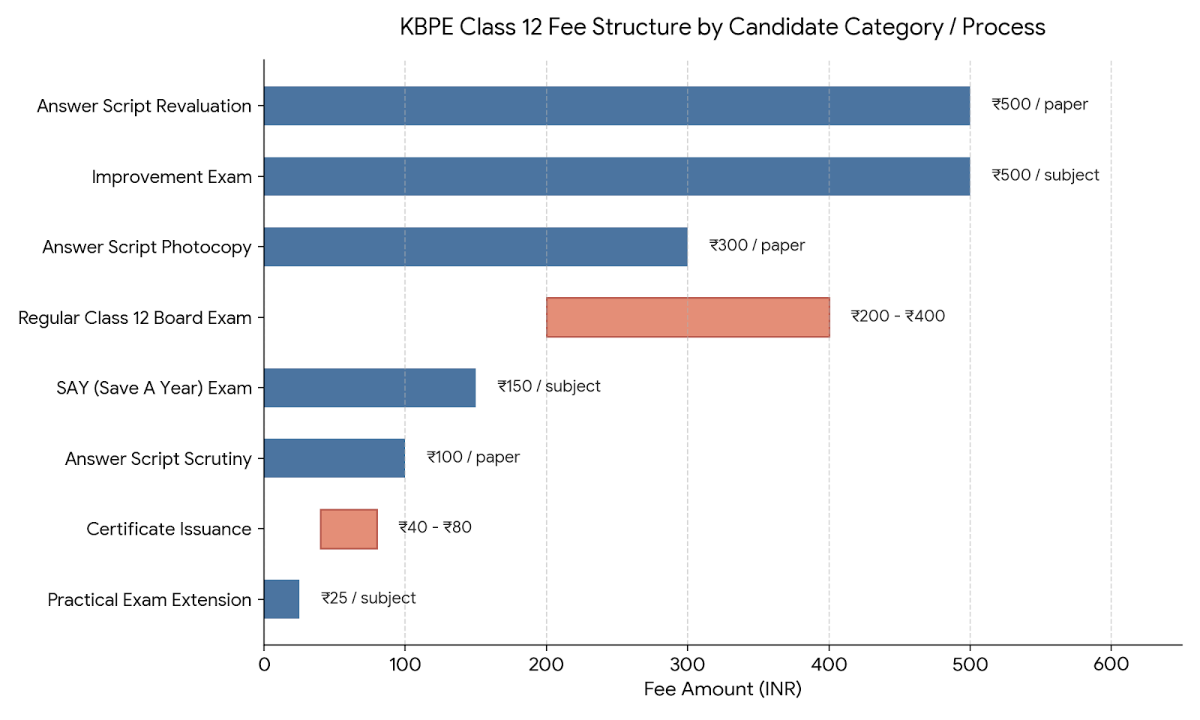
The KBPE Class 12 (Plus Two) application fees for the 2027 board exam are standardized by the Directorate of Higher Secondary Education (DHSE), Kerala. The fees are systematically collected at the school level by administrators before being sent through the government's DHSE Kerala Portal.
Missing the baseline institutional deadline triggers strict fine slabs managed via the school office:
- Initial Late Entry: Applications submitted shortly after the deadline attract a ₹20 late fee.
- Extended Late Entry: A further delay attracts an additional ₹5 per day as a late fee.
- Final Late Entry: Applications submitted after major portal closures may require a ₹600 late fee for manual registration.
Candidates belonging to Scheduled Castes (SC), Scheduled Tribes (ST), or economically weaker sections holding official documentation may qualify for complete fee waivers or concessions on their regular board examination applications under DHSE state policy norms.
| Candidate Category / Process | Fee Amount (INR) |
|---|---|
| Regular Class 12 Board Exam | ₹200 to ₹400 |
| SAY (Save A Year) Exam Fee | ₹150 per subject |
| Improvement Exam Fee | ₹500 per subject |
| Practical Exam Extension Fee | ₹25 per subject |
| Certificate Issuance Fee | ₹40 to ₹80 |
| Answer Script Revaluation Fee | ₹500 per paper |
| Answer Script Scrutiny / Photocopy | ₹100 / ₹300 per paper |
KBPE Class 12 Exam Pattern 2027
The KBPE Class 12 exams are conducted offline via pen-and-paper, and the questions are framed to assess everything from basic recall to advanced problem-solving.
The final board theory paper features a diverse mix of question formats to fairly test students:
- Objective Type: Multiple Choice Questions (MCQs) and one-word answers checking foundational concepts.
- Short Answer (Type I & II): Restructured questions requiring definitions, formulas, or short reasoning (ranging from 2 to 4 marks).
- Long Answer / Essay Type: Multi-part problems, long-form explanations, or detailed derivations (worth 5 to 8 marks). These questions come with internal choice options.
The total marks for each subject depend heavily on whether the course includes laboratory or practical work:
- Each exam includes a 15-minute cooling-off period. In this time, students can read the exam paper before starting to write it.
- No Negative Marking: Marks are never deducted for incorrect answers in the board evaluation.
- The Passing Threshold: Students must score a minimum D+ grade in every subject to clear the exam.
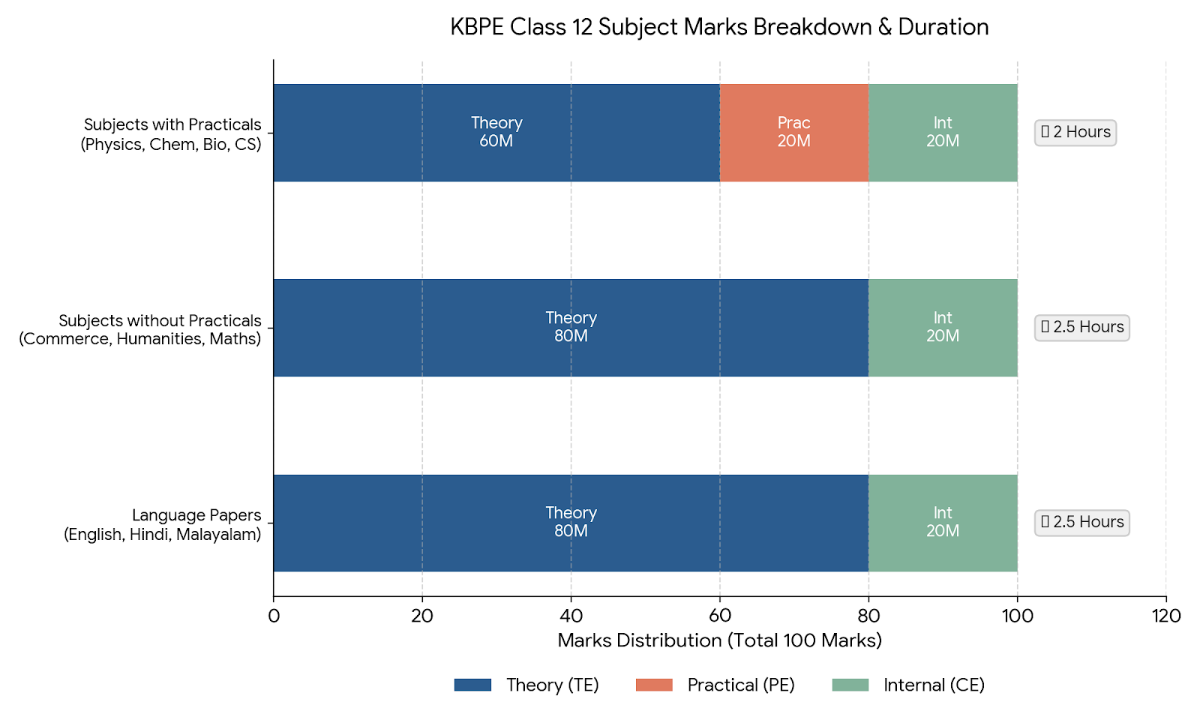
| Subject Category | Theory (TE) Marks | Practical (PE) Marks | Internal (CE) Marks | Total Marks | Exam Duration |
|---|---|---|---|---|---|
| Subjects with Practicals (Physics, Chemistry, Biology, Comp. Science) | 60 Marks | 20 Marks | 20 Marks | 100 Marks | 2 Hours |
| Subjects without Practicals (Commerce, Humanities, History, Maths) | 80 Marks | — | 20 Marks | 100 Marks | 2.5 Hours |
| Language Papers (English, Hindi, Malayalam, etc.) | 80 Marks | — | 20 Marks | 100 Marks | 2.5 Hours |
KBPE Class 12 Syllabus 2027
KBPE syllabus covers the prescribed Class 12 subjects across Science, Commerce, and Humanities/Arts streams, along with mandatory language papers.
Science Stream
The Science stream covers core subjects such as Physics, Chemistry, Mathematics, and Biology.
- The syllabus includes both theory-based concepts and practical-oriented topics, depending on the subject.
- Major areas include calculus, modern physics, organic chemistry, genetics, and biotechnology.
Physics
| Unit | Topics Covered |
|---|---|
| Electrostatics & Current Electricity | Electrostatic Potential & Capacitance; Current Electricity |
| Magnetic Effects & Induction | Moving Charges & Magnetism; Magnetism & Matter; Electromagnetic Induction (EMI); Alternating Current (AC) |
| Optics & Waves | Electromagnetic Waves; Ray Optics & Optical Instruments; Wave Optics |
| Modern Physics & Electronics | Dual Nature of Radiation & Matter; Atoms; Nuclei; Semiconductor Electronics |
Chemistry
| Branch | Topics Covered |
|---|---|
| Physical Chemistry | Solutions; Electrochemistry; Chemical Kinetics |
| Inorganic Chemistry | d- and f-Block Elements; Coordination Compounds |
| Organic Chemistry | Haloalkanes & Haloarenes; Alcohols, Phenols & Ethers; Aldehydes, Ketones & Carboxylic Acids; Amines; Biomolecules |
| Removed Topics | Polymers; Chemistry in Everyday Life |
Mathematics
| Unit | Topics Covered |
|---|---|
| Relations & Algebra | Relations & Functions; Inverse Trigonometric Functions; Matrices; Determinants |
| Calculus | Continuity & Differentiability; Applications of Derivatives; Integrals; Applications of Integrals; Differential Equations |
| Vectors, 3D & Programming | Vector Algebra; Three-Dimensional Geometry; Linear Programming; Probability |
Biology
| Section | Topics Covered |
|---|---|
| Botany | Sexual Reproduction in Flowering Plants; Anatomy of Flowering Plants; Principles of Inheritance & Variation; Biotechnology: Principles & Processes; Biotechnology & Its Applications |
| Zoology | Human Reproduction; Reproductive Health; Molecular Basis of Inheritance; Evolution; Human Health & Disease; Microbes in Human Welfare; Organisms & Populations; Ecosystem; Biodiversity & Conservation |
Commerce Stream
The Commerce stream mainly focuses on Accountancy, Business Studies, and Economics.
- The syllabus covers partnership accounts, financial management, business operations, and economic concepts.
- Students study both accounting procedures and theoretical business/economic principles.
| Subject | Topics Covered |
|---|---|
| Accountancy | Accounting for Partnership: Basic Concepts; Reconstitution of a Partnership Firm; Dissolution of a Partnership Firm; Accounting for Share Capital; Issue and Redemption of Debentures; Financial Statements of a Company; Analysis of Financial Statements; Accounting Ratios; Cash Flow Statement |
| Business Studies | Nature & Significance of Management; Principles of Management; Business Environment; Planning; Organizing; Staffing; Directing; Controlling; Financial Management; Financial Markets; Marketing Management; Consumer Protection |
| Economics | Introduction to Microeconomics; Theory of Consumer Behaviour; Production & Costs; Theory of the Firm under Perfect Competition; Market Equilibrium; National Income Accounting; Money & Banking; Determination of Income & Employment; Government Budget & the Economy; Open Economy Macroeconomics |
Core Languages
English and an additional language are included as mandatory language papers.
- The syllabus covers literature, grammar, reading comprehension, and writing skills.
- The additional language may include Malayalam, Hindi, Arabic, French, or other prescribed options.
| Language | Topics Covered |
|---|---|
| English | Communicative English; Reading Comprehension and Text Analysis; Prescribed Prose and Poetry; Formal and Creative Writing |
| Additional Language | Malayalam, Hindi, Arabic, French, etc.; Literature; Grammar; Composition; Translation Exercises |
Arts Stream Subjects
The Arts stream includes subjects such as History, Political Science, Sociology, and Geography.
- These subjects cover Indian society, politics, population, economic activities, globalisation, and social change.
- History covers major developments in ancient, medieval, and modern Indian history.
- The syllabus combines Indian-specific topics with contemporary world and social issues.
| History | |
|---|---|
| Part | Topics Covered |
| Part I – Ancient Indian History | Bricks, Beads, and Bones; Kings, Farmers, and Towns; Kinship, Caste, and Class; Thinkers, Beliefs, and Buildings |
| Part II – Medieval Indian History | Through the Eyes of Travellers; Bhakti-Sufi Traditions; An Imperial Capital: Vijayanagara; Peasants, Zamindars, and the State |
| Part III – Modern Indian History | Colonialism and the Countryside; Rebels and the Raj; Mahatma Gandhi and the Nationalist Movement; Framing the Constitution |
| Subject | Topics Covered |
|---|---|
| Political Science |
|
| Sociology |
|
| Geography |
|
Also Check:
KBPE Class 12 Exam Preparation Tips 2027
The KBPE preparation strategy should focus on textbook coverage, continuous evaluation, previous-year papers, and effective time management.
- Start with the prescribed textbooks: Build your preparation around SCERT/NCERT books and revise important concepts regularly.
- Practise the actual exam format: Combine previous-year papers, model exams, and timed practice to improve accuracy and answer-writing speed.
| Preparation Area | Key Tip |
|---|---|
| Textbooks First | Complete the prescribed SCERT/NCERT textbooks and practice their questions before using reference books. |
| Continuous Evaluation | Complete assignments, projects, internal exams, and practical records on time to secure CE marks. |
| Cool-Off Time | Use the 15-minute reading time to understand questions and plan answers before writing. |
| Previous-Year Papers | Solve at least the last 5 years' question papers to identify repeated concepts and question patterns. |
| Model Exams | Use the February Model Examination to practise the final exam pattern and identify weak areas. |
| Subject-Wise Practice | Focus on formulas and diagrams in Science, calculations in Commerce, and structured answers in Arts and Languages. |
| Time Management | Practise completing papers within the allotted time and keep a few minutes for final checking. |
The video discusses what students require to score in boards, every prerequisite, way of studying and preparation tips to score better in the KBPE Class 12 exams.
KBPE Class 12 Admit Card 2027
The KBPE Class 12 (Plus Two) Admit Card 2027 is a mandatory identity document issued by the Directorate of Higher Secondary Education (DHSE), Kerala. No student is permitted inside the examination hall without a physical copy of it.
- The admit cards are expected to be generated in January 2027 or early February 2027, roughly 2 to 3 weeks prior to the commencement of the final practical and written board examinations.
- Regular students cannot download your individual hall ticket independently from the public website. The board releases a secure portal download link accessible exclusively through the school code and administrative login password.
If you spot a typo in your name, a spelling error, or an incorrect subject combination, immediately alert your school's principal or examination officer. They can request a corrected rectifying slip via the Sampoorna School Portal Login.
Also Check:
KBPE Class 12 Result and Scorecard 2027
The KBPE Class 12 (DHSE Plus Two) Results for the 2026–2027 academic cycle are expected to be officially declared in late May 2027.
Once announced by the state education minister, individual student scorecards are made available across multiple official channels simultaneously. When the results go live, you can query your scorecard on the following official portals:
- Kerala Results Official Portal
- DHSE Kerala Exam Results
- KITE Kerala Results
Your digital sheet will verify the following metrics:
- Student’s Name and Date of Birth
- Registration Roll Number & School Code
- Subject-wise marks
- Subject-wise letter grades (ranging from A+ down to E)
- Final Qualifying Status (Passed or Needs Improvement)
Also Check:
KBPE Class 12 Passing Marks 2027
To pass the KBPE Class 12 (Plus Two) Board Exams 2027, students must score a minimum D+ Grade (30% marks) in each individual subject.
- Crucially, the Directorate of Higher Secondary Education (DHSE), Kerala, applies a dual-passing rule. It means that one must meet the 30% threshold overall (aggregate) and score at least 30% separately in the Terminal Evaluation (Written Theory) paper.
- Practical Subjects: Students need at least 18/60 in theory and 30/100 overall after combining theory, practical, and internal marks.
- Non-Practical & Language Subjects: Students need at least 24/80 in theory and 30/100 overall, including internal marks.
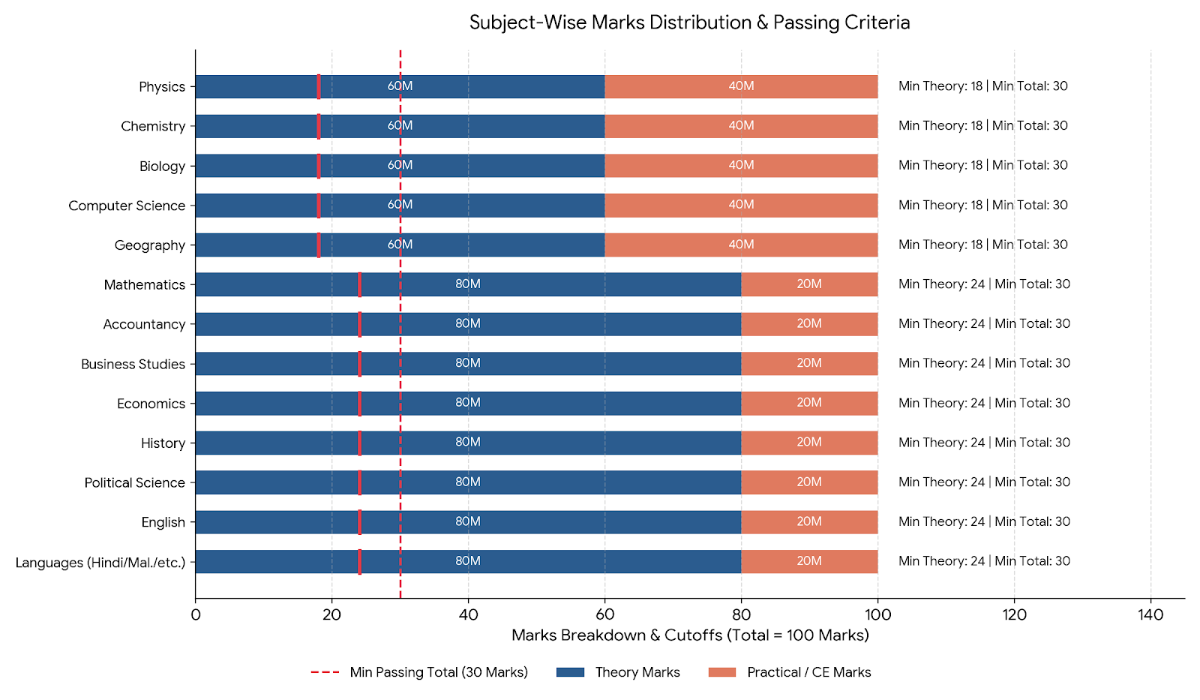
| Subject / Group | Theory Marks | Practical / Internal Marks | Minimum Theory Marks | Minimum Total Marks |
|---|---|---|---|---|
| Physics | 60 | 40 Practical + 20 CE | 18/60 | 30/100 |
| Chemistry | 60 | 40 Practical + 20 CE | 18/60 | 30/100 |
| Biology | 60 | 40 Practical + 20 CE | 18/60 | 30/100 |
| Computer Science | 60 | 40 Practical + 20 CE | 18/60 | 30/100 |
| Geography | 60 | 40 Practical + 20 CE | 18/60 | 30/100 |
| Mathematics | 80 | 20 CE | 24/80 | 30/100 |
| Accountancy | 80 | 20 CE | 24/80 | 30/100 |
| Business Studies | 80 | 20 CE | 24/80 | 30/100 |
| Economics | 80 | 20 CE | 24/80 | 30/100 |
| History | 80 | 20 CE | 24/80 | 30/100 |
| Political Science | 80 | 20 CE | 24/80 | 30/100 |
| English | 80 | 20 CE | 24/80 | 30/100 |
| Hindi / Malayalam / Arabic / Other Languages | 80 | 20 CE | 24/80 | 30/100 |
Which Board is Considered Easier?: KBPE Plus Two vs CBSE Class 12
When comparing KBPE Plus Two (Kerala State Board) and CBSE Class 12, KBPE is generally considered easier for securing high percentages, while CBSE is considered more practical for national-level competitive exam preparation.
While both boards share a similar scientific core derived from the national NCERT blueprint, the key difference lies in the question patterns and evaluation rules.
- KBPE: Questions focus on textbook concepts, standard definitions, short answers, and familiar derivations, with a mix of objective and descriptive questions.
- CBSE: Questions emphasise application of concepts through HOTS, case-based questions, analytical problems, and numerical applications.
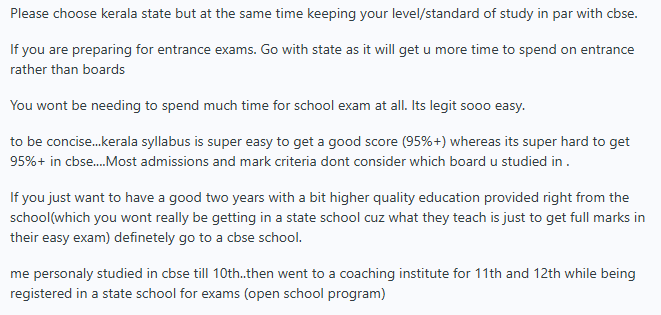
As per Reddit, students compare CBSE and KBPE Plus 2 Board as follows:
- Easier to Score: It is much simpler to achieve high marks (95%+) in Kerala State Board, as the teaching and testing focus strictly on getting full marks in straightforward board exams.
- Less Time-Intensive: State Board requires minimal preparation time for school exams, giving students significantly more time to focus on competitive entrance exam preparation compared to CBSE.

Source: Reddit
Also Check:
- Kerala Plus Two SAY 2026 vs Regular Exam: Which Marks Count for University Admissions
- Kerala Plus Two SAY 2026 Physics: Important Topics and Strategy
- Kerala Plus Two SAY Exam 2026: Is 35 Marks a Safe Score? Minimum Pass Marks Explained
Ques. How many subjects are there in the KBPE Class 12 exam?
Ans. Students generally appear for 6 papers, including 2 mandatory language papers and 4 elective subjects.
Ques. What is the passing mark for KBPE Class 12 2027?
Ans. Students must secure at least 30% marks or a D+ grade in each subject to pass.
Ques. When will the KBPE Class 12 2027 exams begin?
Ans. The final public theory examinations are tentatively scheduled to begin on March 2, 2027.
Ques. Is there negative marking in the KBPE Class 12 exam?
Ans. No, there is no negative marking for incorrect answers in the board examination.
Ques. What is the exam pattern for KBPE Class 12?
Ans. The exam is conducted offline and includes objective, short-answer and long-answer questions. Subjects may have theory, practical and Continuous Evaluation (CE) components.



Comments