



Exams Prep Master
The cell is considered the structural and functional unit of all living entities. Every single being, involved in the process of reproduction or existing in a living form comprises cells. A cell is the most important unit that we all are constructed of. It plays a crucial role in the happening of all the biological processes within a living being. The cell was discovered by the famous English philosopher Robert Hook in 1665. Based on the nucleus's existence and some other factors, cells are classified into prokaryotic and eukaryotic cells. Here, we will be discussing more the cell, animal, and bacterial cells and the differences between them.
Keyword takeaways: Cell, plants, animals, bacteria, plant cell, Animal cell, bacterial cell, living beings.
What is a Cell?
[Click Here for Sample Questions]
A cell is a building block of all multicellular living organisms. It is what every single human being is made of. Countless cells in our body work all the time to keep us going and keep us alive. A cell further comprises of different parts, such as a nucleus, mitochondria, a cell membrane to surround it, and so on. All the parts work in a rhythm and maintain the working of the entire cell which in turn allows a cell to maintain the functioning of a living body.
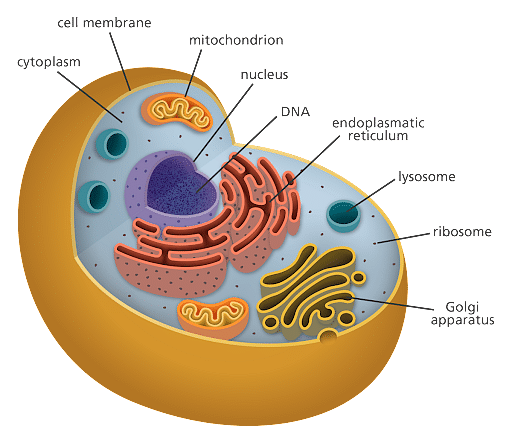
Based on the existence of the nucleus, the cell is divided into two parts:
1) A prokaryotic cell
A prokaryotic cell contains a nucleus and is present in only single-cellular organisms. Such as a bacterial cell.
2) A Eukaryotic cell
A eukaryotic cell does not contain a nucleus and is generally present in two or more cellular organisms. Such as an animal and a plant cell.
Also read:
What is a Plant Cell?
[Click Here for Sample Questions]
A plant cell belongs to the eukaryotic cell category. It has a nucleus and is generally present in plants and trees. It is the same as that of an animal cell but the only difference is that it contains a chloroplast as well which helps the plants and trees to carry out the process of photosynthesis.

Different types of plant cells:
- Phloem cells,
- Xylem cells,
- Collenchyma cells,
- Sclerenchyma cells, and
- Parenchyma cells.
What is an Animal Cell?
[Click Here for Sample Questions]
An animal cell belongs to the prokaryotic cell category. It also contains a well definite nucleus and is present in the animal or human bodies or all multicellular organisms. An animal cell comprises mitochondria, a Golgi apparatus, a cell membrane that separates the outer and inner surface of a cell. All of the cell components are present in a fluid called cytoplasm.

Different types of animal cells:
- Skin cells,
- Muscle cells,
- Brain cells,
- Blood cells,
- Nerve cells, and
- Fat cells.
Also read:
What is a Bacterial Cell?
[Click Here for Sample Questions]
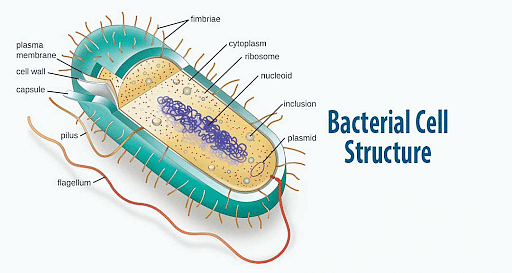
A bacterial cell belongs to the prokaryotic cell category. It does not have a nucleus and is present in single-cellular organisms. Despite a nucleus, it contains an irregular-shaped area where all the components of the cell are present.
Different types of bacterial cells:
- Rod cells,
- Spherical cells,
- Spiral cells,
- Comma cells, and
- Cochlear cells.
Also read: What are Living Organisms Made Up Of?
Difference between a Plant, Animal, and Bacterial Cell
[Click Here for Sample Questions]
| Points of differences | Plant cells | Animal cells | Bacterial cells |
| Type of Cell | Eukaryotic cells | Eukaryotic cells | Prokaryotic cells |
| Size of the cell | 10 to 100 µm | 10 to 100 µm | 0.2 to 2 µm |
| The shape of the cell | Rectangular shaped | Round or Oval shaped | Are of different shapes- cocci, bacillus, vibrio, spirilla. |
| Cell Wall | Present | Absent | Present |
| Nucleus | Present | Present | Absent |
| Plasmids | Absent | Absent | Present |
| Plastids | Present | Absent | Absent |
| Mitochondria | Present | Present | Absent |
| Ribosomes | Larger 80s Ribosomes | Larger 80s Ribosomes | Smaller 70s Ribosomes |
| Centrioles | Absent | Present | Absent |
Related Links:
Things to Remember
[Click Here for Sample Questions]
- A cell is the building block of every living organism.
- Cell repair themselves on their own.
- It is divided into two types based on the nucleus presence: 1) prokaryotic and 2) eukaryotic.
- Prokaryotic cells lack a nucleus. For example a bacterial cell.
- Eukaryotic cells have a defined nucleus. For example an animal and a plant cell.
- A plant cell contains a chloroplast to perform photosynthesis however an animal cell lack it.
- A bacterial cell can be of any shape, whereas a plant cell is rectangular and an animal cell is oval or spherical.
- A plant cell and a bacterial cell contain a well-defined cell wall were an animal cell does not in which the cell membrane does the task of a cell wall as well.
Sample Questions
Ques: What is a cell? (Marks 3)
Ans: A cell is the most essential unit of every living organism. It contains different components which work together to help an organism work smoothly. A cell is surrounded by membranous organelles, which take part in different identical activities to keep the cell alive and in a working state.
Ques: What are the different types of cells? Discuss. (Marks 4)
Ans: Based on the existence of a nucleus, a cell is divided into two types:
- Prokaryotic cell
It does not have a nucleus and is present in single-cellular organisms only. It consists of an irregular surface that suspends all the components present in it. For example a bacterial cell.
- Eukaryotic cell
It consists of a well-defined nucleus and is present in multicellular organisms. It contains a fluid called cytoplasm which sticks all the components together. For example a plant cell and an animal cell.
Ques: What are plant cells? State its types. (Marks 4)
Ans: A Plant cell is a eukaryotic cell and has a well-defined nucleus. It has a rectangular shape, contains a cell membrane and a cell wall to prevent it from outside disturbances. It also contains a chloroplast which helps it during its food formation process i.e. photosynthesis.
Different types of plant cells:
- Xylem,
- Phloem,
- Sclerenchyma,
- Parenchyma, and
- Collenchyma.
Ques: What are Animal cells? State its types. (Marks 4)
Ans: An animal cell is a eukaryotic cell and has a well-defined nucleus just like a plant cell. It contains an oval or spherical shape, a cell membrane but lacks a cell wall. Unlike a plant cell, it does not have a chloroplast.
Different types:
- Blood,
- Skin,
- Muscle,
- Fat, and
- Nerve cell.
Ques: What are bacterial cells? State its types. (Marks 4)
Ans: A bacterial cell is a prokaryotic cell and does not contain a nucleus. It is present in single-cellular organisms such as bacteria. It does not have a definite shape, is very small in size, and no almost no lysosomes.
Different types:
- Spherical,
- Rod,
- Spiral,
- Comma, and
- Cochlear.
Ques: State any five differences between a plant, animal, and bacterial cell. (Marks 5)
Ans: Difference between a plant, animal and a bacterial cell is as follows:
Characteristics Plant cell Animal cell Bacterial cell
Type Eukaryotic Eukaryotic Prokaryotic
Size 10-100 mm 10-20 mm 0.5- 5.0 mm
Nucleus Present Present Absent
Respiration medium Aerobic Aerobic Both aerobic and anaerobic
Reproduction medium Both sexual and asexual Mostly sexual Asexual and sexual both.
Cell wall Present Absent Present
Ques: What are the similarities between a plant cell and an animal cell? (Marks 3)
Ans: Both the plant cell and animal cell belong to the category of the eukaryotic cell. They both have a destined nucleus, the same respiration mediums, mitochondria as the powerhouse of the cell. Both of them have cell membranes to protect the cell from any outside disturbances.
Also read:



Comments