



Content Curator
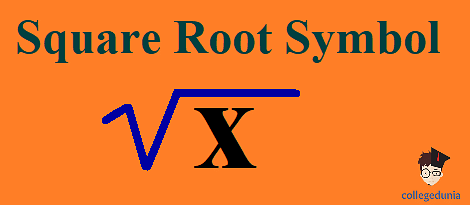
The mathematical symbol '√' represents the square root symbol or square root sign of a number.
- This symbol is also known as radical, and a number present inside it is known as a radicand.
- For example, the square root of 4 is represented by √4.
- In the above example, the number 4 under the square root symbol is known as radicand.
| Table of Content |
Key Terms: Square, Square root, Radicals, Radicand, Repeated subtraction, Prime factorization, Square root symbols
Square Root Symbol
[Click Here for Sample Questions]
The symbol for the square root is shown below


What is Square Root?
[Click Here for Sample Questions]
Consider a number ‘9’. We can obtain this number by multiplying 3 by 3 i.e. 3 x 3 = 9.
- Now if we put a square root symbol in front of 9, then we read it as the square root of 9.
- It can be written as √9.
- The value of the square root of 9 can be written as √9 = √(3 x 3) = 3.
Therefore, we can say
| A square root symbol (√) is a symbol used for a number that gives the original number when the given number is multiplied by itself. |
In the above example
- 3 is the original number, and when this number is multiplied by itself i.e. (3 x 3), gives 9.
- Now taking the square root of 9, we get the original number i.e. 3.
Square Root Formula
[Click Here for Sample Questions]
The formula to find the square root is given by
| y = √a or y2 = a |
Method of Finding Square Root of a Number
[Click Here for Sample Questions]
There are various methods used to find the square root of a number. Some of them are
- Prime factorization method
-
Repeated subtraction method
Prime Factorization Method
The method of finding the square root using the prime factorization method can be understood by considering the example given below.
| Example: Find the square root of 400 using the prime factorization method. Step 1: Taking the prime factorization of the number Prime Factorization of 400 = 2 x 2 x 2 x 2 x 5 x 5 Therefore, the square root of 400 is given as √400 = √(2 x 2 x 2 x 2 x 5 x 5) Step 2: Selecting the numbers that are in pairs In the above expression, there are 3 pairs i.e. 2 pairs of 2 and 1 pair of 5. Step 3: Take out the numbers in pairs out of the square root symbol By taking out the numbers in pairs, we get √400 = 2 x 2 x 5 Step 4: Multiplying the numbers obtained in step 3 with each other gives the required result. We have, 2 x 2 x 5 = 20 ⇒ √400 = 20 Hence, the square root of 400 is 20. We can recheck the above result by taking the square of 20. 202 = 20 x 20 = 400 |
Repeated Subtraction Method
In this method,
- The given number is subtracted from the first odd number (i.e. 1)
- The obtained result is then subtracted by the second odd number (i.e. 3).
- Again the result obtained from this is subtracted by the third odd number (i.e. 5).
- This process continues until we get the final result as zero.
- The number of steps taken to reach the final result as zero gives the square root of the given number.
Consider the example below to better understand the concept
| Example: Find the square root of 81 by repeated subtraction method. Step 1: 81 – 1 = 80 Step 2: 80 – 3 = 77 Step 3: 77 – 5 = 72 Step 4: 72 – 7 = 65 Step 5: 65 – 9 = 56 Step 6: 56 – 11 = 45 Step 7: 45 – 13 = 32 Step 8: 32 – 15 = 17 Step 9: 17 – 17 = 0 Since we get 0 in Step 9, therefore the square root of 81 is 9. |
List of Square Roots
[Click Here for Sample Questions]
Given below is a list of square roots of the first 20 natural numbers.
| Number | Square Root |
|---|---|
| 1 | 1.000 |
| 2 | 1.414 |
| 3 | 1.732 |
| 4 | 2.000 |
| 5 | 2.236 |
| 6 | 2.449 |
| 7 | 2.646 |
| 8 | 2.828 |
| 9 | 3.000 |
| 10 | 3.162 |
| 11 | 3.317 |
| 12 | 3.464 |
| 13 | 3.606 |
| 14 | 3.742 |
| 15 | 3.873 |
| 16 | 4 |
| 17 | 4.123 |
| 18 | 4.243 |
| 19 | 4.359 |
| 20 | 4.472 |
Solved ExamplesQues. Find the square root of 64 by repeated subtraction method. Ans. The steps to find the square root of 81 using the repeated subtraction method are given below Step 1: 64 – 1 = 63 Step 2: 63 – 3 = 60 Step 3: 60 – 5 = 55 Step 4: 55 – 7 = 48 Step 5: 48 – 9 = 39 Step 6: 39 – 11 = 28 Step 7: 28 – 13 = 15 Step 8: 15 – 15 = 0 Since we get 0 in Step 8, therefore the square root of 64 is 8. Ques. Find the square root of 225 using the prime factorization method. Ans. The steps to find the square root of 225 using the prime factorization method are given below Step 1: Taking the prime factorization of the number Prime Factorization of 225 = 3 x 3 x 5 x 5 Therefore, the square root of 225 is given as √225 = √(3 x 3 x 5 x 5) Step 2: Selecting the numbers that are in pairs In the above expression, there are 2 pairs i.e. 1 pair of 3 and 1 pair of 5. Step 3: Take out the numbers in pairs out of the square root symbol By taking out the numbers in pairs, we get √225 = 3 x 5 Step 4: Multiplying the numbers obtained in step 3 with each other gives the required result. We have, 3 x 5 = 15 ⇒ √225 = 15 Hence, the square root of 225 is 15. |
Things to remember
- A square root is a symbol used for a number that gives the original number when the given number is multiplied by itself.
- The root symbol (√) represents the square root of any integer.
- The symbol of the square root is referred to as radical.
- The number inside the square root is known as radicand.
- If a natural number is a square number, it must be the sum of successive odd integers beginning with 1.
Also Read:
Sample questions
Ques. What is a radical symbol? (1 Mark)
Ans. In mathematics, the radical symbol, radical sign, root symbol, radix, or surd represents the square root or higher-order root of an integer.
Ques. What is the symbol of the square root? (1 Mark)
Ans. A square root is represented by the symbol “√”.
Ques. What is radicand? (1 Mark)
Ans. The integer under the square root symbol is known as radicand.
Ques. What is the square root of 16? (2 Marks)
Ans. Since, 4² =16
A square of 16 will be 4
Ques. What is the square root of 49? (2 Marks)
Ans. Since, 7² = 49
The square root of 49 will be 7.
Ques. Find the square root of 729 with the help of the factorization method. (2 Marks)
Ans. 729 = 3 × 3 × 3 × 3 × 3 × 3 × 1
729 = (3 × 3) × (3 × 3) × (3 × 3)
729 = (3 × 3 × 3) × (3 × 3 × 3)
729 = (3 × 3 × 3)²
Thus, √729 = 3 × 3 × 3 = 27
Ques. Find the square root of 100 with the help of the method of repeated subtraction. (2 Marks)
Ans. 100 – 1 = 99
99 – 3 = 96
96 – 5 = 91
91 – 7 = 84
84 – 9 = 75
75 – 11 = 64
64 – 13 = 51
51 – 15 = 36
36 – 17 = 19
19 – 19 = 0
Since the subtraction has been performed ten times,
therefore, √100 = 10
Ques. Find the smallest whole number that should be multiplied with 1008, to get a perfect square. (2 Marks)
Ans. Prime factorization of 1008 is;
1008 = 2 × 2 × 2 × 2 × 3 × 3 × 7
= (2 × 2) × (2 × 2) × (3 × 3) × 7
Here, 7 is left unpaired
Therefore, 1008 will be multiplied by 7 to get a perfect square.
The new number will be 1008 × 7 = 7056
Ques. What is the square root of 42.25? (2 Marks)
Ans. The square root of √42.25 = 6.5
Ques. Find out the least number by which 2800 should be divided in order to get a perfect square. (2 Marks)
Ans. Prime factorization of 2800 is;
2800 = 2 × 2 × 2 × 2 × 5 × 5 × 7
= (2 × 2) × (2 × 2) × (5 × 5) × 7
Here, 7 is left unpaired.
Therefore, 2800 will be divided by 7 to get a perfect square.
The new number obtained will be 2800 ÷ 7 = 400
Ques. Find the square root of 144 by repeated subtraction method. (5 Marks)
Ans. The steps to find the square root of 81 using the repeated subtraction method are given below
Step 1: 144 – 1 = 143
Step 2: 143 – 3 = 140
Step 3: 140 – 5 = 135
Step 4: 135 – 7 = 128
Step 5: 128 – 9 = 119
Step 6: 119 – 11 = 108
Step 7: 108 – 13 = 95
Step 8: 95 – 15 = 80
Step 9: 80 – 17 = 63
Step 10: 63 – 19 = 44
Step 11: 44 – 21 = 23
Step 12: 23 – 23 = 0
Since we get 0 in Step 12, therefore the square root of 144 is 12.
Ques. Find the square root of 256 using the prime factorization method. (5 Marks)
Ans. The steps to find the square root of 256 using the prime factorization method are given below
Prime Factorization of 256 = 2 x 2 x 2 x 2 x 2 x 2 x 2 x 2
Therefore, the square root of 256 is given as
√256 = √(2 x 2 x 2 x 2 x 2 x 2 x 2 x 2)
In the above expression, there are 4 pairs of 2.
By taking out the numbers in pairs, we get
√256 = 2 x 2 x 2 x 2
⇒ √256 = 16
Hence, the square root of 256 is 156.
For Latest Updates on Upcoming Board Exams, Click Here: https://t.me/class_10_12_board_updates
Check-Out:



Comments