



Education Journalist | Study Abroad Lead
Square root of a number is basically that the factor of a number after multiplying by itself gives the original number. Decimal numbers consist of two parts one of them is the integer part and the other one is the fraction part, both of these parts are separated by a decimal point (.) from each other. For example, for the number \(\sqrt{81}\) it could be written as 9 9, so here \(\sqrt{81}\) is 9.
- The symbol for denoting square root is \(\sqrt {}\).
- This is just the opposite form of squaring a number.
- If \(\sqrt{a}\) = b, the a will be called the radicant.
| Table of Content |
Key Terms: Decimal Numbers Whole Number, Fraction, Square Root, Estimation method, Long division method.
What is Square root of a Decimal Number?
[Click Here for Sample Questions]
Square root of a decimal number is nothing different than the square root of any other number. It is the factor multiplication of the same number.
- Square root of a decimal number is the number with a power value of ½.
- For example, the square root of 24.01 = (4.9)2
- As such decimal numbers can consist of a large number of digits so to simplify the calculation fewer calculation methods have been developed.
Read More: Binary Division
Methods of Finding the Square Root of a Decimal Number
[Click Here for Sample Questions]
Finding the square root of a large decimal number can be described by two methods –
- Estimation Method: In this method the square root of a decimal number is estimated or guessed by approximating the closest whole square numbers. This is an approximation method used for finding the square root of fractional decimal numbers–
For example, to find out the square root of the decimal number 31.36–
Step 1: At first finding out the nearest whole square numbers would be necessary to approximate accurately. Here, the nearest whole square numbers of 31.36 will be 25 = (5)2 so, \(\sqrt{25}\) = 5 and 36 = (6)2 so, \(\sqrt{36}\) = 6.
Step 2: As 31.36 lies between squares of 5 and 6, then the square root of 31.36 will be somewhere between 5 and 6.
Step 3: To determine if the square root of 31.36 is closer to 5 or 6, two numbers 5.5 and 6 are considered further.
Step 4: Obtaining square roots of 5.5 and 6 the results will be– (5.5)2 = 30.25 and (6)2 = 36 and from here, conclusion can be drawn that the square root of 31.36 is closer to 5.5.
- Long Division Method: This is a very useful method for determining square roots of large decimal numbers which can not be determined very easily. Dividing any number into sequences and then applying this method to calculate the square root value is very convenient.
For example, to calculate the square root of 2.56–
Step 1: Dividing the number into two portions; first one the number on the left side of decimal point 2 and the other one is the right side of decimal point 0.56. Now, bar signs are put on each of the number pairs.
Step 2: Now, divide the whole number part by the biggest number whose square is less than or equal to that number. As here, the whole number is 2 so, 1 x 1 = 1, remainder will be 1.
Step 3: In this step the fractional part of the number needs to be brought down beside the remainder 1.
Step 4: Now, after adding the remainder’s final last digit to the divisor; 1+1 = 2. An appropriate number to the right of the obtained sum 2 combined with the result of the sum, produces a new divisor for the new dividend which is then written down. A decimal after 1 also to be added after a fractional section of the quotient.
Step 5: Now, the new quotient number is the same as the divisor number; for here, the divisor is now 26 and the quotient is 1.6 as 26 x 6 = 156.
Step 6: Adding zeros in remainder will be continued up to the remainder is 0 and no number is left.
Step 7: Here, the square root of 2.56 is 1.6.
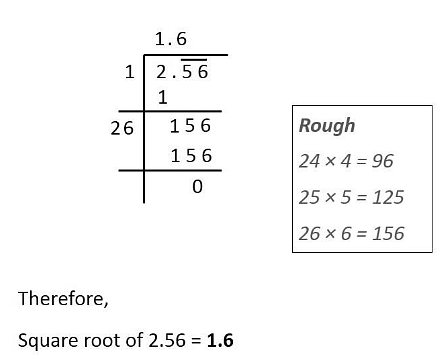
Methods of Finding the Square Root of a Decimal Number
Read More: Quadratic Equation Formula
Solved Examples
[Click Here for Sample Questions]
Example 1: Determine the square root of decimal number 17.64 by estimation method.
Solution: Step 1: The perfect square numbers closest to 17.64 are 16 and 25.
Step 2: \(\sqrt{16}\) = 4, \(\sqrt{25}\) = 5. This means that \(\sqrt{17.64}\) falls between 4 and 5.
Step 3: To check if \(\sqrt{17.64}\) is closer to 4 or 5. Consider the numbers 4.5 and 5.
Step 4: 4.52 = 20.25, 42 = 16 and 52 = 25. As a result, 17.64 falls between 4 and 4.5 and is closer to 4.
As a result, the square root of \(\sqrt{17.64}\) is closer to 4.We can look at 4.1 and 4.2. 4.12 = 16.81 and 4.22 = 17.64.
The square root of 17.64 is 4.2.
Example 2: Find the square root of this decimal number 84.64.
Solution: Step 1: The decimal number is to be written and the integer and fractional portions to be separated. The integer component of a decimal number is created from right to left, whereas the fractional part is generated from the beginning of the decimal point.
As a result, in the decimal value 84.64, 84 is one pair and 64 is another.
Step 2: Which number has a pair that is less than or equal to the first pair is to be determined. 9 squared equals 81 in the number 84.64. As a result, we'll write 9 in the divisor and 9 in the quotient.
Step 3: Now, the deduction of 81 from 84. The correct answer is 3. Then the other pair to be brought down, which is 64, and place the decimal point after 9.
Step 4: Now, increasing the divisor by 2. Because 9 divided by 2 equals 18, putting 18 _ underneath the divisor. Determination of the third digit of the integer is possible so that it is totally divisible by 364.The numerals 18 and 19 are already available. The third digit should be 2 since 182 multiplied by 2 is 364.
Step 5: After the decimal point, 2 in the quotient's place is to be written . As a result, the answer is 9.2.
Also Read:
Things to Remember
- Decimal numbers consist of two parts one of them is the integer part and the other one is the fraction part.
- The symbol for denoting square root is .
- This is just the opposite form of squaring a number.
- Square root is the factor multiplication of the same number.
- Square root of a decimal number is the factor multiplication of the same number in decimal form.
- In the estimation method the square root of a decimal number is estimated or guessed by approximating the closest whole square numbers.
- Long Division is a very useful method for determining square roots of large decimal numbers which can not be determined very easily.
Sample Questions
Ques: What Is the Square Root of Decimals in Math? (2 Marks)
Ans: The square root of a decimal number is the value of a decimal number raised to the power of half. The square root of 12.25, for example, is 3.5 since (3.5)2 = 12.25. It is computed using both estimates and the long division approach. Using the long division approach, it is simple to get the precise square root of any given integer.
Ques: What are Square Roots? (2 Marks)
Ans: A number's square root is the value that, when multiplied by itself, yields the original number. For example, the square root of 64 is 8 since multiplying 8 by itself yields 64. √64 = 8 is how it is written.
Ques: What is the Square Root Symbol? (2 Marks)
Ans: The symbol used to represent the square root of a number is. It is often referred to as the radical symbol. The radicand is the number included within the radical symbol. In √81 = 9, for example, the radicand is 81 and the square root is 9.
Ques: How to Find the Square Root of a Decimal Number by Division Method? (2 Marks)
Ans: The long division method may be used to get the square root of a decimal integer. In this situation, we construct pairs of whole numbers and fractional portions and then repeat the long division operation.
Ques: How to Find the Square Root of Non Perfect Squares? (2 Marks)
Ans: The division technique is the simplest approach to get the square root of a non-perfect square. It displays the value as decimals, which can be rounded off as needed.
Ques: What are the Applications of the Square Root of Decimals? (2 Marks)
Ans: The square root of a decimal has several applications. Algebra and geometry use it. It aids in the solution of quadratic equations. Make it simple to calculate area, volume, and other measures.
Ques: How To Find Square Root of Decimals by Estimation? (2 Marks)
Ans: To estimate the square root of a decimal, seek for perfect square values that are near to the provided decimal integers. Find their square roots to get a rough estimate of the square root of the provided decimal integer. The square root of 11.56, for example, is 3.4.
Step 1: The number √11.56 is close to the perfect squares of 9 and 16.
Step 2:√ 9 equals 3 and √16 equals 4.
Step 3: Find 3.52. 3.52 = 12.25. This means that √11 is between 3 and 3.5.
Ques: Solve \(\sqrt{0.64}\). (2 Marks)
Ans: Removing the decimal point and writing 0.64 as a fraction, as seen below:
0.64 = 64/100
Now, taking the square root of the numerator and the denominator separately:
\(\sqrt{0.64}\) = \(\sqrt{64} / \sqrt{100}\)
64 is equal to 8 .8 and 100 is equal to 10 . 10. The resulting fraction will be:
8/10 = 0.8
For Latest Updates on Upcoming Board Exams, Click Here: https://t.me/class_10_12_board_updates
Check-Out:



Comments