




MSBSHSE Class 10 2027 is the Secondary School Certificate (SSC) exam of the Maharashtra State Board of Secondary and Higher Secondary Education, Pune. The Maharashtra SSC 2027 exam is conducted for over 15 lakh Class 10 students through nine divisional boards across the state. The Maharashtra SSC exam date 2027 was announced on 17 September 2026 and all notices are posted on the official website mahahsscboard.in.
- The Maharashtra SSC 2027 theory exams will be held from 15 February to 11 March 11 2027 while practical and oral exams will be from 28 January to 13 February.
- Schools must register regular students for Maharashtra SSC 2027 on the SARAL portal, by 31 October 2026.
- The Maharashtra SSC exam pattern 2027 has six compulsory subjects of 100 marks each with 80 written marks and 20 for internal or oral assessment.
- Maharashtra SSC passing marks 2027 are 35 out of 100 in each subject and the final percentage is calculated on the best five subjects.
- The SSC result date 2027 is expected in the first or second week of May. The 2026 Maharashtra SSC result was declared on May 8, 2026.
- The Maharashtra SSC result 2026 recorded a 92.09% pass percentage for regular students with Konkan division on top at 97.62%.
- MSBSHSE has waived the SSC 2027 exam fee for Class 10 students from 265 drought-hit talukas, which cover about 74% of Maharashtra.
- The Maharashtra Board's new syllabus does not apply to the 2027 batch as Class 10 moves to the NEP aligned curriculum only in 2028-29.
Related Articles:
- Maharashtra SSC Exam Pattern 2027: Marking Scheme, Question Paper Pattern and Total Marks
- Maharashtra Board Class 10 Syllabus 2027: Subject-Wise Topics, PDF Download and Marking Scheme
Key Summary
- Regular Maharashtra SSC 2027 students need 75% attendance in Class 10 which the Divisional Board Chairman can relax to 60% on medical grounds.
- Late Maharashtra SSC registration 2027 forms are accepted until November 30, 2026 with an extra charge of ₹50 per student per day from November 16.
- The Maharashtra SSC admit card 2027 is expected in January and will reach students through schools with the school seal and principal's signature.
- The Maharashtra SSC 2027 grading system awards Distinction at 75%, First Division from 60% and Second Division from 45%.
- Students who fail can reappear in the Maharashtra SSC supplementary exam 2027 in June as the 2026 supplementary papers ran from June 16 to 30.
MSBSHSE Class 10 2027 Overview: Key Highlights
MSBSHSE conducts the Maharashtra SSC board exam once a year in February–March and a supplementary round follows in June–July. The key facts of the Maharashtra SSC 2027 cycle are given below.
| Particulars | Details |
|---|---|
| Conducting Body | Maharashtra State Board of Secondary and Higher Secondary Education (MSBSHSE) |
| Exam Name | Secondary School Certificate (SSC) Examination 2027 / Maharashtra Board Class 10 |
| Academic Year | 2026–27 |
| Official Website | mahahsscboard.in |
| Result Website | mahresult.nic.in |
| Mode of Exam | Offline (Pen and Paper) |
| Exam Duration | 3 hours per paper |
| Exam Shifts | Morning: 11:00 AM – 2:00 PMAfternoon: 3:00 PM – 6:00 PM |
| Practical / Oral / Internal Assessment | January 28 to February 13, 2027 |
| Theory Exam Dates | February 15 to March 11, 2027 |
| Admit Card | Expected in January 2027 (issued through schools) |
| Result Declaration | Expected in May–June 2027 |
| Compulsory Subjects | First Language (Marathi/Hindi/Urdu/etc.), English, Second/Third Language, Mathematics, Science & Technology, Social Science |
| Marks Structure | 100 marks per subject (generally 80 theory + 20 internal/practical/oral) |
| Minimum Passing Marks | 35 out of 100 in each subject (35%) |
| Negative Marking | None |
| Percentage Calculation | Best of 5 subjects |
| Medium of Instruction | Marathi, English, Semi-English, Hindi, Urdu, and other regional languages |
| Syllabus Basis | Balbharati textbooks |
| Number of Divisional Boards | 9 (Pune, Mumbai, Nagpur, Chhatrapati Sambhajinagar, Kolhapur, Amravati, Nashik, Latur, Konkan) |
Also Check:
- Maharashtra Board Class 10 Question Paper 2026 with Solution PDF
- Maharashtra Board Class 10 Question Paper 2025 With Solutions PDF
Ques. What is the full form of MSBSHSE?
Ans. MSBSHSE stands for Maharashtra State Board of Secondary and Higher Secondary Education. The Pune-based board conducts the SSC (Class 10) and HSC (Class 12) exams across Maharashtra.
Ques. What is the official website for MSBSHSE Class 10 2027?
Ans. The official website is mahahsscboard.in, where the board posts notices, timetables and forms. Results open on separate portals, sscresult.mahahsscboard.in and mahresult.nic.in, and digital marksheets reach DigiLocker.
Maharashtra SSC Exam Date 2027
Maharashtra SSC Exam Date 2027 schedule was announced on September 17 while MSBSHSE waived exam fees for Class 10 students from 265 drought hit talukas.
- The fee waiver covers around 74% of Maharashtra for the February–March 2027 SSC exams, following the September 25 GR.
- MSBSHSE Secretary Dr Deepak Mali announced the Maharashtra SSC 2027 schedule early to help schools and over 15 lakh students plan their preparation.
| Event | Dates | Status |
|---|---|---|
| Practical, Oral, Graded & Internal Assessment | January 28 to February 13, 2027 | Upcoming |
| Theory / Written Examination | February 15 to March 11, 2027 | Upcoming |
| Admit Card Release | Expected in January 2027 | Upcoming |
| Detailed Subject-wise Time Table | Expected in October–November 2026 | To be released |
| Result Declaration | Expected in May–June 2027 | Upcoming |
| Official Website | mahahsscboard.in | Active |
You can watch the YouTube video "Maharashtra Board 2027 Exam Dates OUT 🔥 SSC & HSC Timetable Update" by All About Chemistry (Sovind Sir) for the full schedule. The video explains the SSC and HSC theory and practical windows announced by the board.
Also Check:
- Maharashtra SSC Exam Dates 2027: Registration Open till 31 Oct, Timetable and Result Date
- Maharashtra SSC Practice Paper 2022 Download PDFs
Ques. When will the Maharashtra SSC exam 2027 start?
Ans. The Maharashtra SSC 2027 written exams will start on February 15, 2027, and continue until March 11, 2027, as per the MSBSHSE schedule.
Maharashtra SSC Registration 2027
MSBSHSE is accepting Maharashtra SSC Registration 2027 forms from both regular and private candidates. Schools can file regular students' forms until November 30, 2026 with late fees, whereas private candidates must submit Form No. 17 by October 31, 2026.
Maharashtra SSC Registration 2027 for Regular Students (SARAL Portal)
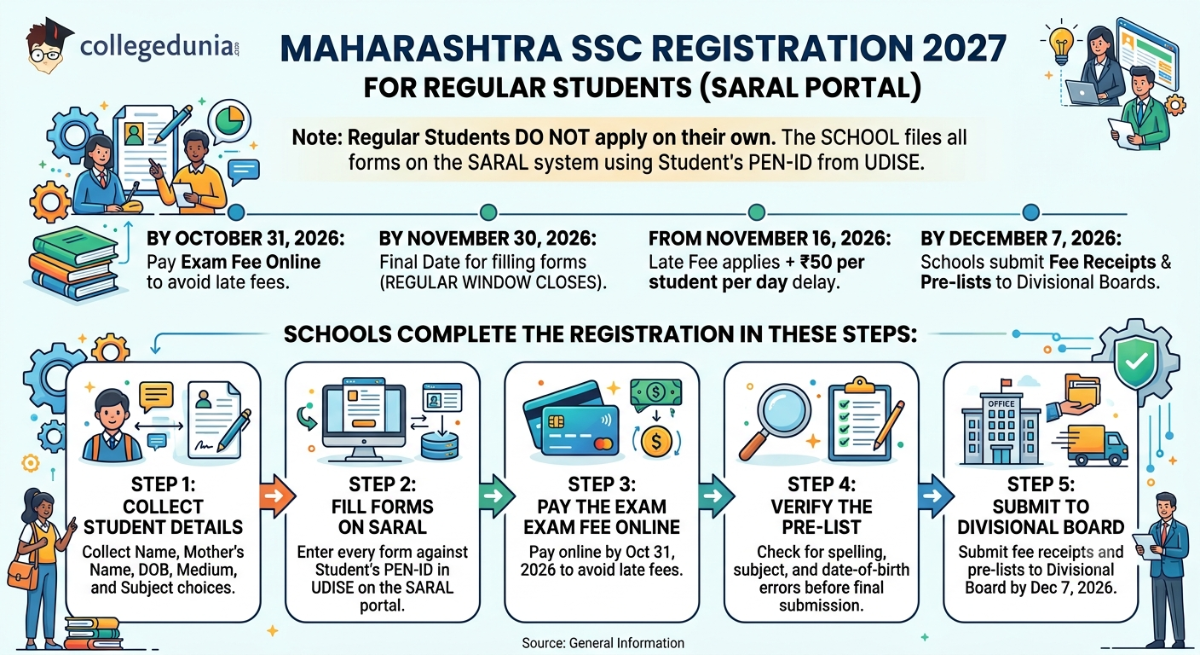
Regular students do not apply on their own for the Maharashtra SSC Registration 2027. Their school files each form on the SARAL system using the student's PEN-ID from UDISE.
- Missing the Maharashtra SSC registration 2027 cutoff adds a late fee and from November 16 the charge grows by ₹50 per student for each day of delay.
- November 30, 2026 is the final date for Maharashtra board 10th forms while schools must hand fee receipts and pre-lists to divisional boards by December 7.
- Schools complete the Maharashtra SSC registration 2027 for regular students in the steps listed below:
- Step 1: Collect Student Details:
The school must collect each student's name, mother's name, date of birth, medium and subject choices.
- Step 2: Fill Forms on SARAL:
The school has to enter every form on the SARAL portal against the student's PEN-ID in UDISE.
- Step 3: Pay the Exam Fee Online:
The school needs to pay the fee for all forms online by October 31, 2026 to stay in the regular fee window.
- Step 4: Verify the Pre-List:
Schools should check the student pre-list for spelling, subject and date-of-birth errors before final submission.
- Step 5: Submit to the Divisional Board:
The school must hand the fee receipt and pre-list to its divisional board by December 7, 2026.
| Fee Window | Form Filling Dates | Extra Charge |
|---|---|---|
| Regular Fee | August 14 to October 31, 2026 | Nil |
| Late Fee | November 1 to November 15, 2026 | Late fee applies |
| Extra Late Fee | November 16 to November 30, 2026 | ₹50 per student per day |
Ques. What is the last date for Maharashtra SSC Registration 2027?
Ans. The last date with the regular fee is October 31, 2026. Forms are accepted with a late fee until November 15, and with an extra ₹50 per day until November 30, 2026.
Ques. How can a regular student confirm the Maharashtra SSC registration 2027 is complete?
Ans. The student should ask the school for a copy of the submitted form and check the name, mother's name and subjects on it. Errors should be reported before the school sends its pre-list to the divisional board by December 7, 2026.
Maharashtra SSC Registration 2027 for Private Candidates (Form 17)
Private candidates for SSC exam 2027 apply through Form No. 17 in the Student Corner of mahahsscboard.in. The form is filed online and the documents are uploaded as PDF files.
- The Form 17 regular fee window closed on September 30 so private candidates applying in October pay a late or super late charge.
| Fee Window | Form Filling Dates | Extra Charge |
|---|---|---|
| Regular Fee | August 1 to September 30, 2026 | Nil |
| Late Fee | October 1 to October 15, 2026 | ₹100 |
| Extra Late Fee | October 16 to October 31, 2026 | Extra Late Fee |
Steps to Apply for Maharashtra SSC Registration 2027 Through Form 17
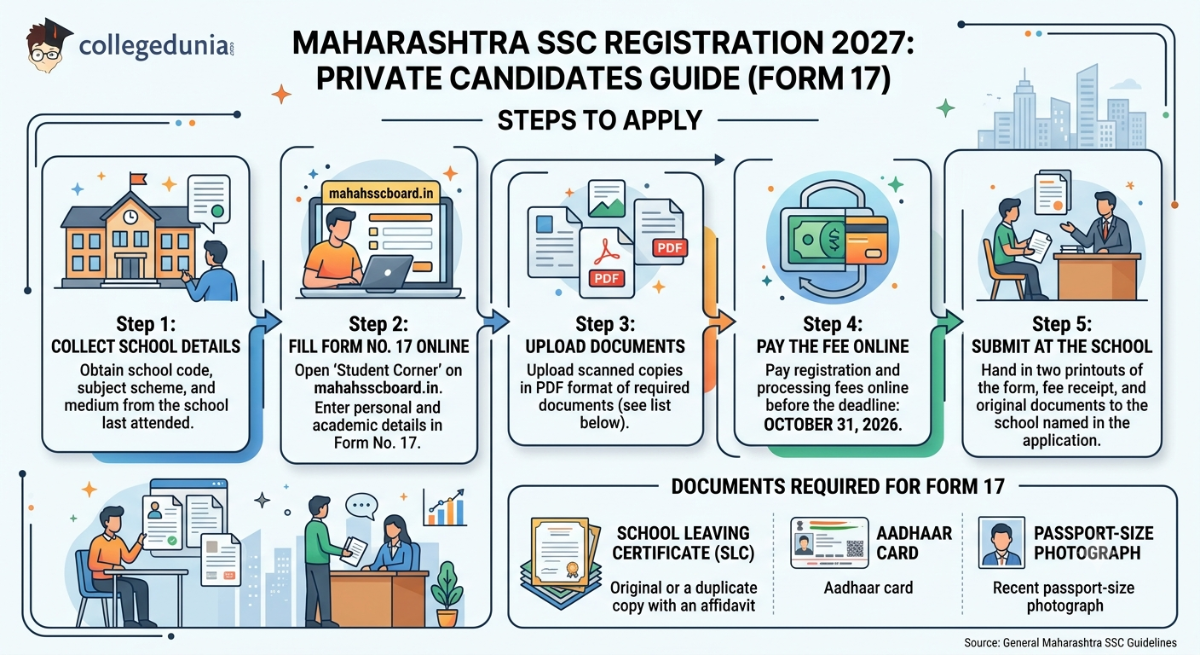
Private candidates can complete the Maharashtra SSC registration 2027 through Form 17 in the steps listed below:
- Step 1: Collect School Details:
Candidates need to get the school code, subject scheme and medium from the school they last attended.
- Step 2: Fill Form No. 17 Online:
Open the Student Corner on mahahsscboard.in and fill in Form No. 17 with personal and academic details.
- Step 3: Upload Documents:
Candidates have to upload the scanned documents listed below in PDF format.
- Step 4: Pay the Fee Online:
Candidates must pay the registration and processing fee online before October 31, 2026.
- Step 5: Submit at the School:
Candidates should hand two printouts of the form, the fee receipt and the original documents to the school named in the application.
Documents Required during Maharashtra SSC Registration 2027 Through Form 17
Private candidates need three documents for Form 17:
- School Leaving Certificate in original or a duplicate copy with an affidavit
- Aadhaar card
- Recent passport-size photograph
Also Check:
Ques. What is Form 17 in the Maharashtra SSC board?
Ans. Form 17 is the registration form for private candidates appearing for the Maharashtra SSC exam without regular school admission. MSBSHSE uses the Form 17 Direct Application Scheme for such candidates.
Ques. What documents are needed for Maharashtra SSC Form 17?
Ans. For SSC Form 17, candidates need documents such as the SSC marksheet, original LC/TC, SSC certificate, affidavit and domicile certificate, as applicable. The exact document list for 2027 is given in the MSBSHSE Form 17 guidelines.
MSBSHSE SSC 2027 Eligibility Criteria
MSBSHSE SSC 2027 Eligibility Criteria requires regular Class 10 students to have 75% attendance in 2026–27.
- With medical or other valid proof, the Divisional Board Chairman can relax the Maharashtra board 10th attendance rule from 75% down to 60%.
- MSBSHSE SSC 2027 Eligibility lets private and Open Schooling candidates appear through Form No. 17, without school enrolment or the 75% attendance rule.
| Criteria | Details |
|---|---|
| Educational Qualification | Must have passed Class 9 from a school affiliated to MSBSHSE |
| Enrollment (Regular Students) | Must be enrolled in Class 10 in a recognised MSBSHSE-affiliated school for the 2026–27 academic year |
| Minimum Attendance | 75% attendance required for regular students |
| Attendance Condonation | Divisional Board Chairman can approve shortage up to 15% (minimum 60%) with valid reasons (e.g., medical) |
| Private / Ex-Students |
|
| Open Schooling Candidates | Students who passed Class 5 or 8 through Maharashtra State Board of Open Schooling can register as private candidates |
| Age Limit | No minimum or maximum age limit prescribed by MSBSHSE |
| Registration Mode |
|
Also Check:
Ques. What is the eligibility for the Maharashtra SSC exam 2027?
Ans. A regular student must pass Class 9 from an MSBSHSE school, study Class 10 in 2026-27 and keep 75% attendance. Private candidates qualify through Form No. 17 after passing Class 5 or Class 8.
Ques. What happens if attendance is below 75% in the Maharashtra Board 10th year?
Ans. The student can apply to the divisional board chairman with medical or other valid proof. The board can relax the requirement by up to 15 points, down to 60% attendance.
Maharashtra SSC Exam Pattern 2027
Maharashtra SSC Exam Pattern 2027 requires 28 marks out of 80 in the written paper and 7 marks out of 20 in the internal or practical component to pass each subject.
- Maharashtra SSC 2027 Passing Marks require candidates to clear the written and internal or practical components separately.
- The SSC 2027 final percentage is calculated using the best five subjects out of six compulsory subjects as per MSBSHSE rules.
| Subject | Written Paper | Written Marks | Internal Marks | Total | Duration |
|---|---|---|---|---|---|
| First Language (Marathi / Hindi / Urdu etc.) | Single paper | 80 | 20 (Oral) | 100 | 3 hours |
| Second / Third Language (English / Hindi etc.) | Single paper | 80 | 20 (Oral) | 100 | 3 hours |
| Mathematics | Algebra (40) + Geometry (40) | 80 | 20 (Internal) | 100 | 3 hours |
| Science & Technology | Part 1 (40) + Part 2 (40) | 80 | 20 (Practical) | 100 | 3 hours |
| Social Science | History & Pol. Sc. (40) + Geography (40) | 80 | 20 (Internal) | 100 | 3 hours |
Also Check:
Ques. How many papers are there in the Maharashtra SSC exam 2027?
Ans. A student writes nine theory papers across six subjects. The three languages have one 80-mark paper each, while Mathematics, Science and Social Science have two 40-mark parts each.
Ques. Is the Maharashtra SSC board total 600 or 500 marks?
Ans. The MSBSHSE Class 10 exam carries 600 marks across six subjects of 100 marks each. The percentage on the marksheet, however, is worked out on the best five subjects, that is, out of 500.
Maharashtra SSC Syllabus 2027
Candidates can check the Maharashtra SSC Syllabus 2027 given below:
| Subject | Part / Section | Chapters / Units / Topics |
|---|---|---|
| Mathematics | Part 1 – Algebra | |
| Part 2 – Geometry | ||
| Science & Technology | Part 1 | |
| Part 2 |
| |
| Social Science | History |
|
| Political Science |
| |
| Geography |
| |
| English (Kumarbharati) | Prose, Poetry & Skills | Units cover lessons such as: Where the Mind is Without Fear, The Thief’s Story , On Wings of Courage, All the World’s a Stage, Joan of Arc, The Alchemy of Nature, Animals, Three Questions, Connecting the Dots, The Pulley, Let’s March, Science and Spirituality, Night of the Scorpion, The Night I Met Einstein, Stephen Hawking, The Will to Win, Unbeatable Super Mom – Mary Kom, The Concert, A Thing of Beauty is a Joy Forever, The Luncheon, World Heritage, The Height of the Ridiculous, The Old Man and The Sea, The Gift of the Magi + Grammar (Tenses, Clauses, Voice, Reported Speech, Modals, etc.) + Writing Skills + Oral |
| Languages (Marathi / Hindi / Others) | Prose, Poetry, Grammar & Writing | Varies by language (Marathi, Hindi Lokbharati/Lokvani, Urdu, Gujarati, Sanskrit, etc.). Includes Gady a, Padya, Grammar, Comprehension and Writing Skills |
Also Check:
Maharashtra Board New Syllabus 2027-28: Does It Affect the 2027 Batch?
No, the Maharashtra board new syllabus 2027-28 does not apply to students writing the February-March 2027 exam.
- The MSBSHSE Class 10 batch of 2027 studies Class 10 in 2026-27 and follows the existing Balbharati textbooks.
- Class 9 and Class 11 will switch to the new textbooks in 2027-28 and Maharashtra board 10th and 12th students will follow a year later in 2028-29.
| Particulars | Details |
|---|---|
| New NEP-aligned curriculum | Being prepared by MSBSHSE for Classes 9 to 12 |
| Implementation for Class 9 and Class 11 | Academic year 2027-28 |
| Implementation for Class 10 and Class 12 | Academic year 2028-29 |
| Does it affect the SSC 2027 batch? | No, the February–March 2027 exam follows the existing Balbharati syllabus |
| Academic year of the 2027 batch | 2026-27 (Class 10) |
| First SSC board exam on new syllabus | February–March 2029 |
| Textbooks for SSC 2027 | Existing Balbharati books |
Also Check:
Ques. Is the Maharashtra SSC syllabus changing for SSC exam 2027?
Ans. No, the syllabus for the 2027 exam stays the same as in 2026. Class 10 moves to the new NEP-aligned syllabus only in 2028-29, so the change first affects the 2029 board exam.
Ques. Which textbooks should Maharashtra SSC 2027 students follow?
Ans. Students should follow the current Balbharati textbooks prescribed for Std. X. Board questions, including activity-based items, are framed on these textbooks.
Maharashtra SSC Admit Card 2027
The Maharashtra SSC admit card 2027 (hall ticket) is expected in January 2027 ahead of the practical exams that begin on January 28.
How to Download Maharashtra SSC Admit Card 2027 for Regular Students
Regular students cannot download the hall ticket themselves. The school downloads it through its institute login on mahahsscboard.in and hands it over after attestation.
- Each hall ticket must carry the school seal and the principal's signature so an unsigned copy is not valid at the exam centre.
- MSBSHSE Class 10 hall tickets are released only after a school has paid the exam fee for every form it submitted.
- A step-by-step guide for schools to download the Maharashtra SSC admit card 2027 is mentioned below:
- Step 1: Visit mahahsscboard.in.
- Step 2: Open the institute login section.
- Step 3: Enter the school's user ID and password.
- Step 4: Click the SSC hall ticket link.
- Step 5: Download and print the hall tickets.
- Step 6: Stamp and sign each hall ticket before distribution.
How to Get Maharashtra SSC Admit Card 2027 for Private Candidates
- Private, isolated and repeater candidates can download the Maharashtra SSC admit card 2027 themselves unlike regular students who collect it from school.
- The hall ticket opens only for candidates who have completed Form 17 registration and paid the full fee.
- A step-by-step guide to download the Maharashtra SSC admit card 2027 for private candidates is mentioned below:
- Step 1: Visit the official website at mahahsscboard.in
- Step 2: Open the Latest Notifications or Student Corner section
- Step 3: Click the SSC 2027 hall ticket link for private / Form 17 candidates
- Step 4: Enter the Form 17 application number, date of birth and captcha
- Step 5: View the hall ticket and download it as a PDF
- Step 6: Take a clear colour printout on A4 paper and keep 2–3 extra copies
- Step 7: Check the name, photo, seat number, subjects and exam centre
- Step 8: Report any error to the divisional board immediately
- Step 9: Carry the printed hall ticket and an original photo ID to every paper
Details Mentioned on Maharashtra SSC Admit Card 2027
| Detail | Description |
|---|---|
| Board Name | Maharashtra State Board of Secondary and Higher Secondary Education (MSBSHSE) |
| Exam Name | Maharashtra SSC (Class 10) Examination 2027 |
| Student’s Full Name | As per registration / school records |
| Photograph | Passport-size colour photograph of the student |
| Signature | Student’s signature (as registered) |
| Seat Number / Roll Number | Unique exam seat number allotted by the Board |
| Registration / Application Number | Board registration number (especially important for private candidates) |
| Mother’s Name / Father’s Name | As per school / Form 17 records |
| Date of Birth | As registered with the Board |
| Gender | Male / Female / Other |
| School / Institution Name & Index Number | Name and code of the school (or “Private Candidate” for Form 17 students) |
| Medium of Examination | Marathi / English / Semi-English / Hindi / Urdu etc. |
| Subjects & Subject Codes | List of all subjects the candidate is appearing for |
| Subject-wise Exam Dates & Timings | Date, day and shift timing for each paper |
| Reporting Time | Time by which the candidate must reach the centre |
| Exam Centre Name & Full Address | Name, code and complete address of the allotted centre |
| Centre Code | Unique code of the examination centre |
| Important Instructions / Guidelines | Exam rules, prohibited items, reporting instructions, etc. |
| Board / Divisional Board Details | Logo, seal and relevant divisional board information |
Also Check:
- Maharashtra Board SSC Admit Card 2027: Expected January 2027, Hall Ticket Download and Documents to Carry
- Maharashtra Board Class 10 English Question Paper 2025 (Code N 817) Available- Download Here with Solution PDF
Ques. What happens if the Maharashtra SSC hall ticket is lost?
Ans. The school can reprint the hall ticket and mark it as Duplicate in red ink. The student should report the loss to the school well before the next paper.
Ques. What should a student do if the hall ticket has an error?
Ans. The student should report it to the school head at once. Name and date-of-birth errors are corrected online by the school, while a wrong photo is replaced with a correct one signed by the principal.
Maharashtra SSC Passing Marks 2027
Maharashtra SSC Passing Marks 2027 require 35% marks in each subject including at least 28 out of 80 in theory and 7 out of 20 in internal or practical assessment.
- Students short by 2–3 marks can receive up to 3 grace marks per subject or 6 marks for Maths and Science combined under existing MSBSHSE rules.
| Subject / Component | Theory Marks | Internal / Practical / Oral | Total Marks | Minimum Passing Marks |
|---|---|---|---|---|
| English / Marathi / Hindi / Other Languages | 80 | 20 | 100 | 35 |
| Mathematics (Algebra + Geometry) | 80 | 20 | 100 | 35 |
| Science & Technology (Part 1 + Part 2) | 80 | 20 | 100 | 35 |
| Social Science (History + Geography) | 80 | 20 | 100 | 35 |
| Overall Requirement | 28 out of 80 | 7 out of 20 | 100 | 35% in each subject |
Also Check:
- Maharashtra Board Class 10 Hindi Question Paper 2025 (Code N 817) Available- Download Here with Solution PDF
- Maharashtra Board Class 10 English 03-N-874 2024 Question Paper (Available): Download Question Paper with Answer Key And Solutions PDF
Ques. What are the Maharashtra SSC passing marks 2027?
Ans. A student needs 35 marks out of 100 in each subject, counting written and internal marks together. Anyone below 35 in even one subject is declared failed in that subject.
Maharashtra SSC 2027 Grading System
Maharashtra SSC 2027 Grading System awards Distinction at 75% or above and First Division from 60% provided the student scores 35% in every subject.
- The Maharashtra SSC result 2027 percentage is calculated on the best five subjects so the lowest scoring subject does not pull the total down.
- Maharashtra board 10th students who fall short of the next division by up to 3 marks may receive grace marks to move into that division.
| Percentage Range | Grade / Division | Remarks |
|---|---|---|
| 75% and above | Distinction (A+) | Outstanding |
| 60% – 74.99% | First Division (A) | Very Good |
| 45% – 59.99% | Second Division (B+) | Average / Good |
| 35% – 44.99% | Pass (B / C) | Pass |
| Below 35% | Fail (D / E) | Needs Improvement / Fail |
Maharashtra SSC Percentage Calculation: A Worked Example
Suppose a student scores 88 in Marathi, 79 in Hindi, 84 in English, 72 in Mathematics, 81 in Science and 69 in Social Science. A common question is how the Maharashtra SSC board turns these marks into a percentage.
Total out of 600 = 88 + 79 + 84 + 72 + 81 + 69 = 473, which is 78.83%.
Best five total = 473 − 69 (lowest subject) = 404, which gives (404 ÷ 500) × 100 = 80.80%.
Hence, the student clears every subject, and both figures fall in the Distinction band.
Also Check:
- MSBSHSE Class X Grading System 2027: Grade Band, CGPA Calculation and Percentage Equivalence
- Maharashtra Board Class 10 MATHEMATICS-ALGEBRA-71-N-913 Question Paper 2023 with Solution PDF
Ques. What percentage is Distinction in the Maharashtra Board 10th exam?
Ans. A score of 75% or above earns Distinction in the Maharashtra Board 10th exam. First Division starts at 60%, and Second Division starts at 45%.
Maharashtra SSC Result Date 2027
Maharashtra SSC Result Date 2027 is expected in the first or second week of May following the May 8, 2026 result declaration.
- With theory exams ending on March 11, 2027, the board usually takes around 50–60 days to process the results before releasing them on mahresult.nic.in.
| Event | Expected / Tentative Date |
|---|---|
| SSC Result 2027 | First / Second week of May 2027 |
| Previous Year (2026) Result | 8 May 2026 |
| Theory Exams End | 11 March 2027 |
| Official Result Website | mahresult.nic.in / mahahsscboard.in |
| Credentials Required | Seat Number + Mother’s First Name |
| Supplementary Result (expected) | July / August 2027 |
How to Check Maharashtra SSC Result 2027
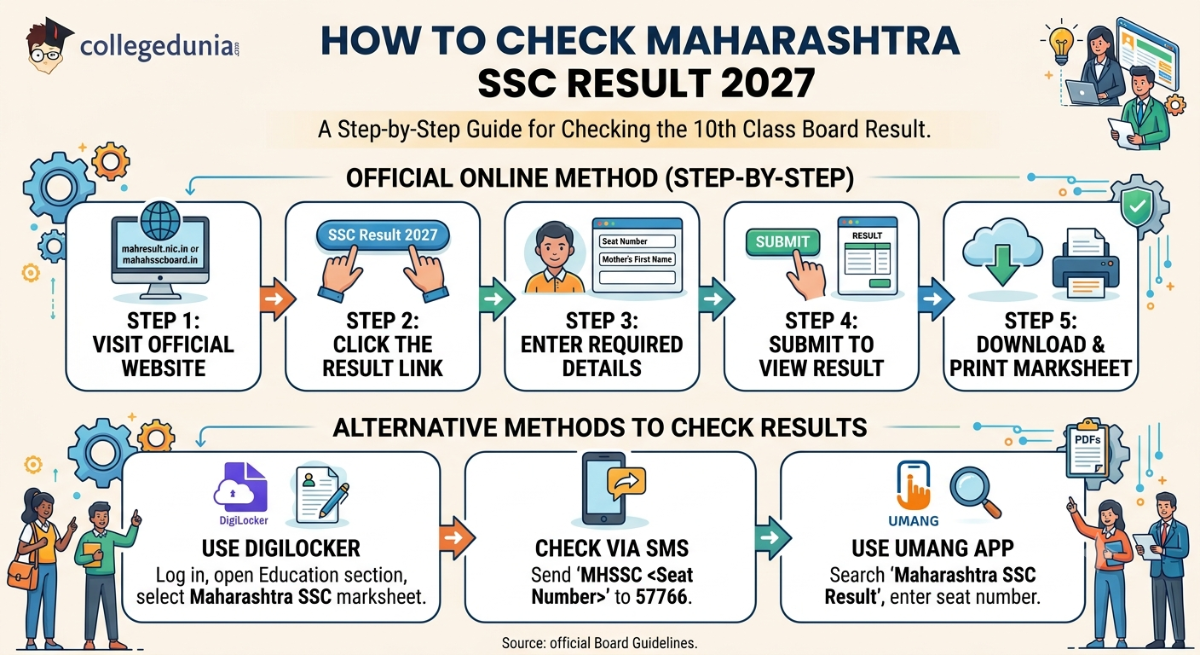
A step-by-step guide to check the Maharashtra SSC result 2027 is mentioned below:
- Step 1: Visit the official website at mahresult.nic.in or mahahsscboard.in
- Step 2: Click the SSC Result 2027 or Class 10 Result link on the homepage
- Step 3: Enter the seat number and mother's first name as per school records
- Step 4: Click Submit / View Result to open the marksheet on screen
- Step 5: Download the result as a PDF and take a printout for future use
The Maharashtra SSC result 2027 can also be checked through the following alternative methods:
- DigiLocker: Log in, open the Education section and select the Maharashtra SSC marksheet
- SMS: Send MHSSC <Seat Number> to 57766
- UMANG App: Search for Maharashtra SSC Result and enter the seat number
Also Check:
- MSBSHSE Class X Result 2027: Expected May, Compartment, Pass Percentage and Grading System
- Maharashtra Board Class 10 Science and Technology 72 N 300 Question Paper 2024 with Answer Key
Ques. When will the Maharashtra SSC result 2027 be declared?
Ans. The Maharashtra SSC Result 2027 date has not been officially announced. Based on the previous schedule, the result is expected in May 2027. MSBSHSE will confirm the exact date on its official website.
Maharashtra SSC Supplementary Exam 2027
Maharashtra SSC Supplementary Exam 2027 is expected in mid-to-late June based on the June 16–30, 2026 supplementary exam schedule.
- Students who fail in any number of subjects can reappear only for the failed subjects in the Maharashtra SSC Supplementary Exam 2027.
| Event | Expected / Tentative Timeline | Details |
|---|---|---|
| Main SSC Result 2027 | First / Second week of May 2027 | Prerequisite for eligibility |
| Supplementary Application Window | May – early June 2027 | Online via schools / mahahsscboard.in |
| Admit Card Release | June 2027 | Distributed by schools |
| Supplementary Exam Dates | June 2027 (likely mid-to-late June) | Based on 2026 pattern (16–30 June) |
| Supplementary Result | July 2027 | Usually 2–3 weeks after exams |
| Official Website | mahahsscboard.in | For form, timetable & updates |
Also Check:
- Maharashtra Board SSC Supplementary Exam 2027: Expected June 2027, Eligibility, Application Form and Result
- Maharashtra Board Class 10 Science and Technology 72 N 654 Question Paper 2024 with Answer Key
Ques. When is the Maharashtra SSC supplementary exam 2027?
Ans. The Maharashtra SSC 2027 supplementary exam is expected in mid-to-late June 2027. In 2026, the written papers ran from June 16 to June 30 and the result came on July 14.
Ques. Can a student who has passed take the supplementary exam to improve marks?
Ans. Yes, a student who has passed can apply under the Class Improvement Scheme. The form is filed in the same window as other supplementary applications, soon after the main result.
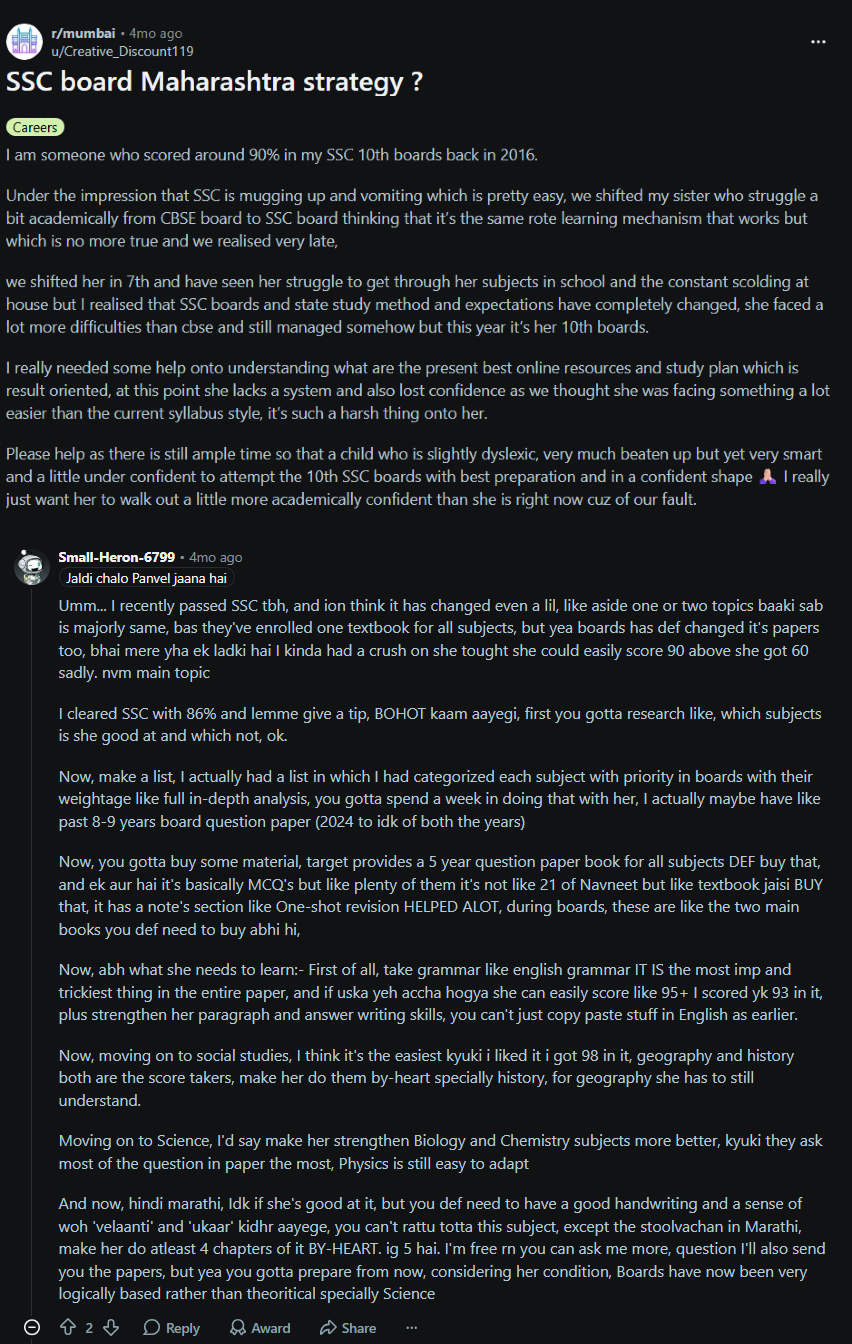
According to a Reddit discussion, previous-year question papers and one-shot revision notes were suggested for Maharashtra SSC 2027 preparation. The response recommended analysing 8–9 years of board papers to identify important topics and understand question trends. It also suggested focusing on English grammar, Social Science, Biology and Chemistry for stronger scoring.
Source: Reddit
MSBSHSE Class 10 2027 Frequently Asked Questions (FAQs)
Ques. Will there be a 10th board exam in 2027?
Ans. Yes. The Maharashtra SSC Class 10 board exam 2027 will be conducted from February 15 to March 11, 2027.
Ques. Is MSBSHSE harder than CBSE?
Ans. There is no official ranking of difficulty. MSBSHSE and CBSE follow different syllabi, exam patterns and evaluation systems, so difficulty varies by subject and student.
Ques. Is 22 out of 70 pass or fail?
Ans. 22 marks out of 70 is below 35%, so it is generally below the passing level for a 70-mark paper. The applicable subject-wise passing rules should be checked in the MSBSHSE regulations.
Ques. What is the full form of SSC board?
Ans. SSC stands for Secondary School Certificate. In Maharashtra, the SSC examination is conducted by the Maharashtra State Board of Secondary & Higher Secondary Education (MSBSHSE).
Ques. Is 40 good in 10th?
Ans. 40 marks out of 100 is a passing score but not a high score. For a stronger SSC percentage, students generally need to target substantially higher marks across subjects.
.png?h=112&w=263&mode=stretch)
.png?h=112&w=263&mode=stretch)
.jpeg?h=112&w=263&mode=stretch)
.png?h=112&w=263&mode=stretch)
.png?h=112&w=263&mode=stretch)
.png?h=112&w=263&mode=stretch)



Comments
Found 2 Comments
The Maharashtra State Board (MSBSHSE) does not offer its own dedicated online classes for Class 10 SSC board exam preparation through its main website or portals. However, the board provides digital access to exam applications, timetables, results, and notifications online on its official site.
To download Maharashtra SSC (Class 10) 10-year question papers officially, visit the MSBSHSE official website, i.e., https://www.mahahsscboard.in/en/questionPaper. Navigate to the “Examinations” or “Previous Question Papers” section, select SSC, choose the desired subject and years, and download the PDFs. These official papers help in exam preparation and practice