



Content Curator
Neurons also known as nerve cells are the fundamental part and the longest cell in vertebrates and invertebrates. These cells generate action potentials and transmit messages from different parts of the body by releasing neurotransmitters.
| Table of Content |
What are Neurons?
Neurons are fundamental and structural units of the nervous system and are electrically excitable cells which are specialised to receive and transmit information to different parts of the body.

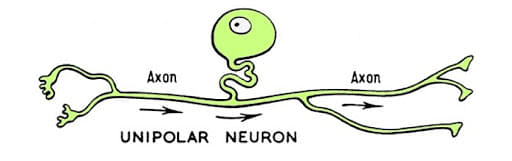
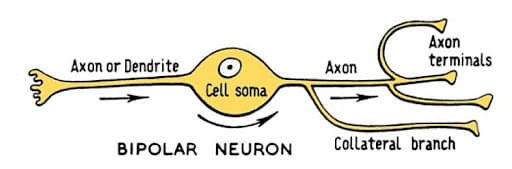
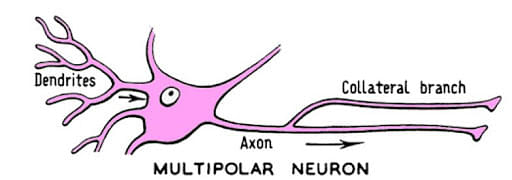
Neurons are anatomically characterised into three types based on polarity.
- Unipolar: These neurons have a single short process and are found in the embryonic stage. Processes emerge from the cell body and divide into proximal and distal branches.
- Bipolar: These neurons are found in the retina of the eye and have two processes, one axon and another one dendrite which extend from opposite ends of the cell body.
- Multipolar: These neurons are most common in nature, found in the cerebral cortex. They have one axon and two or more dendrites arise from the two opposite ends of the cell body.
Types of neurons
Neurons are classified on the basis of the direction of signal transmission into 3 parts.
- Sensory neurons: Sensory neurons' main function is to receive information from different sensory receptor cells present in different parts of the body and transmit it to the central nervous system. They are examples of afferent neurons.
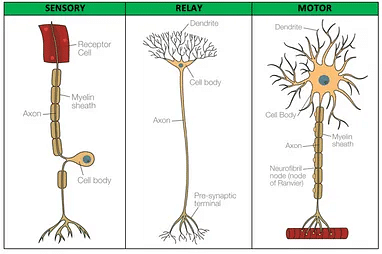
- Motor neurons: Motor neurons collect response from the central nervous system and transmit it to the muscles. They are also called efferent neurons.
- Interneurons: The interneurons’ function is to transmit information between different neurons of the body.
Basic functions of neurons
Some of the important functioning of the neurons are given below.
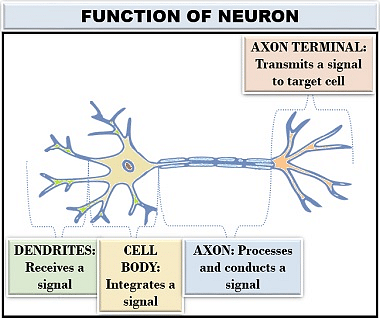
- Receive information from different parts of the body.
- Collect and Integrate all the incoming information from different receptors.
- Transmit information to required target cells or neurons or glands.
Neuron Parts and their functions
Depending upon the function and location of the neuron its shape and size varies. All neurons have three main parts- Dendrites, Cell body and Axon.
Dendrites
These branch-like extensions are at the beginning part of the neuron to help in receiving signals and transmit them to the cell body of the neuron. The number of dendrites varies from the location of the cell. They receive signals in electrical or chemical form and send them to inwards parts of the neuron.
Cell body
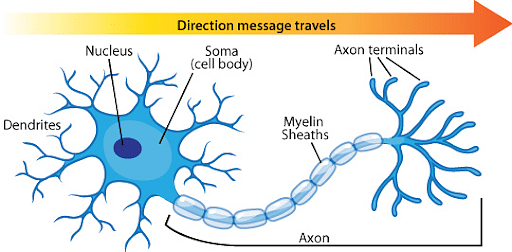
Cell body is the neuron’s core containing a cell nucleus and numerous cellular components which helps in performing different functions of the cell. It supports and maintains the functions of the cell body with a nucleus, Golgi body, endoplasmic reticulum, mitochondria and other components. The cell body is also called soma. It maintains the genetic structure, carries genetic information and provides energy to drive various activities.
Axon hillock
The position of axon hillock is found at the end of soma and it acts as a manager, summing the total inhibitory and excitatory signals. When the sum of all the signals received by dendrites exceeds a certain threshold value, the action potential is caused by changes in ion channels transmitted in the form of an electrical signal down the axon from the cell body. In a normal resting state, it possesses an internal polarization of approximately -70mV.
Axon
Axon is a tube-like structure of the neuron which conducts signals from the cell body to the synaptic knob. For faster transmission of signals, a larger diameter of the axon is required. Axons are covered by Schwann cells and it secretes myelin sheath. The broken point is called nodes of Ranvier which helps in increasing the efficiency of transmission of signals.

Terminal buttons and synapses
The location of terminal axons are at the end of the neuron and they are responsible for transferring signals from one neuron to other neurons. The gap at the end of the terminal neurons is known as a synapse in which neurotransmitters are responsible for the transmission of signals to other neurons. Terminal buttons contain some vesicles which hold neurotransmitters that convert the electrical impulses into chemical signals.
Types of synapses
In neurons, signal transmission takes place by two types of synapses namely Chemical and electrical.
Chemical Synapse: These are the synapses formed between the two neurons during the transmission of signals with the help of neurotransmitters which may be excitatory or inhibitory in nature.
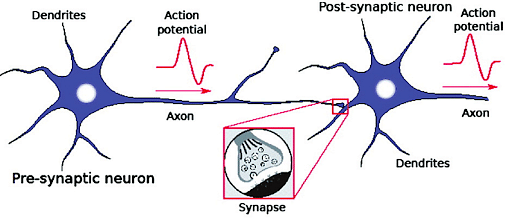
Electrical Synapse: These are the type of synapses where neurotransmitters are not involved and transmission of signals takes place similarly as transmission takes place in a single axon as the terminal buttons of two synapses are closely associated with each other.
Things to Remember
- The neuron is a highly specialized cell that is responsible for the transmission of nerve impulses.
- It is classified into unipolar, bipolar and multipolar neurons.
- On the basis of transmission mechanism, neurons are classified into sensory, motor and interneurons.
- Dendrites, Cell body and Axon are the main parts of the neuron.
- The cell body is also called Soma.
- Electrical and chemical synapses are the two types of synapses.
Sample Questions
Ques. Distinguish between Afferent neurons and efferent neurons. (2 marks)
Ans.
| Afferent Neurons | Efferent Neurons |
|---|---|
| They conduct impulses from the receptors to CNS. | They conduct impulses from CNS to the effectors. |
| They are sensory in nature. | They are motor in nature. |
Ques: Why are neurons important? (2 marks)
Ans. Neurons are the basic unit of the nervous system and are responsible for carrying information throughout the body by using electrical and chemical signals.
Ques.: How can I increase my brain neurons? (2 marks)
Ans. For increasing the number of neurons in the brain, regular exercise like running, swimming, jogging can help in maintaining the number of neurons in the brain.
Ques. Describe the nervous system. (2 marks)
Ans. The nervous system is composed of specialized tissues, called nervous tissue. The nerve cell or neuron is the functional unit of the nervous system. It is the nervous system which is mainly responsible for control and coordination in complex animals. A neuron is the structural and functional unit of the nervous system.
Functions of the nervous system
- The nervous system receives information from the environment.
- To receive the information from the various bodies.
- To act according to muscles and glands.
Ques. What are the parts of the neuron? (2 marks)
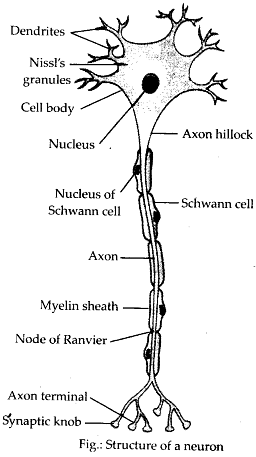
Ans. The basic structural component of a neuron includes- Dendrites, Cell body, axon hillock, axon, nucleus, a node of Ranvier, myelin sheath, Schwann cell, Axon terminal.
Ques. How many types of neurons are there in terms of their function? (2 marks)
Ans. Neurons are classified into 3 parts in terms of their function- Sensory, Motor and interneurons.
Ques. Are nerves called neurons? (2 marks)
Ans. Nerve cells are the cells present in nervous tissue which generate and conduct impulses; it is also known as neurons.
Ques. How fast do neurons travel in the brain? (2 marks)
Ans. Large diameter myelinated neurons can travel signals ranging from 70-120 meters per second approximately.
Ques. What is a synapse? (2 marks)
Ans. Synapses are the tiny gaps present between the axon of one neuron and the dendrite of the next neuron.
Ques. How are neurons generally classified? (2 marks)
Ans. Neurons are generally classified on the basis of the number of processes arising from the cell body. These neurons are unipolar, bipolar and multipolar neurons.
Ques. What are the parts of a neuron? (2 marks)
Ans. The neuron is a highly specialized cell that is responsible for the transmission of nerve impulses. The neuron consists of the following parts
(i) Cyton or cell body: The cell body or cyton is somewhat star-shaped, with many hair-like structures protruding out of the margin. These hair-like structures are called dendrites. Dendrites receive the nerve impulses.

(ii) Axon: This is the tail of the neuron. It ends in several hair-like structures, called axon terminals. The axon terminals relay nerve impulses.
(iii) Myelin sheath: There is an insulator cover around the axon. This is called the myelin sheath. The myelin sheath insulates the axon against nerve impulses from the surroundings.
Ques. How many neurons are found in the brain? (2 marks)
Ans. Approximately 86 billion neurons are present in the brain.
Ques. How do neurons work? (2 marks)
Ans. A neuron consists of neurotransmitters in the synaptic vesicles of the terminal buttons; it releases chemicals that travel across a synapse and conduct signals from one neuron to another one.
Ques. Draw a labelled diagram of the neuron. (2 marks)
Ans.
Ques. What are receptors and what are the classification of receptors? (2 marks)
Ans. Receptors are the specialized tips of the nerve fibres that collect the information to be conducted by the nerves.
Receptors are in the sense organs of the animals.
These are classified as follows :
- Phono-receptors: These are present in the inner ear.
Functions: The main functions are hearing and balance of the body. - Photo-receptors: These are present in the eye.
Function: These are responsible for visual stimulus. - Thermo-receptors: These are present in the skin.
Functions: These receptors are responsible for pain, touch and heat stimuli.
These receptors are also known as thermoreceptors. - Olfactory-receptors: These are present in the nose.
Functions: These receptors receive smell. - Gustatory-receptors: These are present in the tongue.
Functions: These help in taste detection.



Comments