



Content Curator
Orbital overlaps mainly happen in covalent bonding. The overlapping of atomic orbitals result in the formation of new shapes. Atoms combine to achieve stability and decrease the energy levels in the system. When two atoms come together to make a covalent bond, the energy between them is minimum while they are very near to each other. As a result, orbitals of the atoms get partially merged, and the phenomenon is called orbital overlapping. It can also result in formation of bonds.
Also Read: Valence Bond Theory
| Table of Content |
Key Terms: Atoms, covalent bond, orbitals, orbital overlapping, bond, orbital hybridization, valence electrons
Concept of Orbital Overlap
[Click Here for Sample Questions]
Orbital overlapping is also referred to as overlapping of atomic orbitals. In simple words, orbital overlap is a concept in which atoms come together via colliding in the same space. During the process, two atoms come close to each other in such a way that they enter into the orbitals of each other. As a result, a new hybridised orbital is formed where a bonding pair of electrons is present. Lower energy level of the newly formed hybridised orbital makes it stable. This partial merging is called orbital overlap.
Three factors are responsible for the level of overlap – the pair of participating atoms, their size, and valence electrons. Higher level of overlap, leads to the formation of stronger bonds amid atoms. As per the concept of orbital overlap, atoms merge by overlapping of orbitals and result in a low energy state where valence electrons with counter spin combine to make covalent bonds.

Orbital Overlap
Also Read: Magnetic Quantum Number
Directional Properties of Bonds
[Click Here for Sample Questions]
We know that overlapping of atomic orbitals results in the formation of covalent bonds. The formation of hydrogen molecules takes place because of the overlap of one s-orbitals of 2 hydrogen atoms.
Overlapping of Atomic Orbitals
[Click Here for Sample Questions]
Orbitals of two atoms combine to make a bond, the overlapping may be of three types, namely, positive, negative, or zero. Nature of the overlap depends on orientation and the phase (sign) w.r.t. orbital wave function. In the following figure1, +ve and -ve sign on the border reveal the phase (sign) of orbital wave function. Thus, orientation in space and sign should be the same in the orbitals which combine and make a bond. This is termed as positive overlap.
Also Read: Shapes of Atomic Orbitals
Types of Overlaps in Atomic Orbitals
[Click Here for Sample Questions]
The following are the types of orbital overlaps:
- Positive Overlap of Atomic Orbitals: Positive overlap occurs when the phase of two participating atomic orbitals is the same. This overlap results in bond formation.
- Negative Overlap of Atomic Orbitals: When the phase of participating atomic orbitals is opposite to each other, negative overlap takes place. In this case, bond formation does not occur.
- Zero Overlap of Atomic Orbitals: When two engaging orbitals do not overlap one another in an orbital, it is called zero overlap of atomic orbitals.
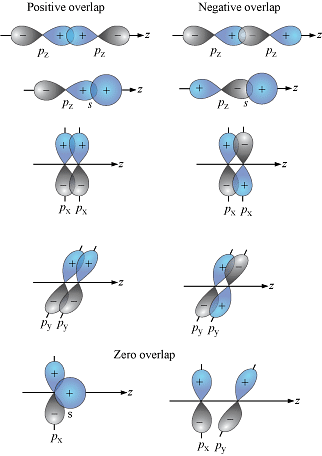
Positive, negative, and zero overlaps of ‘s’ and ‘p’ atomic orbitals
Also Read: Hybridization
Things to Remember
- In the formation process of hydrogen molecules, there is very less or say minimal energy. When two atoms of hydrogen are very close to each other, atomic orbitals of both atoms go through partial inter-penetration. This partial combining of atomic orbitals leads to pairing of electrons and is called orbital overlap.
- Linus Pauling emphasised the importance of orbital overlapping while describing the molecular bond angles noticed while experimenting. Also, orbital overlapping is further evolved as the concept of orbital hybridization.
- The process where partial merging of orbitals leads to making a brand new hybridised orbital is called as orbital overlap. The orbitals have two overlapping areas, namely, sigma (σ) and pi (π).
- Both, sigma and pi types of bonds take place via orbital overlapping process. In a single bond there is one and only one sigma bond. Whereas, double bonds include a sigma and a pi bond. Even more, in a triple bond, there is only one sigma bond, and two pi bonds.
- Orbitals which combine to make a bond should have identical orientation and phase in space.
Sample Questions
Ques. What is the reason behind orbital overlap? (4 Marks)
Ans. Since atomic orbitals occupy space, they overlap. In an atomic orbital, there is a probability of an electron being detected or found. The electron has no predefined boundary. Consider an example of HCL, hydrogen orbital 1s below.
As hydrogen atom comes near an atom of chlorine. Here 1s orbital of hydrogen can overlap with 3p orbital of chlorine. This accelerates electron density in the area amid H and Cl nuclei. As a result, density of the electrons increases and two nuclei get attracted towards each other. The attraction also lowers the repulsion rate between two nuclei. Thus, a covalent bond forms between hydrogen and chlorine.
Ques. Differentiate between sigma bond and pi bond. (5 Marks)
Ans.
| sigma (σ) Bond | pi (π) Bond |
|---|---|
| End-to-end overlapping of orbitals results in the formation of sigma bonds. | A Pi bond forms due to lateral overlap of orbitals. |
| This bond is strong. | This bond is weak. |
| s-s, s-p, or p-p orbitals are involved in the overlap. | Formation of pi bond takes place only when p-p orbitals are present. |
| In sigma bond, only one electron cloud is present symmetrical to the inter-nuclear axis. | In pi bond there are two electron clouds present at the top and bottom of plane of atomic nuclei. |
| Here, the electron cloud is symmetrical. | The clouds are not symmetrical. |
| Rotation around sigma bonds is allowed. | Rotation around pi bonds is not allowed. |
Ques. What are the conditions essential for linear association of atomic orbitals during the formation of molecular orbitals? (3 Marks)
Ans. The following are the requisite conditions for linear association of atomic orbitals during the formation of molecular orbitals:
- The coupling of atomic orbitals should have appropriate orientation in order to provide passage for maximum overlap.
- The penetrating atomic orbitals should have similar or nearly the same state of energy. Thus, in a homo-nuclear molecule, the 1s orbital of the first atom can merge with the 1s orbital of the second atom. It cannot combine with 2s orbital of the second atom.
- The scope of overlapping must be broad.
Ques. What are orbital phases? Explain. (4 Marks)
Ans. Firstly, orbitals are one of the important mathematical functions. They assist in the development and determination of complex models that float around fixed waves which can be plotted on a graph. Notably, the orbitals do not exist in the physical world. An orbital process is an outcome of the action which takes place between wave-like attributes of electrons.
Ques. Show the formation diagrams of double and triple bonds amid carbon atoms in the case of C2H4. (5 Marks)
Ans. In the case of C2H4, the electronic configuration of carbon atom when in excited state is:
6 C = 1s2 2s1 2px1 2py1 2pz1
In the evolution process of a C2H4 molecule, 1 sp2 hybrid orbital of one carbon atom overlaps 1 sp2 hybrid orbital of another atom of carbon. Thus, it forms one C-C σ i.e., sigma bond.
After that, the remaining 2 sp2 orbitals of the two carbon atoms make a sp2 – s sigma bond along with 2 atoms of hydrogen. The un-hybridized orbital of a single carbon atom overlaps with the orbital of the same type of another c atom. This forms a weak pi bond. The following figure shows formation diagrams of double and triple bonds amid carbon atoms in the case of C2H4.
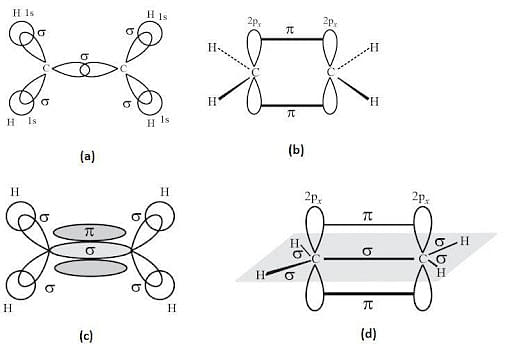
Formation diagrams of double and triple bonds amid carbon atoms of C2H4
Ques. Define orbital overlap and hybridization. (4 Marks)
Ans.
Orbital Overlap: An orbital overlap is the fusion of orbitals of atoms present in the same area of the space. Orbital overlap results in bond formation. In an orbital overlap process, two atoms come near each other and then merge orbitals of one another. This results in the formation of new hybrid orbital where electrons’ bonding pair is present. The newly generated orbital is state in nature as it has less energy than old atomic orbitals.
Hybridization: It is a chemical process which assists in the merging process of atomic orbitals where creation of new hybridized orbitals occur. Hybridization usually leads to the creation of hybrid orbitals featuring totally different shapes, energies, characteristics, etc. The orbitals which have similar energy levels participate in the process of hybridization.
Ques. What type of orbitals can overlap to form a covalent bond? (2 Marks)
Ans. In chemistry, binding is defined based on orbitals which stretch the complete molecule. These orbitals are nothing but the atomic orbitals of two nuclei engaging beneficially and harmfully i.e., positively or negatively. For an overlap of atomic orbitals, it is essential to have same energy levels and precise symmetry.
In the case of constructive overlap, the density of electrons in the space between the two atoms will increase. Whereas, the formation of nodal phases takes place when the atomic orbitals react destructively or negatively. As a result, an unstable or antibonding orbital is formed. Thus, half-filled atomic orbitals which have opposite spin electrons can overlap
Ques. Explain positive overlapping of atomic orbital. (2 Marks)
Ans. When atomic orbitals of any two atoms combine they make a bond. Nature of the bond can be positive, negative, or zero. It depends on the sign and phase of the orbitals interacting together.
Positive Overlapping of Atomic Orbital – When phase of two atomic orbitals is same while interacting, it results in a positive overlap and bond formation. The sign of atomic orbital wave function decides the phase, whether positive, negative, or zero.
Ques. Explain the term orbital phases. (2 Marks)
Ans. Orbital phase is a result of electrons’ wave-like properties. While representing orbitals on a graph, minus or plus sign decides phase of an orbital. Signs of a phase does not exist in real or physical world. Still, they are helpful while combining orbitals to make molecular orbitals. In other words, orbital phase is the relation between orbitals which develops from their wave characteristics.
Ques. What is zero overlapping of atomic orbital? (2 Marks)
Ans. A bond can be positive, negative, or zero. It depends on the sign and phase of the atomic orbitals interacting with each other. Zero overlapping of atomic orbital takes place when two atomic orbital with opposite phases react with one another. In a zero overlap orbitals do not overlap, i.e., there is no overlapping of atomic orbitals. Also, the formation of covalent bonds does not take place in zero overlapping of atomic orbitals.
Ques. Which bond is stronger among sigma and pi bonds? Why? (2 Marks)
Ans. Sigma bond is stronger than pi bond because of the formation process. A sigma bond is created by head-on overlap of orbitals. In sigma bonds, the orbitals are alongside the internuclear axis. As a result, more effective overlap occurs in sigma bond. Whereas, a pi bond forms via side-wise overlapping. In pi bind, the atomic orbitals lie perpendicular to the axis. Thus, sigma bond is stronger than pi bond.
Also Check:



Comments