



Exams Prep Master
The atomic orbitals are of different shapes, where the s orbital has a spherical shape, the p orbital has a dumbbell shape, and four of the five d orbitals have a cloverleaf shape. The fifth d orbital has a shape of an elongated dumbbell with a doughnut around its middle. The orbitals in an atom are organized into different layers or electron shells. Atomic orbitals describe the most likely location of the electrons that will be found around the nucleus of an atom; every unique orbital can comprise only up to two electrons. Let’s have a closer look at the topic with some important questions.
Key takeaways: Orbitals chemistry, shapes of atomic orbitals, the s orbitals, p orbitals, the d orbitals, the f orbitals, orbital wave function.
NCERT Solutions of:
What are Atomic Orbitals?
[Click Here for Sample Questions]
The 3-dimensional space around the nucleus of an atom where the possibility of finding an electron is the highest is called an atomic orbital.

In an atom, there exist many orbitals. These orbitals, further, exist in various shapes. A small sized orbital means there is a higher probability of finding an electron near the nucleus.
Read More: Cannizzaro Reaction Mechanism
Orbital Wave Function
[Click Here for Sample Questions]
The varied shapes and orientation of atomic orbitals state that there is either no or a greater probability of finding an electron near the nucleus along some directions. According to the quantum atomic model, an atom can have various possible orbitals which can be categorized on the basis of their shape, size or orientation. The orbital wave function or \(\Phi \) is a mathematical function that is used to denote the coordinates of an electron. The square of \(\Phi \) indicates the probability of finding an electron in the orbital. \(\Phi \) helps in drawing out the boundary surface diagrams. The shape of the atomic orbitals can be understood by boundary surface diagrams of the constant probability density for different orbitals. All the information of an electron in an atom is stored in its orbital wave function i.e. \(\Phi \).

The probability of finding an electron in an atom is proportional directly to \(\Phi ^2\) which is called as probability density which is, further, always positive. Each atomic orbital is denoted by a specific number and a specific letter, called quantum numbers. Each orbital is denoted by three quantum numbers, n, l and m. The number against an orbital is indicated by the energy level of the electron in that orbital.
The energy level closest to the nucleus is 1; the next one is 2 and so on. The symbols of the orbital shapes i.e. s, p, d and f come from the words meaning sharp, diffuse, principal and fundamental respectively. Of the four orbitals, the s and p orbitals are considered significant because they are the commonly used orbitals in organic and biological chemistry.
Read More: Dalton’s atomic theory
Nodes
[Click Here for Sample Questions]
They are the region where the probability of finding an electron would be zero. The nodal plane is the plane which passes through the nucleus where the probability of finding an electron is zero.
In any orbital, the number of nodal planes is equal to I i.e. the Azimuthal quantum number.

The two types of nodes are: radial and angular nodes. The radial nodes are the spheres at fixed radius that occur as the principal quantum number increases while angular nodes are flat at fixed angles.
The total number of nodes of an orbital is the sum of the radial and angular nodes. It is represented in terms of n and I quantum number, N = n - I - 1
Read More: Franck Hertz Experiment
The s Orbitals
[Click Here for Sample Questions]
- The shape of the s orbital is spherical with the nucleus in the centre.

- The boundary surface diagram for the s shaped orbital is similar to a sphere with a nucleus at its centre. In two dimensions, it can be seen as a circle.
- Therefore, s orbitals can be said to be spherically symmetrical.
- Due to their symmetry, they have the probability of finding an electron at equal distances from the nucleus.
- The size of the s orbital is found to increase with increase in the value of principal quantum number (n). Hence, 4s > 3s > 2s > 1s.
The p Orbitals
[Click Here for Sample Questions]
- All p orbitals contain two sections called lobes that lie on either side of the plane which passes through the nucleus of the atom.
- The three p orbitals are identical in terms of shape, size and energy. However, they differ in their orientation of lobes.
- Since the lobes lie along one out of the three axes, namely, x, y and z, the three orbitals are designated as 2px, 2py and 2pz. It can thus be said that there are 3 p orbitals with mutually perpendicular axes.
- As in s orbitals, the energy and size of p orbitals increases with an increase in the quantum number i.e. 4p > 3p >2p.

Read More: Charge to Mass Ratio of Electron
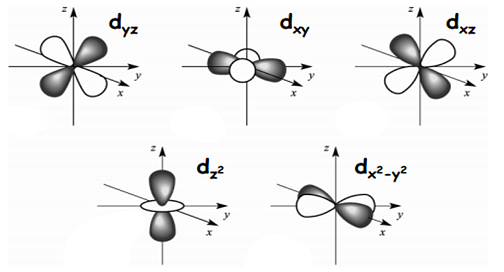
The d Orbitals
[Click Here for Sample Questions]
- The magnetic orbital quantum number for d orbitals is denoted as (-2, -1, 0, 1, 2). Thus, there exist five d orbitals.
- The d orbitals are given the designations dxy, dyz, dxz, dx2-y2 and dz2.
- The shapes of the first four d orbitals are similar to one another while being different from the dz2 orbital.
- The energy of all five d orbitals is the same.
The f Orbitals
[Click Here for Sample Questions]
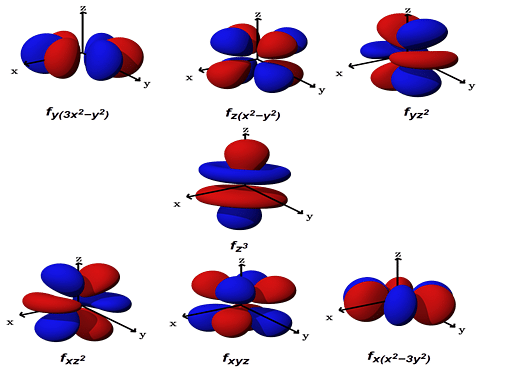
- The f orbitals have corresponding magnetic quantum numbers m1 (-3, -2, -1, 0, 1, 2 3).
- They have the secondary quantum number I = 3.
- They are buried deeply beneath the valence shell for the elements that are even beyond cerium since; they are not occupied in the ground state until the element cerium.
- The f orbitals are given the designations
![]() and fz3.
and fz3. - Each f orbital has a multi-lobed and complex shape with several nodal points.
- The 4fy3- 3x2y orbital corresponds to l = 3, ml = -3, and n = 4
The 4fxyz orbital corresponds to l = 3, ml = -2, and n = 4.
The 4f5yz2- yr2 orbital corresponds to l = 3, ml = -1, and n = 4.
The 4f5z3- 3zr2 orbital corresponds to l = 3, ml = 0, and n = 4.
The 4f5xz2- xr2 orbital corresponds to l = 3, ml = +1, and n = 4.
The 4fzx3- xy2 orbital corresponds to l = 3, ml = +2, and n = 4.
The 4fx3- 3xy2 orbital corresponds to l = 3, ml = +3, and n = 4.
- The f orbitals have three nodal planes and complex shapes with the atomic nucleus at the centre.
Points to Remember
[Click Here for Sample Questions]
- Orbits and orbitals are two different concepts: Orbit is a well-defined circular path in the atom in which the electrons move around the nucleus whereas orbitals are the three-dimensional space around the nucleus of an atom in which the probability of finding an electron is the highest.
- The nodal plane is the plane where the probability of finding an electron is Zero.
- Out of all the orbitals, only the s orbitals are non-directional.
- The orbital 1s holds the highest energy.
- Difference between a shell and an orbital: A shell in an atom is a set of sub-shells of the same quantum number theory i.e. n, while orbitals consist of two electrons each.
Sample Questions
Ques. Why is the s orbital spherical in shape? (2 marks)
Ans. All the s shaped orbitals have a spherical shape and symmetry which means that the function of the wave will be dependent only on the distance from the nucleus and not the direction. This further implies that for any particle, the size of the orbital will decrease as the central quantum number of the orbital will decrease.
Ques. How do orbitals work? (2 marks)
Ans. An atomic orbital describes the wave-like behavior of either one electron or a pair of electrons in an atom. It is a mathematical term used in atomic theory and quantum mechanics.
Ques. What is orbital energy? (2 marks)
Ans. The average distance of the electron from the nucleus determines the energy of the electron; therefore, each atomic orbital with a given set of quantum numbers will be having a particular energy associated with it. This energy is called orbital energy.
Ques. How many orbitals are there in chemistry? (3 marks)
Ans. There are four different orbitals in chemistry (s, p, d, and f) that have different sizes and one orbital will accommodate up to two electrons. The orbitals p, d, and f have separate sub-levels which will therefore accommodate more electrons. Each electron of the element configuration is unique to its position on the periodic table.
Ques. What is sigma and pi bond? (3 marks)
Ans. Sigma bonds, in chemistry, are the first bond between two atoms that result from overlap along the bonding axis while the pi bonds are the second and third bonds resulting from the overlap of p orbitals above and below or in front and back of the bonding axis.
Ques. What does the p orbital stand for? (3 marks)
Ans. All p orbitals contain two sections called lobes that lie on either side of the plane which passes through the nucleus of the atom. The three p orbitals are identical in terms of shape, size and energy. However, they differ in their orientation of lobes. Since the lobes lie along one out of the three axes, namely, x, y and z, the three orbitals are designated as 2px, 2py and 2pz. It can thus be said that there are 3 p orbitals with mutually perpendicular axes.
Ques. What does the f orbital stand for? (3 marks)
Ans. The f orbitals have corresponding magnetic quantum numbers m1 (-3, -2, -1, 0, 1, 2 3). They have the secondary quantum number I = 3. They are buried deeply beneath the valence shell for the elements that are even beyond cerium since; they are not occupied in the ground state until the element cerium. The f orbitals are given the designations and fz3. Each f orbital has a multi-lobed and complex shape with several nodal points. The 4fy3- 3x2y orbital corresponds to l = 3, ml = -3, and n = 4
Ques. Differentiate between a shell and an orbital. (3 marks)
Ans. A shell in an atom refers to a set of subshells of the same quantum number theory, n. Whereas, orbitals comprise two electrons each, and the electrons are part of the same orbital in an orbital of the same size, angular momentum size, and magnetic quantum number.
Ques. Which orbitals have the highest energy? (2 marks)
Ans. The orbital 4s behaves as the outermost, highest energy orbital.
Also check:



Comments