



Education Journalist | Study Abroad Lead
Perpendicular is a straight line that makes a 90° angle with another line. 90° is also called the right angle and is marked with a small square between two perpendicular lines. When two lines meet at right angles, they are said to be perpendicular to each other. This is called perpendicularity. Perpendicular lines can be found all around us, such as at intersections, in rectangular windows.
Read Also: NCERT Solutions For Class 11 Mathematics Chapter 10: Straight Lines
Key Terms: Perpendicular Lines, Parallel Lines, Intersecting Lines, Coplanar, Perpendicular Foot
Perpendicular Lines
[Click Here for Sample Questions]
In geometry, a branch of mathematics, perpendicular lines are defined as two interlocking or intersecting lines at right angles (90°). When a line is perpendicular to a plane, it is then perpendicular to all points in the plane or perpendicular to each line of the plane that crosses. Two planes are said to be perpendicular to the atmosphere if the dihedral angle at which they meet the plane is the correct angle.
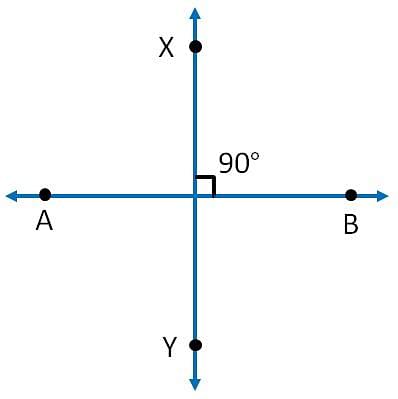
Perpendicular Lines
Read Also:
Perpendicular Symbol
[Click Here for Sample Questions]
Perpendicular lines are represented by the symbol ‘⊥’. Suppose, l1 and l2 are two rows intersecting 90 degrees, then they are perpendicular to each other and are represented as l1 ⊥ l2. The intersection point is called the perpendicular foot.
Read Also:
Construction of Perpendicular Lines
[Click Here for Sample Questions]
The protractor, mathematically, is regarded as an important measurement tool in a geometric box. This tool not only helps to measure angles in degrees but also helps to draw perpendicular lines. The construction of a perpendicular line is a very simple process. To build perpendicular lines, you will need a compass and a ruler for a straight line or scale. Below are the steps for the construction of perpendicular lines:
- Draw a horizontal line first.
- With the help of a compass, draw an arc in the center of the line to point O so that you can cross the line at two points and the same point from O. Two points should be P and Q.
- Also in the areas P and Q, draw an arc inside, so that the two arcs meet at the top and bottom of the horizontal line.
- Now connect the two points where the two arcs meet.
- Now, the obtained line is perpendicular to the horizontal line.

Construction of Perpendicular Lines
Also Read:
Properties of Perpendicular Lines
[Click Here for Sample Questions]
The intersecting lines are called perpendicular lines when it complies with the following structures. The two major properties of perpendicular lines are
- Perpendicular lines always cross the right angle.
- If two lines are perpendicular to the same line, then both are parallel and never intersect.
Also Read:
Things to Remember
- Perpendicular lines always intersect by 90 degrees but not all cross lines are perpendicular.
- Perpendicular lines lie on the same plane which is coplanar and intersect at right angles.
- Using just a compass one can draw a perpendicular to a line. These straight-edge systems were developed by the ancient Greeks.
- The two lines are perpendicular to each other only if the product of the two-slope is equal to negative of unity i.e. -1.
Also Read:
Sample Questions
Ques. Define parallel lines. (2 Marks)
Ans. In contrast to the perpendicular lines, in geometry, we have parallel, cohesive and non-cohesive lines at any time. They remain consistent and equal to each other. The parallel lines are non-intersect lines. So, we can also say that parallel lines meet at infinity.
Ques. Give some examples of perpendicular lines in real life. (3 Marks)
Ans. Some of the examples of the perpendicular lines in real life are as follows - railway track crossing, first aid kit, football field, television, designs in windows, construction of a house in which the floors and the walls are perpendicular to each other. Also, the adjacent sides of the square and the rectangle are always perpendicular to each other. The sides of the right-angled triangle that encloses the right angle are perpendicular to each other.
Ques. Do the diagonals of a rhombus are perpendicular to each other? (2 Marks)
Ans. Yes, the diagonals of a rhombus are perpendicular to each other. They intersect each other at 90 degrees forming a right angle. Hence, they are perpendicular to each other.
Ques. Find the slope of the lines -
(i) Passing through the point (3, -2) and (-1, 4)
(ii) Passing through the points (3, -2) and (7, -2) (3 Marks)
Ans. (i) Slope of the line (3, -2) and (-1, 4)
m = [4 - (-2)] / (-1 -3)
= 6/-4 = -3/2
(ii) Slope of the line (3, -2) and (7, -2)
m = -2 - (2) / 7 - 3
= 0/4 = 0
Ques. The line through the points (-2, 6) and (4, 8) is perpendicular to the line through the points (8, 12) and (x, 24). What is the value of x? (3 Marks)
Ans. m1 = 8-6 / 4 - (-2)
= 2/ 6 =
⅓m2 = 24 - 12 / x - 8
= 12 / x - 8
Since, the lines are perpendicular to each other
So, m1 m2 = -1
Therefore,
⅓ × 12/ x-8 = -1⇒ x = 4.
Ques. The two lines AB and CD inside the kite intersect each other at right angles are perpendicular. List the total number of right angles formed at the intersection. (2 Marks)

Ans. Since the two lines, AB and CD intersect each other at 90 degrees. Then, there are 4 right angles at the intersection.
∠AOD = ∠AOC = ∠BOD = ∠BOC = 90 degree.
Ques. In the figure, AB is perpendicular to CD. If ∠BOC = 90 degree. Then, what is the value of x? (2 Marks)

Ans. ∠BOC = 90 degree
So, x + 63 = 90
⇒ x = 90 - 63
⇒ x = 27.
Ques. Give the difference between parallel and perpendicular lines. (3 Marks)
Ans. The main differences between parallel lines and perpendicular lines are as follows:
| Parallel lines | Perpendicular lines |
|---|---|
| Parallel lines are those lines that do not intersect with each other. | The lines which intersect at the right angle are called perpendicular lines. |
| Example - opposite side of the ladder, or adjacent sides of the rectangle. | Example - railway tracks, or the corner of two walls. |
| The symbol of the parallel line is ||. | The symbol of the perpendicular line is ⊥. |
Read Also:



Comments