



Content Writer-SME
Psilopsida, also known as whisk fern, is one of the four members of Tracheophyta. Psilotum and Temesipteris are two common examples of Psilopsida. Psilotum is used to treat stomach infections and respiratory problems. These plants usually lack leaves, hence they are called leafless plants. The spores of Psilopsida develop into an intact gametophyte.
With fossils from the Devonian period, the Psilopsida represents an early plant lineage and is regarded as one of the first vascular plant species on Earth. The lifecycle of Psilopsida is a complex and multi-step process that includes spore production, germination, fertilization, and zygote development. In this article we will learn in more detail about the characteristics and lifecycle of Psilopsida.
Introduction to Psilopsida
[Click Here for Sample Questions]
Psilopsida are characterized by simple, dichotomously branching stems and small, scale-like leaves without true vascular tissue. They reproduce via spores and are distributed in warm, moist, and shaded habitats, including tropical and subtropical regions. Plants in this class are commonly called "whisk ferns" because of their appearance, which have simple, leafless stems that often branch in a bifurcated (Y-shaped) pattern. They are some of the most ancient and primitive vascular plants.
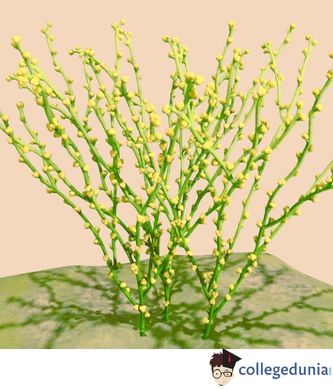
Psilotum: An Example of Psilopsida
- Psilopsida are important in understanding the evolution of vascular plants and their adaptations to terrestrial environments.
- These plants are part of the Psilophyta, which includes only a single surviving genus, Psilotum.
- It is a botanical term referring to a class of primitive vascular plants known as whisk ferns.
Classification of Psilopsida
[Click Here for Sample Questions]
Earlier Psilopsida were placed in the category of Pteridophytes, but later it was reported by many botanists that the plants of Psilopsida display various characteristics similar to Pteridophytes. Thus, it was placed in a separate group called Tracheophyta. The classification of Psilopsida is done as:
- Division- Tracheophyta
- Sub-Division- Psilopsida
- Order- Psilophytales & Psilotales
- Family- Psilotaceae
- Genus- Psilotum
Life Cycle of Psilopsida
[Click Here for Sample Questions]
Psilopsida are considered living fossils and provide insights into the early evolution of vascular plants. In the life cycle of Psilopsida, the alternation of generations is fundamental. The sporophyte, dominant and visible, contrasts with the short-lived and inconspicuous gametophyte.

Spore Production
- The sporophyte, the dominant generation, produces spores within sporangia.
- Sporangia are typically located on aerial shoots or specialized leaf-like appendages.
- Meiosis within sporangia results in haploid spore formation.
Spore Dispersal and Germination
- Mature spores are dispersed by wind or other means.
- Spores germinate in moist environments, developing into gametophytes.
Gametophyte Development
- Gametophytes are smaller and less conspicuous than sporophytes.
- They are green, underground, and dependent on mycorrhizal fungi for nutrients.
- Gametophytes produce both male (antheridia) and female (archegonia) gametes.
Fertilization
- Fertilization occurs in the presence of water.
- Sperm from antheridia swims to reach archegonia for fertilization.
Sporophyte Development
- The zygote develops into a new sporophyte.
- Initially dependent on the gametophyte, the sporophyte establishes its vascular system.
- It grows, matures, and produces new sporangia.
Growth and Maturity
- The sporophyte completes its growth cycle, producing sporangia.
- The life cycle continues with sporangia formation and spore dispersal.
Characteristics of Psilopsida
[Click Here for Sample Questions]
Psilopsida, also known as whisk ferns, are primitive vascular plants characterized by the following features:
- Plant Body: They have a simple plant body structure, lacking true leaves and roots.
- Branching: Psilopsida have dichotomously branching, underground rhizomatous stems.
- Leaves: Instead of true leaves, they have small, scale-like structures called enations.
- Reproduction: They reproduce via spores produced in sporangia borne on specialized structures called sporophylls.
- Nature: Most Psilopsida species are homosporous, meaning they produce a single type of spore that develops into a bisexual gametophyte.
- Vascular System: Psilopsida possesses a simple vascular system with no true xylem or phloem.
- Distribution: They are often found in moist, tropical environments, growing on rocks or in soil with high organic content.
- Secondary Growth: Psilotum, an important member of Psilopsida shows secondary growth which provides support to their stem and roots.
- Seed Growth: The members of Psilopsida are incapable of producing seeds. Reproduction in Psilopsida takes place through spore formation.
- Gametophyte: The presence of colourless, underground, branched or cylindrical gametophyte is a distinctive feature of Psilopsida.
Things to Remember
- Psilopsida is the member of Tracheophyta.
- They are capable of producing identical spores called homospores.
- Psilotum is a common example of Psilopsida that is used to treat diseases.
- The complete body of Psilotum is differentiated into aerial branches and rhizomes.
- Psilopsida reproduce only through spore formation as they lack seeds.
Sample Questions
Ques. How does Psilopsida reproduce? (3 marks)
Ans. Psilopsida reproduces through a process called alternation of generations, which involves two distinct phases: sporophyte and gametophyte.
- Psilopsida rely on spores for reproduction, with the sporophyte as the dominant stage producing spores within sporangia.
- Spores disperse and germinate into the inconspicuous gametophyte, which produces sperm and eggs.
- Fertilization, requiring water, leads to the development of a new sporophyte from the zygote, completing the cycle.
Ques. Where are Psilopsida commonly found in terms of habitat? (3 marks)
Ans. Psilopsida are typically found in warm, moist, and shaded habitats, such as:
- Tropical rainforests
- Cloud forests
- Shaded rock faces
- Tree trunks and branches (epiphytic species)
They thrive in environments with high humidity and protection from direct sunlight due to their lack of true roots and simple vascular system.
Ques. Are Psilopsida considered living fossils? Why? (3 marks)
Ans. Yes, Psilopsida are widely considered living fossils.
- Fossil evidence suggests their existence dates back over 400 million years, placing them among the earliest land plants.
- They exhibit several primitive characteristics, such as the absence of true roots, leaves, and seeds, resembling their ancient ancestors.
- Compared to more diverse plant groups, Psilopsida represent a relatively unchanged lineage over vast evolutionary time, earning them the "living fossil" status.
Ques. How does Psilopsida differ from other vascular plants in terms of their morphology? (5 marks)
Ans. Psilopsida differ from other vascular plants in terms of their morphology:
- Unlike most vascular plants with true roots, Psilopsida have rhizomes with hair-like rhizoids for anchorage and absorption.
- While other vascular plants typically have well-developed leaves, Psilopsida are either leafless or have only rudimentary scales or small leaves.
- Their vascular system is protostelic, a very basic structure compared to the more complex and diverse vascular systems found in other groups.
- The sporangia (spore-producing structures) in Psilopsida are often located directly on the shoots or leaf-like appendages, unlike the specialized structures like strobili seen in some other vascular plants.
These morphological differences highlight the primitive nature of Psilopsida, reflecting their position as some of the earliest land plants.
Ques. Are Psilopsida homosporous or heterosporous? (3 marks)
Ans. Psilopsida are homosporous. This means they produce one type of spore during their reproductive cycle. These spores are all morphologically similar and develop into bisexual gametophytes, capable of producing both male and female gametes.
This stands in contrast to heterosporous vascular plants, which produce two distinct types of spores: microspores (giving rise to male gametophytes) and megaspores (developing into female gametophytes)
Ques. How does Psilopsida contribute to the ecosystem? (3 marks)
Ans. Psilopsida contributes to the ecosystem in several ways -
- In their moist habitats, Psilopsida play a role in the initial decomposition of organic matter, breaking down dead plant material and contributing to nutrient cycling.
- Epiphytic Psilopsida species growing on other plants can create microhabitats for small invertebrates and other organisms, increasing the biodiversity of the ecosystem.
- In disturbed areas or newly exposed environments, Psilopsida, with their simple requirements, can act as a pioneer species, helping initiate the process of colonization and facilitating the establishment of other plants.
Ques. How does Psilopsida obtain nutrients and water? (3 marks)
Ans. Psilopsida obtains water through their rhizoids on the rhizome, which absorbs water from the moist environment they typically inhabit. As for nutrients, some Psilopsida, especially epiphytic species, might benefit from nutrient capture through their rhizoids and potentially from mycorrhizal associations with fungi, similar to some other plants.



Comments