



Content Curator
Pteridophyta, a kind of vascular plant, has nearly 12000 kinds of species. Pteridophyta are referred to as "cryptogams" because unlike most other members of the Plant Kingdom, Pteridophyta do not reproduce by seeds but rather through spores. Ferns, horsetails, and lycophytes come under Pteridophyta.
Read Also: Five Kingdom Classification
| Table of Contents |
Key Terms: Pteridophyta, Fern Pteridophyta, Primal Terrestrial Plants, Sporangia
Characteristics of Pteridophyta
[Click Here for Sample Questions]
Following are the key characteristics of Pteridophyta:
Primal Terrestrial Plants
It is an anticipation that life has originated in the waters and gradually adapted to dry land during millions of years of development. Similarly, Pteridophyta are primitively living terrestrial plants that have evolved.
Plant Body
A sporophyte is the primary plant body. It is further differentiated into stems, roots and leaves.
- Stems: The branches are mostly herbaceous, but some are woody. The branches could either be a monopodial stem or a dichotomous branching stem.
- Roots: Roots are small and they accidentally grow along the rhizomes.
- Leaves: The leaves can be of three types like scale, small sessile and large petiolate compound.
Also Read:
Vascular Plant
The vascular tissues are well developed in Pteridophyta. Xylem is made of tracheids and the phloem consists of sieve cells and phloem parenchyma. Although, the tissue lacks xylem vessels and phloem companion cells.
Sporangia in Sporophytes
Sporophytes have sporangia that are tended by sporophylls, which are leaf-like structures. To safeguard the delicate growth regions, the tip of the leaves curls inwards. Moreover, spores are produced inside the sporangia. Also, sporophylls may sometimes form compact structures known as cones or strobili.
Formation of Spores
Spores are formed in the sporangia. The spores can be
- Homosporous: Meaning only one type of spore is produced.
- Heterosporous: Meaning two kinds of spores are produced.
Multicellular Sex Organs
Pteridophyta have multicellular sex organs. Antheridia are the male sex organ whereas archegonia are the female organ. The sexual organs are borne by the prothallus. A prothallus is a small gametophyte that develops after the germination of spores.
Check Also:
Male and Female Reproductive SystemAlternation of Generation
The Pteridophyta show an alternation of generation. It is proved by observing the presence of sporophyte and gametophyte generations in them. Meiosis is used by the dominant sporophyte to create spores. Mitosis produces gametes in the gametophyte generation. Pteridophytas and other plants have a life cycle called alternation of generations (also known as metagenesis).
Pteridophyta Diagram
Read More: Biodiversity and Conservation
Pteridophyta: Classification
[Click Here for Sample Questions]
Following is the classification of the Pteridophyta:

Psilopsida
- These are the earliest vascular plants to be discovered. The majority of them are now extinct.
- Psilotum and Tmesipteris are the only two surviving species left.
- It is a sporophyte with Rhizoids instead of roots.
- They have spirally organized lateral appendages such as scales or leaves.
- The leaves are mostly absent in psilopsida.
- Psilophyta or psilopsida is homosporous.
- Examples are
- Psilotum
- Tmesipteris
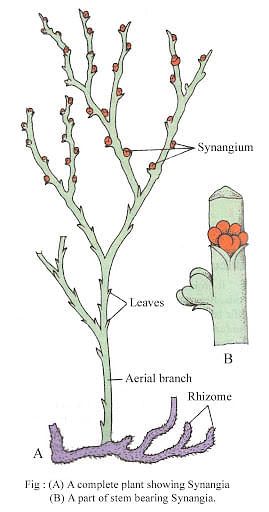
Psilotum Diagram
Check Important Notes for Endangered Species
Lycopsida
- Lycopsida can be differentiated into roots, stems and leaves.
- It is most commonly known as club mosses.
- It has microphyllous (small) leaves, with a single unbranched vein running across the midrib.
- Lycophyta or lycopsida are homosporous in the case of lycopodium or heterosporous in selaginella.
- The axil of sporophylls consists of sporangia.
- The sporophylls are grouped in a strobili-like pattern.
- Examples are
- Lycopodium
- Selaginella

Lycopodium
Read More: Mutualism
Sphenopsida
- It is also known as horsetail.
- Sporangia seen in the axil of the plant body have nodes and internodes, just like higher vascular plants.
- Roots emerge from nodes of the underground rhizome, stem, and scaly leaves.
- Microphyllous leaves appear in whorls at each node.
- It is homosporous.
- An example is
- Equisetum

Equisetum Labelled Diagram
Check Important Difference Between Difference Between Plant Cell and Animal Cell
Pteropsida
- Pteropsida is the largest group of Pteridophyta, with more than 9000 species.
- Plant body is differentiated into stems, leaves and roots.
- It is either homosporous or heterosporous.
- Antherozoids are multiflagellate.
- Leaves are advanced, being megaphyllous (large) and pinnately compound.
- Members of this class can be found in a variety of environments, including terrestrial, damp and aquatic. Moreover, some are epiphytes.
- Examples are
- Pteris
- Dryopteris
- Adiantum
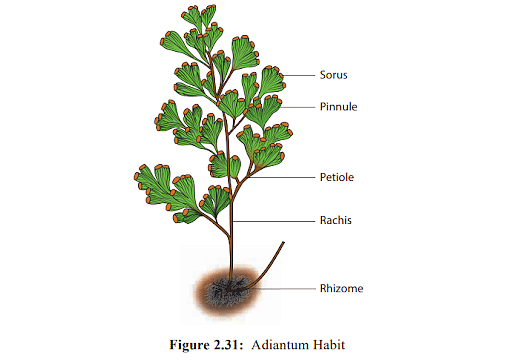
Adiantum
Read Important Chapter The Fundamental Unit of Life
Life Cycle of Pteridophyta
[Click Here for Sample Questions]
Pteridophyta show an alternation of generation. They have a similar life cycle to that of seed-bearing plants; unlike mosses and seed plants, Pteridophytas have distinct and free-living generations of haploid gametophyte and diploid sporophyte. Following is a brief life cycle of a Pteridophyta (in case of fern):
- Pteridophyta reproduces through spores since they are flowerless and seedless.
- In the beginning, spores are sent into the air.
- Spores grow into heart-shaped haploid gametophytes where both male and female sex organs are present.
- Sex organs get active as soon as the young gametophyte matures.
- Antheridium (producing sperm) is the male reproductive organ in ferns whereas archegonium (producing eggs) is the female reproductive organ.
- In case of fern reproduction, water is required for the sperm to flow and fertilize the egg.
- A fertilized egg, or zygote, develops roots, stems, and a new sporophyte through the process of mitosis (cell division).
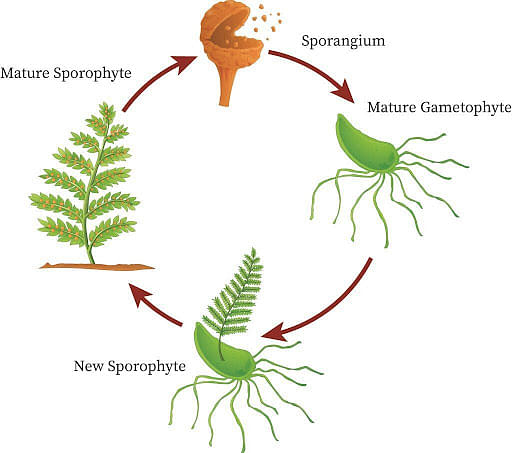
Life Cycle of Pteridophyta
Things to Remember
[Click Here for Sample Questions]
- Ultimately, Pteridophyta are primitive plants.
- They are terrestrial plants that grow in wet, shaded environments. Some, like Selaginella lepidophylla (resurrection plant), survive in open, arid environments.
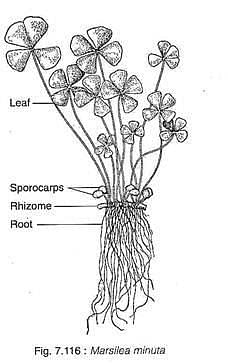
- Tribals eat Marsilea because it is a good source of starch.
- Ferns come in a variety of shapes and sizes, and they're used to treat various diseases. The herb Lycopodium clavatum is used to cure skin problems. Equisetum species are used as diuretics. Dryopteris is utilized in the production of anthelmintic drugs, which treats tapeworm infections.
- Ferns have been present on this planet for 360 million years. Moreover, ferns are found in abundance around us.
Also Check More:
Sample Questions
Ques. Why are Pteridophyta known as tracheophytes? (1 Mark)
Ans. Due to the presence of vascular tissue, Pteridophytaare termed as tracheophytes. Pteridophyta are a form of vascular plant that reproduces by the use of spores. They're also known as cryptogams due to a lack of flowers or seeds.
Ques. Where are Pteridophyta found? (1 Mark)
Ans. Pteridophyta are terrestrial plants that grow in wet, shaded environments. Some, like Selaginella lepidophylla (resurrection plant), survive in open, arid environments.
Ques. Why are Pteridophyta known as “Botanical snakes”? (2 Marks)
Ans. Pteridophyta are known as botanical snakes because they are the first terrestrial plants, just like snakes. Bryophytes evolved into the first real land plants. Pteridophyta are frequently referred to as "snakes of the plant kingdom" or "botanical snakes" for this reason.
Ques. What are Pteridophyta? (2 Marks)
Ans. Plants with no flowers or seeds are known as Pteridophyta. As a result, it's also known as Cryptogams. Ferns and horsetails are among them. They can be regarded as the first terrestrial vascular plants because they have vascular tissue, xylem, and phloem. The habitat of these plants is in moist, gloomy areas. In addition, the majority of ferns are planted as ornamental plants.
Ques. Explain the life cycle of Pteridophyta. (3 Marks)
Ans. Pteridophyta show an alternation of generation. They have a similar life cycle to that of seed-bearing plants; unlike mosses and seed plants, Pteridophytas have distinct and free-living generations of haploid gametophyte and diploid sporophyte. In the life cycle, the sporophytic generation is prominent. Both the sporophyte and the gametophyte are morphologically different, self-contained, and free-living organisms. As a result, they exhibit a diplo-haplontic life cycle.
Ques. How are Pteridophyta different from phanerogams? (3 Marks)
Ans. Following are the key differences between Pteridophyta and phanerogams:
| Pteridophyta | Phanerogams |
|---|---|
| Pteridophyta do not produce flowers which make them non-flowering plants. | Phanerogams produce flowers which make them flowering plants. |
| Pteridophyta are seedless plants.; | Phanerogams are seed-bearing plants. |
| Pteridophyta reproduce by forming spores.; | Phanerogams cannot reproduce with spore formation.; |
Ques. What is the difference between Pteridophyta and bryophytes? (3 Marks)
Ans. Differences between Pteridophyta and bryophytes have been tabulated below:
| Pteridophyta | Bryophytes |
|---|---|
| The sporophyte is autotrophic and completely independent of the gametophyte. | In this gametophyte is dominant and sporophyte depends on the gametophyte. |
| Vascular tissue is present. | Vascular tissue is absent. |
| They have roots, stems, and leaves. | They have leaf-like appendages. |
Science Related Links:



Comments