



Education Journalist | Study Abroad Lead
Reflection of Sound may be described as the oscillations produced by a particle’s displacement or velocity conveyed in a medium with internal force, evoking auditory sensations. Sound travels through a medium like air or water as a mechanical wave. The phenomena of sound waves bouncing back from the surface, partially or fully, is known as reflection of sound, or we may say that when sound travels through one medium and contacts the surface of another medium, it returns in a different direction.
| Table of Content |
Key Terms: Sound, Reflection, Medium, Wave, Displacement, Velocity, Angle, Oscillations, Energy, Vibrations, Light
What is Sound?
[Click Here for Sample Questions]
Sound is defined as the oscillations or perceptions elicited by a particle's movement. The energy that moves in waves through the water, or any other media is referred to as sound. Sound may be heard and travels through the air in the form of a longitudinal wave. It can neither be generated or destroyed, but it may be transformed into another form. For example, electrical energy is turned into sound energy when an electric bell rings. The vibration of an item causes sound to be created.
Sound, like light and heat energy, is a kind of energy. As a result, sound is not heard in space. Sound is reflected at the surface of a solid or liquid in the same way that light is. The reflection of sound is the bouncing back of sound when it strikes any surface. The utilisation of a medium is required for the transmission of sound waves. These waves pass across a medium by causing the medium particles to vibrate about their mean locations. As a result, they are referred to as elastic or mechanical waves.
Reflection of Sound
[Click Here for Sample Questions]
Sound reflection is comparable to light reflection in that it follows the rules of reflections, where the angle of reflection equals the angle of incidence and the reflected sound, incident sound, and normal sound all reside in the same plane.
- Sound bounces off the medium's surface, which might be solid or liquid. The surface might be big and either rough or polished in order for sound to be reflected.
- Regardless of the surface, sound reflection may be explained as being similar to that of light. In terms of that medium, it's known as a sound reflection.
- The same principle holds true for light. If we use any substance as a surface, whether it's rough, smooth, or hard water, sound flows towards the surface, half of it travels through the medium, and the other half returns to its original location. This is nothing more than a sound reflection in part.
- The curvature of the surface has an impact on how sound waves are reflected.
- Sound waves that move towards a reflecting surface are known as incident sound waves whereas sound waves that return from a surface of reflection are referred to as reflected sound waves.
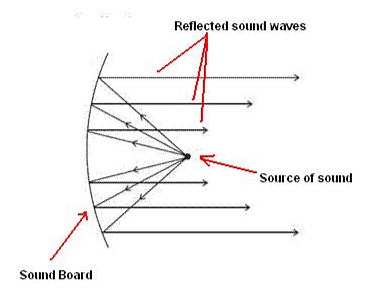
Reflection of Sound
Examples of Reflection of Sound
Below are some key phrases defined to help you better grasp how sound is reflected:
- An echo is the repetition of sound created by the reflection of a sound wave.
- The bouncing back of a sound wave when it strikes a surface such as a wall, metal sheet, plywood, or other object is referred to as sound wave reflection.
- When the distance between the source and the reflected sound is less than 17 metres, reverberation occurs. The sound is delayed as a result of repeated reflections at the reflecting surface.
Transmission of Sound
The percentage of energy that can pass through the wall is used for sound transmission.
Through any medium, the sound wave is transported as energy from molecule to molecule.
The energy that is reflected back to the previous medium is known as sound reflection.
Laws of Reflection of Sound
[Click Here for Sample Questions]
Sound reflection is governed by two laws, as mentioned below:
- First Law of Reflection of Sound: The incidence angle and the reflection angle are always the same.
- Second Law of Reflection of Sound: The incident sound is in the same plane as the reflector sound.
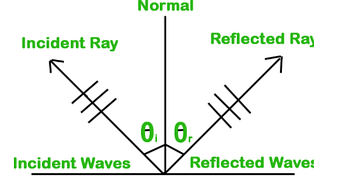
Reflection of Sound Waves
Applications of Reflection of Sound
[Click Here for Sample Questions]
We may easily learn about the applications of reflection of sound if we see and comprehend the examples of reflection of sound. Let's take a look at a few of the uses of sound reflection, as mentioned below:
- Echo: The reflection of sound waves causes an echo, which is the recurrence of a sound. After the direct sound, the echo arrives with a delay at the listener. The reflection is called an echo if the time difference between the objects is more than one second. Echo is used by bats and dolphins to locate impediments. It is also employed in the Sonar (Sound Navigation and Ranging) method, which is used to identify and locate submerged submarines and icebergs in the water.

Echo
- Megaphones: Megaphones are the next example of sound reflection. The megaphones are horn-shaped tubes that prevent Echos and numerous reflections while speaking. All sounds can be fine-tuned and converted into tubes. These megaphones are commonly used for a variety of announcements.
- Soundboards: The soundboards are concave boards with a curve shape. These are for the audience's convenience in the auditorium or seminar hall, for example. These are usually situated on the opposite side of the speakers. These sounds use the loss of reflection of sound to take the signals from the speakers and reflect them to the listener in a higher quality. This allows the audience to hear Mike more clearly, even if they are sitting far away.
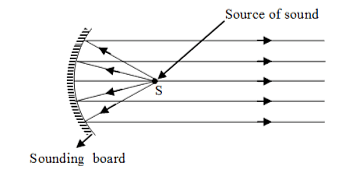
Reflection of Sound Wave from Soundboard
- Stethoscope: The stethoscope is a well-known piece of diagnostic gear. It is used to hear the position of an organ in the human body, as we all know. It likewise functions on the basis of sound reflection. With the use of the tube, the sound absorbed from the chest may be sent to the ears. Every doctor should have one of these stethoscopes. Medical practitioners regard it as a symbol.
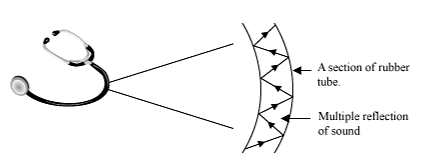
Reflection of Sound Wave from Stethoscope
- Hearing Aid: A hearing aid is a device that people with hearing loss use to help them hear better. The hearing aid picks up the sound waves and reflects them in a smaller region heading to the ear.
Read More:
Things to Remember
[Click Here for Sample Questions]
- When sound waves enter one medium by leaving one behind, for as when an airborne wave in a room hits a brick wall, they take on specific characteristics.
- A portion of the wave will try to travel across the medium, while the remainder will bounce back off the wall.
- Waves of Sound Reflection happens when a piece of the energy remains within the confines of the room.
- The sound wave is transmitted as energy from one molecule to another across either medium in either circumstance.
- The reflection is called reverberation if the gap is less than.1 second.
- Our ears can't tell the difference between sound impulses that are shorter than.1 second long.
- As a result, we perceive echo as two independent sound signals, but reverberation is perceived as a single lengthy sound.
Sample Questions
Ques. Is sound subject to the same reflection rules as light? Explain. (3 marks)
Ans. Yes, the laws of reflection for sound and light are the same, as mentioned below:
- At the point of incidence, the angle of incidence equals the angle of reflection.
- The incident, normal, and reflected sound waves all lie in the same plane at the moment of incidence.
Ques. What are the different types of Reflections? (4 marks)
Ans. The reflection phenomena is the same. Whether it's light, sound, or something else entirely. Different forms of reflections are based on the principle of reflection. They're -
- The phenomena of neutron reflection, which we can see in atoms. The neutrons reverberate within the atoms, assisting in the formation of additional compounds or materials such as nuclear reactors or nuclear weapons.
- Reflection of Sound: When sound hits a substance, it can travel partially through a medium and partially backwards, which is known as sound reflection. The sort of drug cannot be taken into account in this case.
- Seismology is the study of the earth's vibrations. As a result, the same reflection can be seen within the layers of the earth during earthquakes, explosions, or other natural disasters that strike multiple strata of the earth.
Ques. How can a vibrating item in a medium generate sound that reaches your ear? (3 marks)
Ans. The most prevalent medium for sound transmission is the air. Vibrating items, such as tuning fork prongs, forcefully push air particles in their frontal side as they travel ahead.. As a result, the air is compressed, resulting in a zone of high pressure and density known as compression. Rarefaction occurs when the tuning fork's prongs slide backward, creating a low-pressure zone in the air. Low pressure, low density, and increased volume characterise this area. The regions of compression in the air alternate with the regions of rarefaction as the tuning fork continues to vibrate. The vibrational energy of a tuning fork moves outward. The eardrums vibrate as a result of the energy reaching the ears, and we perceive sound.
Ques. What path does a musical instrument's sound take to reach your ears? To communicate with each other on the moon, astronauts require radio transmitters. Why? (2 marks)
Ans. The air molecules vibrate as a result of the sound produced by the musical instrument. Other molecules carry these vibrations ahead until they reach our ear, where they vibrate our eardrum and form sound. Because sound requires a medium to spread, astronauts on the moon utilise radio transmitters because sound cannot travel between them.
Ques. Explain how your school bell generates sound. (2 marks)
Ans. When the school bell rings, it causes the particles in the air around it to vibrate as well. This disruption causes a wave, and the bell pushes the air in front of it as it goes ahead. This forms a compression zone, which is characterised by high pressures. Rarefaction occurs when the bell slides rearward, creating a low-pressure zone. The bell creates a succession of compressions and rarefactions as it moves forward and backward. The sound of a bell travels through the air as a result of this.
Ques. Elucidate the term called Reverberations. (3 marks)
Ans. The principle of sound reflection is described by the term reverberation. It differs from the others in that it may be explained as the persistence of sound will, which can be detected after repeated reflections. The reflected sound will be of low quality and entirely blurred due to many reflections over a lengthy period of time. The majority of these may be seen in large halls and auditoriums. Certain sound-absorbent devices were employed to prevent this blindness and to create excellent sound quality for all listeners. These gentlemen aid in the absorption of excess sound and the production of the proper quantity for the audience.
Ques. How is the experiment on sound reflection different from the experiment on light reflection laws? (2 marks)
Ans. For light reflection, we require a polished and smooth surface that is not transparent, however for sound reflection, the surface does not need to be polished and can be transparent. We must select materials that do not absorb sound for sound reflection.
Ques. An echo is created when a sound is reflected from a faraway object. Maintain the same distance between the reflecting surface and the sound source. On a hotter day, do you notice echoes? (2 marks)
Ans. When the time delay between the original sound and the reflected sound is at least 0.1 s, an echo is heard. When the temperature of a medium rises, so does the speed of sound in that medium. As a result, the time delay between the original sound and the reflected sound will shorten on a hotter day. As a result, only if the time delay between the original sound and the reflected sound is more than 0.1 s can an echo be heard.



Comments