



Exams Prep Master
The resultant force is the total amount of force that is acting on the object or body along with the direction of the body. When the object is at rest or it is traveling with the same velocity, as the object the resultant force is zero. When there are two groups of people playing tug of war, both of the groups are pulling the rope towards themselves, and by doing so they put in all of their strengths to win over the other group. What do you think will win over whom? this is the real question in the whole scenario. To give answers to these questions, the viewer needs to find the net force or the Resultant force acting on the body. The resultant force is a single force that brings effect to the body and makes the body move. We will learn more about the concept from the below concept, let us discuss the whole concept of Resultant Force with practice questions and get a better understanding of the topic.
| Table of Content |
Key Takeaways: Resultant Force, forces, Pythagoras Theorem,
Also check: Potential Energy
Resultant Force
[Click Here for Sample Questions]
The Resultant Force is the type of force that comes into action when two or more forces are acting on an object, the total force that comes into effect on the object is known as the Resultant Force or the Net Force of the body.
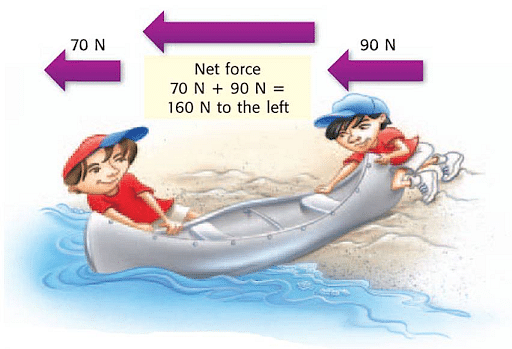
The resultant force is very useful as it allows the student to think about many forces through a single force. There is only a need to determine the effect of a single force. The resultant force is the only force that produces the same amount of acceleration as all the other forces acting on the body do.
Also Read: Resultant Vector Formula
Formula of Resultant Force
[Click Here for Sample Questions]
When two or more forces are acting on the particular body, the total force adds up to a single force, referred to as its Resultant Force, and can also be called the Net force on that body as mentioned above.
If the forces are in the same direction then the forces in all the directions will be the same for all the forces.
The Resultant Force on anybody can be given by:
F(R) = F (1) + F (2) + F (3)
In the above formula,
F (1), F (2), F (3) are the three different forces that are acting upon a body in the same direction.
Consider that F (2) is perpendicular to the F (1) then the Resultant force is given as
F(R) = [(F (1) ^2+F (2) ^2)] ^ 1/2.
Using the Pythagorean Theorem, the sum of the vectors is taken as the vectors as they have a particular direction. (Vector Quantities have both magnitude and direction.)
Instead of the normal summation of the forces, the Pythagoras theorem is used to perform the vector summation of the forces.
Also Read: Electric Field
Finding the Resultant Force
[Click Here for Sample Questions]
Forces can be applied in any direction on the body, the forces can act in the same direction, in the opposite direction, or can be acting in the angular direction.
1. Forces acting in the SAME Direction
When two or more forces are acting in the same direction:
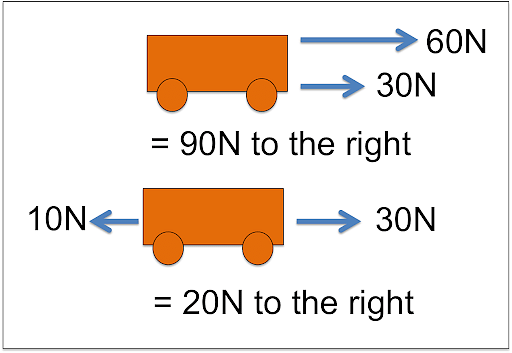
In the above image, two forces are acting in the same direction on the object, hence the magnitude of the resultant force will be the sum of the two forces.
2. Forces acting in the OPPOSITE Direction
When two or more forces are acting in the opposite direction:

In the above image, two forces are acting in the opposite direction on the object, hence the magnitude of the resultant force will be the sum of the two forces. The resultant force on the body will be zero if the forces are equal in magnitude and opposite in direction. Hence, they cancel out each out.
But, if the magnitudes are not equal then take the difference of the magnitudes.
Let's consider F(1)= 3N and F(2)= 5N; Then the resultant vector will be 5N- 3N= 2N.
3. Forces acting in ANGULAR Direction
In the above case, the forces were acting parallel or in opposite directions. Let's consider that one of the forces acting now on the body is in the angular direction. F (1) is acting at 45 degrees on the object whereas F (2) has the magnitude of 60N which is acting horizontally.

Then, the next step to determine the x and the y component of the force that is acting on the body is as follows.

F (1)x = F (1) cos 45; F(1)y = F (1) sin 45;
F (2)x = F (2); F(2)y = 0;
F(1)x = F(2)x;
R(x) = F (1) cos 45 + F (2)
R (x) = (50N) (cos 45) + 60N;
R (x) = 95N
Similarly, F(1)y + F(2)y = R(y);
R(y) = F (1)y + F (2)y;
R (y) = F(1) sin 45 + 0;
R (y) = (50N)(sin 45)
R (y) = 35N;
The magnitude of and the direction of the resultant force:
R (x) = 95N;
R (y) = 35N;
Also Read: Concave Mirror
Things to Remember
- The resultant force is referred to as the total amount of force that is acting on the object or body along with the direction of the body.
- The resultant force will be zero when the object is at rest or it is traveling with the same velocity as the object.
- The resultant force has to be equal for all the force as all the force is acting in the same direction.
- The Resultant Force on anybody can be given by: F(R) = F (1) + F (2) + F (3)
- In the above formula, F (1), F (2), F (3) are the three different forces that are acting upon a body in the same direction.
Also check: Difference Between Equinox and Solstice
Sample Questions
Ques: What is meant by the Resultant Force acting on anybody? (2 marks)
Ans: The Resultant Force is mainly a single force which is the final effect of all the forces which are acting on a certain body. It is associated with torque just by combining the system of forces or torques altogether.
Ques: What is Pythagoras Theorem? (2 marks)
Ans: Pythagoras Theorem is defined for any right-angled triangle where 'the square of the hypotenuse is equal to the sum of the squares of the other two sides. The Hypotenuse id the longest side in the triangle and it is always the opposite side of the corner where the right angle is situated.
Ques: Two forces are acting on a body of 9N and 4N respectively in a perpendicular direction to that body. Find the resultant force that is acting on the body. (4 marks)
Ans: According to the question;
F (1) = 4N;
F (2) = 9N;
As the two forces are in a perpendicular direction, the resultant force on the body is formulated as:
F (R) = [F (1)^2) + F (2)^2) ]^ 1/2
=> [(4)^2+ (9)^2]^1/2
=> (97)^1/2
=> 9.84N
Hence, the resultant force is 9.84N.
Question: Consider three different forces acting on an object simultaneously. The forces are 60N, 50N, and the third force is 20N which is acting opposite to the direction as compared to the other two. Find the Resultant force acting on the object. (4 marks)
Ans: According to Question;
F (1) = 60N
F (2) = 50N
F (3) = 20N
As mentioned in the Question above the third force is opposite from the other two hence it is negative.
So, the Resultant force can be given by:
F (R) = F (1)+ F (2) + F (3) ;
F (R) = 50+60-20;
Hence, the Resultant Force on that object is 90N.
Ques: There are three forces of equal magnitude acting on a body. Then which of the following is correct? (2 marks)
(a) The resultant Force can be zero if all the forces are collinear
(b) The Resultant Force can never be zero
(c) The resultant of the forces will be zero
(d) One of the force should be in the opposite direction as compared to the other two for zero resultant force.
Ans: (D) = The resultant force will be zero if one of the three forces acting on the body is in opposite direction.
Ques: There is a car that weighs 1400kg and there are multiples forces that are acting on that car and producing an acceleration of 3.5 m/s^2 towards the north. Find the Net force that is acting on the car. (2 marks)
Ans: According to the Question,
The mass of the car = 1400kg;
Acceleration = 3.5 m/s^2;
The direction of the F (R) will be the same as the acceleration in the north direction;
F (R) = ma;
F (R) = (1400 kg)(3.5 m/s^2);
F (R) = 4900N
The net force acting on the car is 4900N.
Ques: There is a block that is pulled by two forces of the 15N and 25N towards the left and other forces are acting toward the right which are 10N, 20N, and 30N. Find the magnitude and the direction of the resultant force. (2 marks)
Ans: According to the question, the total amount of forces acting on the block on the right side of the block is 10N+20N+30N = 60N. And the total effective force acting on the left side of the block is 15N+25N = 40N.
Hence, the total Resultant force acting on that block will be the difference between the two forces acting on the two sides so the net force is 60N-40N= 20N.
20N is the net force acting on the block that to towards the right side of the block.
Ques: There is a box that weighs about 1 kg and is said to be falling freely from a tower. Find the resultant force on that box. (2 marks)
Ans: According to the Question; the net force is equal to the force of gravity then the box is said to be having only one force. Hence, the direction of the box will be in the downward direction so the magnitude of the force will be:
F(R) = mg;
F(R) = (1kg)(9.8 m/s^2);
F (R) = 9.8 N;
Therefore, the Resultant force acting on the box is 9.8N.
More Related Topic:



Comments