



Education Journalist | Study Abroad Lead
Oscillatory motion is the to and fro motion of a body from a mean position at a fixed axis. It is a periodic motion that repeats itself after fixed time intervals. In the absence of friction, an object can be in oscillatory motion forever in an ideal scenario but in the real world, this is not possible as the object settles into equilibrium. Oscillatory motion can be observed widely in our daily life. Some examples of oscillatory motion are –
- The orbital motion of the earth around the sun
- The motion of a clock's arms
- The motion of a simple pendulum
Oscillatory motion is essential to study the characteristics of Electromagnetic propagation of waves, Alternating current vibrations and molecular motions.
| Table of Content |
Key Takeaways: Oscillatory Motion, Periodic Motion, Friction, Equilibrium, Simple Harmonic Motion, Amplitude, Frequency, Hooke’s Law
What is Oscillatory Motion?
[Click Here for Previous Year's Questions]
Oscillatory Motion is the to and fro periodic motion of an object from its mean location.
- The highest deviation of the object from equilibrium is called amplitude, and the time it takes for the motion to repeat itself is called the period.
- The frequency is the number of oscillation cycles per unit of time.
- One hertz (Hz) is equal to the one oscillation cycle every second.
- Frequency is measured in hertz (Hz).
- The principles of oscillatory motion are necessary for a thorough knowledge of a wide range of physical phenomena.
- Frequency f and period T are complementary and are mathematically inverse of each other.
\(f = \frac{1}{t}\)
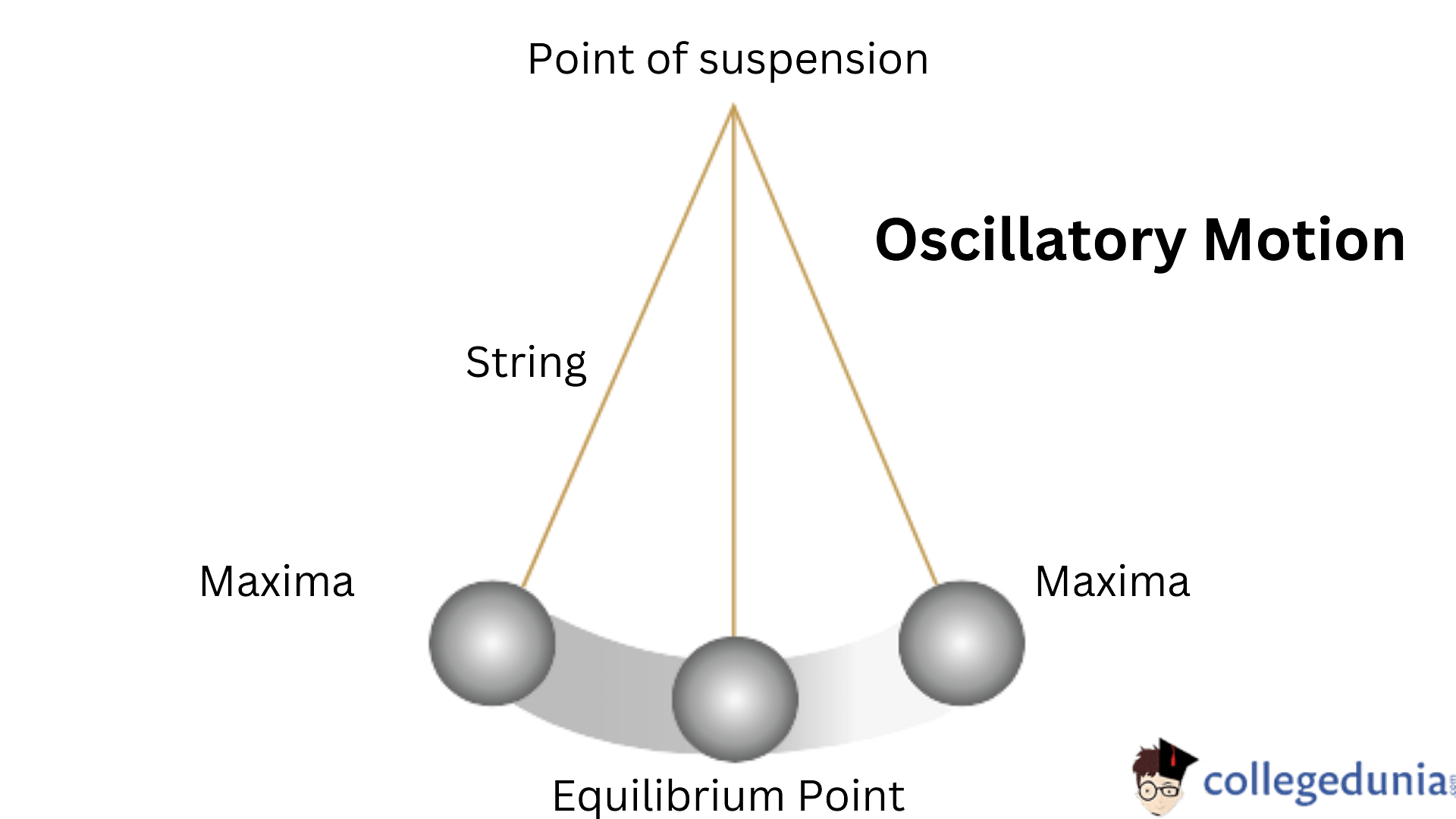
Oscillatory Motion of a Pendulum
NOTE- Every oscillatory motion is also a periodic motion, although not all periodic motions are oscillatory.
The video below explains this:
Simple Harmonic Motion Detailed Video Explanation:
Read More:
| Learn More about Oscillatory Motion | ||
|---|---|---|
| Unit of Vibration | Resonant frequency formula | LC Oscillation |
| Free, Forced And Damped Oscillations | Harmonic progression | NCERT Solutions for Class 11 Oscillations Chapter |
Examples of Oscillatory Motion
[Click Here for Sample Questions]
Some of the examples of oscillatory motion are as follows:
- Vibrating strings in musical instruments such as the sitar, violin, or guitar, produce pleasing and beautiful sounds.
- The membranes in drums, telephone diaphragms, and speaker systems vibrate back and forth about their mean positions.
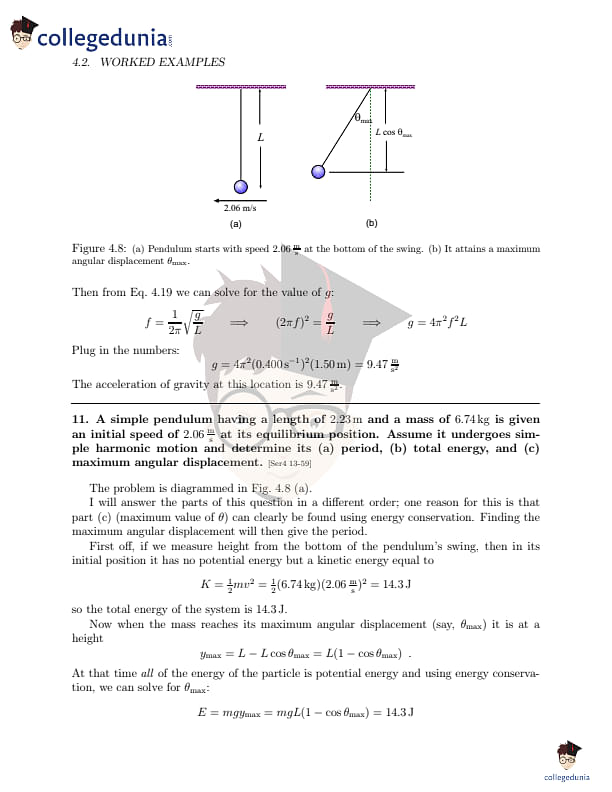
- The oscillation of a pendulum.
- The movement of spring
- Alternating Current is also an example of oscillatory motion.
- Simple pendulum
- Series of oscillations are observed in the cosmological model
Types of Oscillatory Motion
[Click Here for Previous Year's Questions]
Oscillatory motion can be divided into two types. These are as follows:
Linear oscillatory motion
The object goes left and right or up and down in linear oscillatory motion. For example:
- The vibration of strings of musical instruments.
- Floating ships or large boats in the sea
- Fluid movement in a U-tube column
Circular oscillatory motion
The motion in which the object moves left to right in a circular way is called oscillatory motion. For example:
- The motion of a solid sphere in a half-hollow sphere.
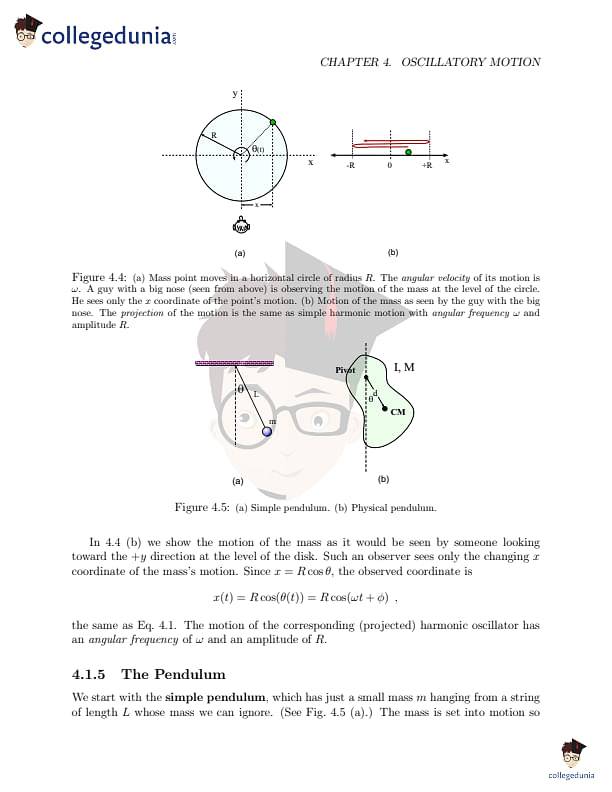
- The pendulum in a watch moves back and forth.
- Swinging motion
- A wheel's rotation
- A string swinging from a nail
Oscillatory Motion Notes








Simple Harmonic Motion (SHM)
[Click Here for Sample Questions]
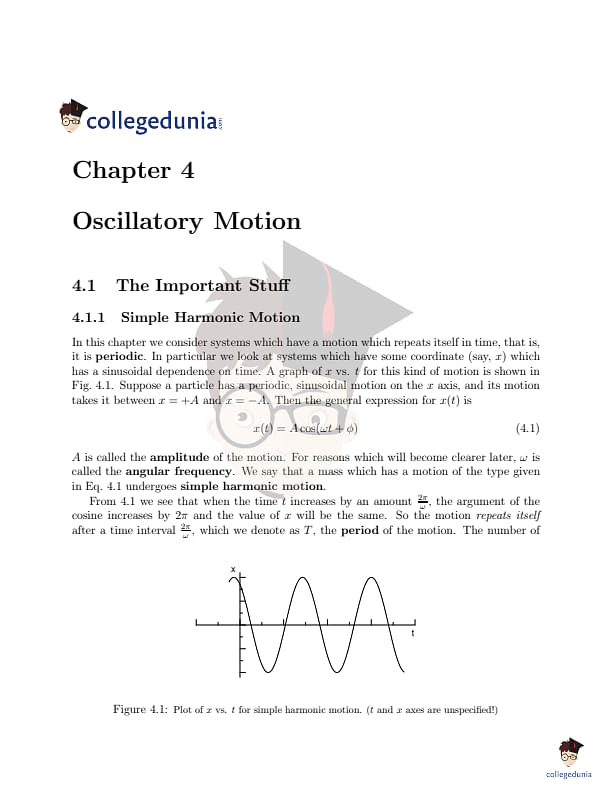
Simple harmonic motion (SHM) is a type of oscillatory motion specified for a particle travelling along a straight line with an acceleration that is proportional to the distance from a fixed point on the line.
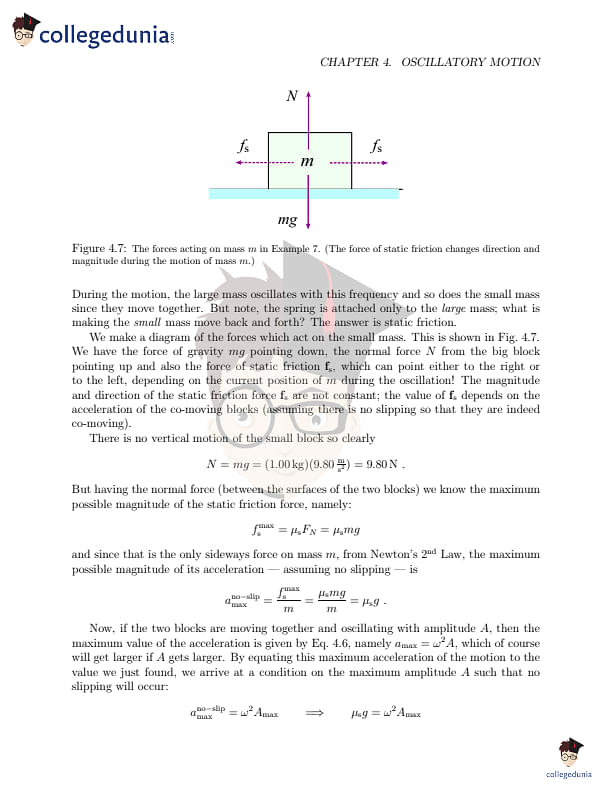
A restoring force that obeys Hooke's law has to restore any simple mechanical harmonic system (system of the weight hanged by the spring to the wall) that has been shifted from its equilibrium position. The mathematical expression of restoring force or Hooke’s law is as follows:
F = -kx
Where,
- F is the spring's restoring elastic force in newton (N)
- k is spring constant in Nm-1
- x is the displacement from equilibrium position in meter (m)
The negative sign in Hooke's law describes the force as a restorative force that attempts to bring the spring back to its equilibrium position.
Difference between Periodic and Oscillatory Motion
[Click Here for Previous Year's Questions]
The key differences between Periodic and Oscillatory motion are tabulated below.
| Periodic Motion | Oscillatory Motion |
|---|---|
| Periodic motion is described as a movement that repeats itself at regular intervals. | The to and fro motion of the body around its fixed position is referred to as oscillatory motion. |
| The time period of a periodic motion is defined as a definite interval of time. | An oscillation having a definite period is known as a periodic motion. After each period of time, the system returns to its initial position. |
| Periodic motion is not always Oscillatory. | Oscillatory motion can be periodic. |
| Example: The movements of the hands of a clock, the motion of planets around the sun, etc. | Example: Vibrating strings, swinging of the swing, etc. |
Read More:
Things to Remember
- Oscillatory Motion is an object's to and fro motion from its mean location.
- For a pendulum, the highest deviation from equilibrium is called amplitude, and the time it takes for the motion to repeat itself is called the period.
- Oscillatory Motion is of two types- Linear Oscillatory Motion and Circular Oscillatory Motion.
- The object goes left and right or up and down in linear oscillatory motion.
- The object moves left to right in a circular way in circular oscillatory motion.
- Every oscillatory motion is also a periodic motion, but not all periodic motions are oscillatory.
- Simple Harmonic Motion is a type of oscillatory motion specified for a particle travelling along a straight line with an acceleration proportional to the distance from a fixed point on the line.
Sample Questions
Ques: Is the motion of a simple pendulum strictly simple harmonic? (1 Mark)
Ans: a simple pendulum is not strictly simple harmonic because we make the assumption that Sin θ = θ. It can be valid only if θ is very small.
Ques: At what distance from the mean position, is the kinetic energy in a simple harmonic oscillator equal to potential energy? (1 Mark)
Ans: The kinetic energy in a simple harmonic oscillator is equal to potential energy when it is between mean and extreme position. It will be at x= a2.
Ques: Define oscillation and explain it with reference to periodic motion. (2 Marks)
Ans: If the body moves back and forth (to and fro) around a fixed position or point after a regular interval of time, it is said to be an oscillatory or vibratory motion. The mean position and equilibrium position are two fixed points around which a body oscillates. Every periodic motion is oscillatory, but not every oscillatory motion is periodic. The vibration of a sitar wire and the oscillation of a mass suspended on a spring are two examples of oscillatory motion.
Ques: Mention the types of oscillatory motion. (2 Marks)
Ans: There are mainly two types of oscillatory motion i.e. linear and circular oscillatory motion.
Linear Oscillatory Motion- The object goes left and right or up and down in linear oscillatory motion. For example, the vibration of strings of musical instruments.
Circular Oscillatory Motion- In Circular Oscillatory Motion, the object moves left to right in a circular motion. For example, the motion of a solid sphere in a half hollow sphere.
Ques: What does Hooke’s law state? (2 Marks)
Ans: Hooke’s law states that the restoring force is directly proportionate to the displacement from the equilibrium position. For example:
A spring is linked to a block and fixed to the wall on a horizontal plane, and the block is placed in such a way that it can move horizontally. When the block slides horizontally away from the wall, the spring strives to recover its position, resulting in oscillatory motion. The restoring force attempts to prevent distortion of the spring. This restorative force is expressed as :
F= – kx
Where,
- F is the restoring elastic force of the spring
- k is spring constant in Nm-1
- x is displacement from equilibrium position in meter (m)
Ques: Differentiate between oscillatory and periodic motion. (2 Marks)
Ans: An object in oscillatory motion moves back and forth over a fixed location regularly. On the other hand, the objects in periodic motion move from a fixed location after a set amount of time. Oscillatory motion can be both oscillatory and periodic, while periodic motion cannot be oscillatory.
For example, the motion of an automobile wheel is periodic but not oscillatory, whereas the motion of a strung object affixed to a wall is both periodic and oscillatory.
Ques: Why motion of a pendulum is an oscillatory motion? (2 Marks)
Ans: The motion of a pendulum is an example of oscillatory motion. The pendulum of a pendulum watch swings back and forth over a set potion, known as the equilibrium potion. If ideal conditions prevail, any object's oscillatory motion will never come to an end because there is no friction due to air under the ideal state.
Ques: A spring balance has a scale that reads from 0 to 50 kg. The length of the scale is 20 cm. A body suspended from this balance, when displaced and released, oscillates with a period of 0.6s. What is the weight of the body? (3 Marks)
Ans: M = 50 kg, y = 20 cm = 0.2 m, T = 0.60 s
F = ky or Mg = ky or k = Mg/0.2 = (50 x 9.8)/0.22 Nm-1
or K = 2450 Nm-1
Now, T = \(2 \pi \sqrt {m \over k}\)
T2 = 4\(\pi\)2\(m \over k\)
or m = \(T^2k \over 4 \pi^2\)
m = \(0.6 \times 0.6 \times 2460 \times 49 \over 4 \times 484 \)kg = 22.3 kg
mg = 22.3 x 9.8 N = 218.5 N
= 22.3 kgf
Ques: A simple pendulum of length l and having a bob of mass M is suspended in a car. The car is moving on a circular track of radius R with a uniform speed v. If the pendulum makes small oscillations in a radial direction about its equilibrium position, what will be its time period? (3 Marks)
Ans: According to the question, the bob of the pendulum is under the action of two accelerations.
(i) Acceleration due to gravity ‘g’ acting vertically downwards.
(ii) Centripetal acceleration ac = V2 / R which is acting along the horizontal direction.

Ques: A mass attached to a spring is free to oscillate, with angular velocity w, in a horizontal plane without friction or damping. It is pulled to a distance x0 and pushed towards the center with a velocity v0 at time t = 0. Determine the amplitude of the resulting oscillations in terms of the parameters w, x0 and v0. (3 Marks)
Ans:

Ques: The piston in the cylinder head of a locomotive has a stroke (twice the amplitude) of 1.0 m. If the piston moves with simple harmonic motion with an angular frequency of 200 rev/min, what its maximum speed? (3 Marks)
Ans: Stroke of piston = 2 times the amplitude
Let A = amplitude, stroke = 1m
Therefore, A = ½ m
Angular frequency = 200 rad/min
Vmax = ?
We know that the maximum speed of the block when the amplitude is A,
Vmax = \(\omega\)A = 200 x ½ = 100m/min
= 100/60 = 5/3 ms-1 = 1.67 ms-1
For Latest Updates on Upcoming Board Exams, Click Here: https://t.me/class_10_12_board_updates
Do Check Out:



Comments