



Content Curator
A right-angle triangle is a triangle that has a 90-degree angle in it.Right triangles are employed in a wide range of applications, from the design of fighter jets, to finding distances, if we know the angle of elevation or the angle of depression, and to the proof of complicated mathematical theorems and so on.Let's learn more about the right-angle triangles and associated theorem- The right-angle triangle theorem or the Pythagoras theorem.
| Table of Content |
Key Terms: Right angle triangle, Pythagoras theorem, Proof of right-angle triangle theorem, Pythagorean triplets
Also read: Area of a Triangle
What are Right Triangles?
[Click Here for Sample Questions]
A right triangle is defined as a triangle in which one of the angles is 90 degrees.A right angle is the one that measures 90 degrees.Two legs and a hypotenuse make up a right-angle triangle.The hypotenuse is the longest side of the right triangle and the side opposite the right angle, and the two legs meet at a 90° angle.
An important feature of right-angled triangles is that the non-right angles (labeled alpha and beta in this diagram) must add up to 90 degrees.This is because the sum of all triangle angles is 180 degrees, therefore alpha plus beta plus 90 equals 180 degrees.As a result, Alpha plus beta is equal to 90 degrees.And the angles(alpha and beta) that add up to 90 degrees are called complementary angles.
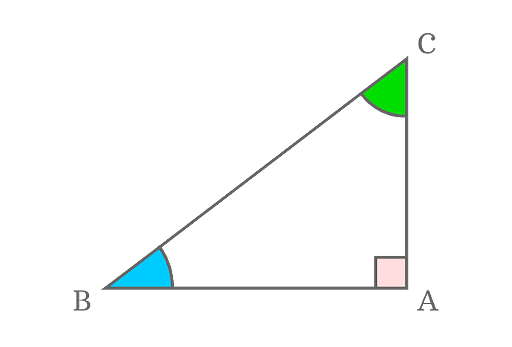
Right Triangle
Right Angle Triangle Theorem
[Click Here for Sample Questions]
The right-angle triangle theorem is also known as the Pythagoras theorem.The Pythagorean Theorem, which explains the relationship between the perpendicular, hypotenuse, and base of a right triangle, is one of the most well-known formulas in mathematics.This theorem states that, if the square of the hypotenuse of any right-angle triangle is equal to the sum of squares of base and perpendicular, then the triangle is a right triangle.It can be denoted as follows:
If Hypotenuse2=Perpendicular2+Base2
then, ∠θ=90°
Where,
The hypotenuse is the side opposite to the right angle(90 degrees),
the Perpendicular is the side adjacent to the right angle and connected to the hypotenuse,
The base is the adjacent side to the right angle, the perpendicular and the base are called the legs of the triangle here.
With the help of this formula, we can easily find the length of the side of a right-angle triangle, if we know the length of the other two sides and vice versa.The three sides of a triangle, the base, perpendicular, and hypotenuse, are known as Pythagorean triples, and the triangle is known as a Pythagorean triangle if all three sides are integers.
Proof of Right-Angle Triangle Theorem
Theorem: In a triangle, if the square of one side is equal to the sum of the squares of the other two sides, then the angle opposite the first side is a right angle.
That is, If Hypotenuse2=Perpendicular2+Base2
then, ∠θ=90°
To prove: ∠B=90°
Proof: We have a Δ ABC in which AC2=AB2+BC2
We need to prove that ∠B=90°
In order to prove the above, we construct a triangle PQR which is right-angled at Q such that:
PQ=AB and QR=BC
From triangle PQR, we have
PR2=PQ2+ QR2(According to Pythagoras theorem, as ∠Q=90°)
or, PR2=AB2+BC2 (By construction) ……(1)
We know that;
AC2=AB2+BC(Which is given) …………(2)
So, AC=PR [From equation(1) and(2)]
Now, in Δ ABC and Δ PQR,
AB=PQ(By construction)
BC=QR(By construction)
AC=PR [Proved above]
So, Δ ABC ≅ Δ PQR(By SSS congruence)
Therefore, ∠B=∠Q(CPCT)
But, ∠Q=90°(By construction)
So, ∠B=90°
Hence the theorem is proved.
The Pythagoras theorem can be proved in a number of ways.Two of the most prevalent and commonly used ways are the algebraic method and the similar triangles method.
Also read: Isosceles Triangle Theorems
Right Angle Triangle Formula
[Click Here for Sample Questions]
The formula of the right-angled triangle is as follows:
(Hypotenuse)2=( Perpendicular)2+( Base)2
If p, q, and r are perpendicular, base, and the opposite of a right-angles triangle, then:
p2=r2+q2
or
p =r
√p=r2+q2
This implies-the root of the sum of the squares of the base and the perpendicular.
Half of the product of the base and the perpendicular is equal to the area of the triangle.
Right Angle Triangle Formula is:
A=1/2 x base x height
Here,
b=base
h=height of the triangle
Also read: Differentiation and Integration Formula
Things to Remember
- The Right-angle triangle theorem states that, if the square of the hypotenuse of any right-angle triangle is equal to the sum of squares of base and perpendicular, then the triangle is a right triangle.
- The sides of this triangle have been named Perpendicular, Base, and Hypotenuse.
- The hypotenuse is the longest side, as it is opposite to the angle 90 degrees.
- The sides of a right triangle(say a, b and c) which have positive integer values, when squared, are put into an equation, also called Pythagorean triples.
- If Hypotenuse2=Perpendicular2+Base2 then, ∠θ=90°
- The formula of the right-angle triangle is: A=1/2 x base x height
Also read: Differential Equation
Sample Questions
Ques. The angle ∠PRQ=90° and RS is perpendicular to PQ. Prove that QR2/PR2=QS/PS. (3 Marks)
Ans. We can see that,
PSR ~ PRQ
According to the property of similar triangles,
we have:
PR/PQ=PS/PR
or it can also be written as PR2=PQ.PS ……….(1)
Similarly, we have QSR ~ QRP
So, we have, QS/QR=QR/QP
Or it can also be written as;
QR2=QP.QS ………..(2)
By dividing the equations(2) by(1) we can have the following:
QR2/PR2=(QP.QS)/(PQ.PS)=QS/PS
Hence, proved.
Ques. If the measure of hypotenuse and base is 5cm and 3cm of a right triangle.Then find its height. (3 Marks)
Ans. By the formula of right-angle triangle, we know;
(Hypotenuse)2=(Adjacent side)2+(Opposite side)2
(5)2=(3)2+(Perpendicular)2
25=9+(P)2
16=(P)2
P=√16=4cm
Hence, the measure of perpendicular is 4 cm.
Ques. The angle ∠JLK=900 and LP is perpendicular to K.Prove that KJ2/ JL2=KP / JP. (3 Marks)
Ans. We can see that,
JJL ~ JLK
According to the property of similar triangles,
we have:
JL / JK=JP / JL
or it can also be written as, JL2=JK.JP ……….(1)
Similarly, we have KPL ~ KLJ
So, we have, KP / KL=KL / KJ
Or it can also be written as;
KL2=KJ.KP ………..(2)
By dividing the equations(2) by(1) we can deduce that:
LL2 / JL2=(LJ.LP) /(JL.JP)=LP / JP
Hence, it proved.
Ques. If the length of the hypotenuse and the base is 6 cm and 5 cm of the right triangle.Find the height of the triangle. (3 Marks)
Ans. We know the formula of the right-angle triangle.It goes by:
( Hypotenuse)2=( Opposite)2+( Adjacent)2
( 6)2=( 5)2+( Perpendicular)2
36=25+( P)2
36-25=( P)2
( P)2=9
Therefore, P=3 cm
Hence, the height of the perpendicular is 3 cm.
Ques. If the length of the hypotenuse and the base is 10 cm and 6 cm of the right triangle.Find the height of the triangle. (3 Marks)
Ans. We know the formula of the right-angle triangle.It goes by:
( Hypotenuse)2=( Opposite)2+( Adjacent)2
( 10)2=( 6)2+( Perpendicular)2
100=36+( P)2
100-36=( P)2
( P)2 =64
Therefore, P=8 cm
Hence, the height of perpendicular is 8 cm.
Ques. Find the length of the perpendicular of a triangle whose base is 5 cm and the hypotenuse is 13 cm.Also, find its area. (3 Marks)
Ans. Given
Base=5 cm
Hypotenuse=13 cm
By Pythagoras theorem,
(perpendicular)2=(13 cm)2–(5 cm)2
(perpendicular)2=169 cm2–25 cm2
(perpendicular)2=144 cm2
(perpendicular)2=(12 cm)2
Hence,
perpendicular=12 cm
Now,
Area of triangle=(1/2) x(Base x Perpendicular)
=(1/2) x 5 x 12
= 5 x 6
We get,
= 30 cm2
Ques. Find the length of the hypotenuse of the triangle when the other two sides are 24 cm and 7 cm. (3 Marks)
Ans. Given
The two sides(excluding hypotenuse) of a right-angled triangle are 24 cm and 7 cm
(hypotenuse)2=(24 cm)2+(7 cm)2
(hypotenuse)2=576 cm2+49 cm2
(hypotenuse)2=625 cm2
(hypotenuse)2=(25 cm)2
(hypotenuse)=25 cm
Therefore, the length of the hypotenuse of the triangle is 25 cm
Ques. Calculate the area of a right-angled triangle whose hypotenuse is 65 cm and one side is 16 cm. (3 Marks)
Ans. We have,
Hypotenuse=65 cm
One side=16 cm
Let the length of the other side=x cm
By the Pythagoras theorem,
(65 cm)2=(16 cm)2+(x cm)2
(x cm)2=(65 cm)2–(16 cm)2
(x cm)2=4225 cm2–256 cm2
On further calculation, we have,
(x cm)2=3969 cm2
We get,
(x cm)2=(63 cm)2
Hence,
x=63 cm
Area of the triangle=(1/2) x(Base x Height)
=(1/2) x 16 cm x 63 cm
= 8 cm x 63 cm
We get,
= 504 cm2
Ques. A man goes 10 m due east and then 24 m due north.Find the distance from the starting point. (3 Marks)
Ans. Let us take ‘O’ as the original position of the man
From the figure, we know that B is the final position of the man
Here,
AOB is right-angled at A
By the Pythagoras theorem,
OB2=OA2+AB2
OB2=(10m)2+(24 m)2
OB2=100 m2+576 m2
OB2=676 m2
OB2=(26 m)2
We get,
OB=26 m
Therefore, the man is at a distance of 26 m from the starting point
Ques. A ladder 25 m long reaches a window of a building 20 m above the ground. Determine the distance of the foot of the ladder from the building. (3 Marks)
Ans. Let AC be the ladder and A be the position of the window
Then,
AC=25 m and AB=20 m
Using Pythagoras theorem,
AC2=AB2+BC2
By substituting AC=25 and AB=20
We get,
(25 m)2=(20 m)2+BC2
BC2=(25 m)2–(20 m)2
BC2=625 m2–400 m2
BC2=225 m2
BC2=(15 m)2
We get,
BC=15 m
Hence,
The distance of the foot of the ladder from the building is 15 m
Ques. A right triangle has hypotenuse p cm and one side q cm.If p–q=1, find the length of the third side of the triangle. (3 Marks)
Ans. We have,
Hypotenuse=p cm
One side=q cm
Let the length of the third side=x cm
Using Pythagoras theorem,
x2=p2–q2
x2=(p+q)(p–q)
Substituting(p–q)=1
We get,
x2=(p+q)(1)
x2=(p+q)
x=√p+q
Therefore, the length of the third side of the triangle is √p+q cm
Ques. A ladder 15 m long reaches a window which is 9 m above the ground on one side of a street.Keeping its foot at the same point, the ladder is turned to the other side of the street to reach a window 12 m high.Find the width of the street. (3 Marks)
Ans. Let ‘O’ be the foot of the ladder
Let AO be the position of the ladder when it touches the window at A which is 9 m high and CO be the position of the ladder when it touches the window at C which is 12 m high.
Using Pythagoras theorem,
In AOB,
BO2=AO2–AB2
BO2=(15 m)2–(9 m)2
BO2=225 m2–81 m2
On simplification, we get,
BO2=144 m2
BO2=(12 m)2
We get,
BO=12 m
Using Pythagoras theorem,
In COD,
DO2=CO2–CD2
DO2=(15 m)2–(12 m)2
DO2=225 m2–144 m2
We get,
DO2=81 m2
DO=9 m
Width of the street=DO+BO
= 9 m+12 m
= 21 m
Therefore, the width of the street is 21 m
Ques. The foot of a ladder is 6 m away from a wall and its top reaches a window 8 m above the ground.If the ladder is shifted in such a way that its foot is 8 m away from the wall to what height does its top reach? (4 Marks)
Ans. Let AC be the ladder and A be the position of the window which is 8 m above the ground
Now,
The ladder is shifted such that its foot is at point D which is 8 m away from the wall
Hence,
BD=8 m
At this instance, the position of the ladder is DE
Hence,
AC=DE
Using Pythagoras theorem,
In ABC,
AC2=AB2+BC2
AC2=(8 m)2+(6 m)2
AC2=64 m2+36 m2
AC2=100 m2
We get,
AC=10 m
We know that, AC=DE=10 m
Using Pythagoras theorem,
In DBE,
BE2=DE2–BD2
BE2=(10 m)2–(8 m)2
BE2=100 m2–64 m2
BE2=36 m2
We get,
BE=6 m
Hence,
The required height up to which the ladder reaches is 6 m above the ground
Ques. Two poles of height 9m and 14 m stand on plain ground.If the distance between their feet is 12m, find the distance between their tops. (4 Marks)
Ans. Let AB and CD be the two poles of 9 m and 14 m respectively
Given that,
BD=12 m
Thus,
CE=12 m
Now,
AE=AB–EB
AE=14 m–9 m
We get,
AE=5 m
Using Pythagoras theorem in ACE,
AC2=AE2+CE2
AC2=(5m)2+(12 m)2
AC2=25 m2+144 m2
AC2=169 m2
AC2=13 m2
We get,
AC=13 m
Therefore, the distance between the tops of their poles is 13 m
Ques. The length of the diagonals of the rhombus is 24 cm and 10 cm.Find each side of the rhombus. (4 Marks)
Ans. Given
The length of the diagonals of rhombus are 24 cm and 10 cm respectively
Therefore,
d1=24 cm and d2=10 cm
The diagonals of a rhombus bisect each other
Hence,
(d1 / 2)2+(d2 / 2)2=side2
side2=122+52
side2=144+25
side2=169
side2=132
We get,
side=13
Therefore, each side of the rhombus is of length 13 cm
Ques. Each side of the rhombus is 10 cm.If one of its diagonals is 16 cm, find the length of the other diagonal. (3 Marks)
Ans. Given
Side of the rhombus=10 cm
Length of one diagonal, d1=16 cm
Let d2 be the other diagonal of the rhombus
The diagonals of a rhombus bisect each other
Therefore,
(d1 / 2)2+(d2 / 2)2=side2
On further calculation, we get,
82+(d2 / 2)2=102
(d2 / 2)2=102–82
(d2 / 2)2=100–64
We get,
(d2 / 2)2=62
(d2 / 2)=6
d2=6 x 2
d2=12
Therefore, the length of the other diagonal of the rhombus is 12 cm.
Ques. In a \(\Box\) ABC, AD is perpendicular to BC .Prove that AB2+CD2=AC2+BD2 (3 Marks)
Ans. Since triangles ABD and ACD are right triangles right angled at D,
AB2=AD2+BD2 ………..(i)
AC2=AD2+CD2 ………..(ii)
Subtracting(ii) from(i), we get,
AB2–AC2=BD2–CD2
We get,
AB2+CD2=AC2+BD2
Hence, proved
Ques. From a point O in the interior of a ABC, perpendicular OD, OE, and OF are drawn to the sides BC, CA, and AB respectively.Prove that:
(a) AF2+BD2+CE2=OA2+OB2+OC2–OD2–OE2–OF2
(b) AF2+BD2+CE2=AE2+CD2+BF2. (5 Marks)
Ans. (a) In right triangles OFA, ODB and OEC,
We have,
OA2=AF2+OF2
OB2=BD2+OD2
OC2=CE2+OE2
By adding all these results, we get,
OA2+OB2+OC2=AF2+BD2+CE2+OF2+OD2+OE2
AF2+BD2+CE2=OA2+OB2+OC2–OD2–OE2–OF2
Hence, proved
(b) In right triangles ODB and ODC,
We have,
OB2=OD2+BD2
OC2=OD2+CD2
On subtracting, we get,
OB2–OC2=(OD2+BD2)–(OD2+CD2)
We get,
OB2–OC2=BD2–CD2 …….(1)
Similarly, we have,
OC2–OA2=CE2–AE2 ……..(2)
OA2–OB2=AF2–BF2 ……..(3)
Adding equations(1),(2) and(3) we get,
(OB2–OC2)+(OC2–OA2)+(OA2–OB2)=(BD2–CD2)+(CE2–AE2)+(AF2–BF2)
On further calculation, we get,
(BD2+CE2+AF2)–(AE2+CD2+BF2)=0
AF2+BD2+CE2=AE2+CD2+BF2
Hence, proved
Ques. A point O in the interior of a rectangle ABCD is joined with each of the vertices A, B, C and D.Prove that OB2+OD2=OC2+OA2. (5 Marks)
Ans. Let ABCD is the given rectangle and ‘O’ be a point within it
Join OA, OB, OC, and OD
Through ‘O’, draw EOF||AB
Then, ABFE is a rectangle
In right triangles OEA and OFC,
We have,
OA2=OE2+AE2 and
OC2=OF2+CF2
On adding, we get,
OA2+OC2=(OE2+AE2)+(OF2+CF2)
OA2+OC2=OE2+OF2+AE2+CF2 ……(1)
Now,
In right triangles OFB and ODE,
We have,
OB2=OF2+FB2 and
OD2=OE2+DE2
On adding, we get,
OB2+OD2=(OF2+FB2)+(OE2+DE2)
OB2+OD2=OE2+OF2+DE2+BF2
OB2+OD2=OE2+OF2+CF2+AE2 …….(2)
From equations(1) and(2) we get,
OA2+OC2=OB2+OD2
Hence, proved
Ques. ABCD is a rhombus.Prove that AB2+BC2+CD2+DA2=AC2+BD2. (3 Marks)
Ans. In AOB, BOC, COD and AOD
Applying Pythagoras theorem
AB2=AO2+OB2
BC2=BO2+OC2
CD2=CO2+OD2
AD2=AO2+OD2
On adding all these equations, we get,
AB2+BC2+CD2+AD2=2(AO2+OB2+OC2+OD2)
= 2 [(AC/2)2+(BD/2)2+(AC/2)2+(BD/2)2]
Since diagonals bisect each other
= 2 [(AC)2 / 2+(BD)2/ 2]
=(AC)2+(BD)2
Hence, proved
Also read:



Comments