



Content Curator
Right angled triangle is a geometrical figure which has one of its angles as 90 degrees. It is considered as the basis of trigonometry and Pythagoras theorem. The presence of a 90 degrees angle makes it known as a right-angled triangle. A right-angled triangle is referred to as a right triangle too. It has three sides namely base, altitude or a perpendicular, and hypotenuse. The identification of these sides is done in respect to the angle in consideration. The side opposite to the considering angle is perpendicular/altitude and the side in contact with the angle is the base. The other side is known as the hypotenuse.
Read Also: Rationalize the Denominator
| Table of Content |
Key Terms: Right-angled triangle, base, hypotenuse, perpendicular, height, altitude, sides, 90 degrees, angles, triangles, area, perimeter.
Shape of a right-angled triangle
[Click Here for Sample Questions]
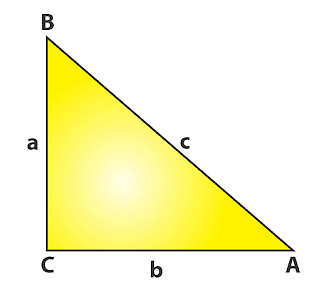
A right-angled triangle is a three-sided shape that is closed and has one perpendicular side. To identify a right-angled triangle, a ruler or a set square is placed in the corner of the angle and if the lines are in alignment with it means it is a right angle thus, making the triangle a right-angled triangle. In the figure, ABC is a right-angled triangle with side c as hypotenuse, side a being the altitude and side b known as the base.
Right Angled Triangle
Read More: Distance Formula and Derivation of Coordinate Geometry
Types of right-angled triangles
[Click Here for Sample Questions]
As we have seen that one of the angles of right-angled triangle is 90 degrees, it is necessarily required for the other two angles to be acute. So, they can be of two types
- Scalene right-angled triangle
- Isosceles right-angled triangle
Scalene right-angled triangle
A scalene right-angled triangle is a triangle where one of the angles is 90° and the other two angles sum up to give 90 degrees making it a total of 180 degrees. The other two angles are of different measurements. In the triangle PQR, ∠Q =90degrees, hence, it is a right-angled triangle. PQ is not equal to QR. Hence, it becomes a scalene triangle.
There is also a special case of scalene triangle which has angles as 30-60-90 degrees which is also a right-angled triangle. Here, the ratio of the triangle's longest side to its shortest side is 2:1. The side opposite to the 30 degrees angle is the shortest side.
Isosceles right-angled triangle
An isosceles right triangle is also known as a 90-45-45 (in degrees) triangle. In triangle ABC, angle A = 90degrees. Therefore, the triangle ABC is a right-angled triangle. Also, AB is given equal to AC.
Since two sides are equal, the triangle is also said to be an isosceles triangle. Considering AB and AC to be equal, the base angles will also turn out to be equal. We know that the sum of all the angles of a triangle is 180 degrees. Hence, the base angles when added makes it to be 90degrees which implies that they need to be 45 degrees each. Thus, in an isosceles right triangle, angles will always be 90-45-45 degrees.

Types of Right Triangles
Check Important Notes for Empirical Probability
Properties of right-angled triangles
[Click Here for Sample Questions]
All the properties of the right-angled triangle are mentioned below:
- One angle, which is the largest angle of the triangle, will always measure 90 degrees.
- The longest side of the right-angled triangle is called the hypotenuse.
- The hypotenuse is the side that is opposite to the 90 degrees angle.
- The sum of two angles apart from Right angle of the right-angled triangle is always 90 degrees.
- The sides adjacent to the Right angle in the triangle are known as the base and perpendicular of the triangle.
- If a circle is drawn along the three vertices of the triangle, then the radius of the circle drawn, will be equal to half of the actual length of the hypotenuse in all cases.
- The two angles, other than Right angle in a right-angled triangle, are always acute angles.
Area of a right-angled triangle
[Click Here for Sample Questions]
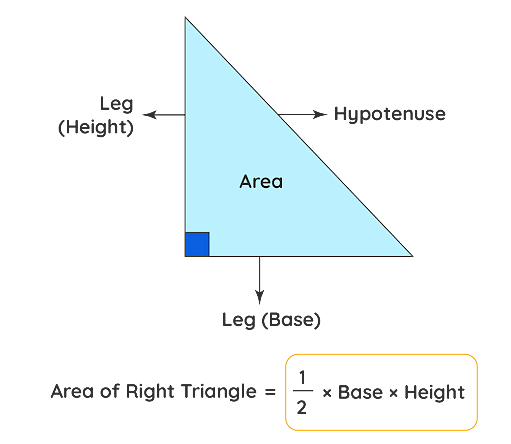
Area refers to the amount of space a closed figure occupies within the perimeter of a 2D shape. It is measured in square units. The amount of space that a right-angled triangle takes up is known as area of a right-angled triangle. It is measured as half of its product of base and height. The unit used for the same is square units because it is a two-dimensional quantity. Altitude/height and base are required to calculate the area of a right-angled triangle. The formula is:
\(Area = (\frac{1}{2} × base × height)\text{ square units.}\)
Area of a right-angled triangle
Perimeter of a right-angled triangle
[Click Here for Sample Questions]
Perimeter refers to the boundary. Boundary is always taken into consideration when the figure is a closed figure. Perimeter of any figure is calculated as sum of all its sides. Similarly, in a right-angled triangle, we have base, height and hypotenuse as the three sides to it. Therefore, the perimeter of a right-angled triangle is the summation of all its sides. The value thus obtained is a linear value and the unit is taken of length.

Perimeter of a Right-Angled Triangle
Things to remember:
[Click Here for Sample Questions]
- A right-angled triangle is geometrical figure or a geometrical shape which has one of its angles as 90 degrees.
- The side opposite to the considering angle is perpendicular/altitude
- The side in contact with the angle is the base.
- Hypotenuse is identified as the opposite side to Right angle in the triangle.
- The other two angles sum up to give 90 degrees making it a total of 180 degrees.
- An isosceles right triangle is also known as a 90-45-45 (in degrees) triangle.
Sample Questions
Ques. In a right triangle, if perpendicular = 8 cm and base = 6 cm, then what is the value of hypotenuse? [2 marks]
Ans. Given,
Perpendicular = 8 cm
Base = 6cm
We are required to find the hypotenuse.
By Pythagoras theorem, we know that;
Hypotenuse = √(Perpendicular2 + Base2)
H = √(62 + 82)
= √36 + 64
= √100
= 10 cm
Therefore, the hypotenuse of the right triangle is 10 cm.
Ques. If the hypotenuse is 13 cm and the base is 12 cm, then find the length of perpendicular of the right triangle? [3 marks]
Ans. Given, Hypotenuse = 13 cm
Base = 12 cm
Perpendicular=?
By Pythagoras theorem, we know that,
Hypotenuse2 = Perpendicular2 + Base2
Perpendicular2 = Hypotenuse2 – Base2
P = √(132 – 122)
P = √(169 – 144)
P = √25
P = 5 cm
Therefore, the value of perpendicular is 5cm.
Ques.Find the area of a right-angled triangle whose base is 12 units and height is 5 units. [2 marks]
Ans.
The area of a triangle formula is
1/2 × b × h.
Substituting b = 12 units and h = 5 units as stated
We get,
Area =1/2 × 12 × 5 = 30 units2.
Therefore, the area of the right triangle comes out to be 30 square units.
Ques.The perimeter of a right triangular swimming pool is 720 units. The three sides of the pool are in the ratio 3:4:5. Find the area of the pool. [4 marks]
Ans. The right triangle perimeter is the sum of the measures of all the sides.
Therefore, we have
3x+4x+5x = 720
12x = 720
x = 60
The sides of the triangle are
First is 3x=180 units,
Second is 4x=240 units,
And third is 5x=300 units.
Since, 1802 + 2402 = 3002, these sides form a right triangle with a hypotenuse of 300 units. Therefore, the area of the swimming pool is
A= 1/2 × 180 × 240= 21600 units2.
Therefore, the area of the swimming pool will be 21600 square units.
Ques. The foot of a ladder is 6m away from the top wall and its top reaches a window 8m above the ground. If the ladder is shifted in such a way that its foot is 8m away from the wall, to what height does its top reach? [5 marks]
Ans. Consider AC to be the ladder and A to be the position of the window which is 8 m above the ground
Now,
The ladder is shifted such that its foot is at point D which is 8 m away from the wall
Hence,
BD=8 m
At this instance, the position of the ladder is DE
Hence,
AC=DE
Using Pythagoras theorem,
In ABC,
AC2=AB2+BC2
AC2=(8 m)2+(6 m)2
AC2=64 m2+36 m2
AC2=100 m2
We get,
AC=10 m
We know that, AC=DE=10 m
Using Pythagoras theorem,
In DBE,
BE2=DE2–BD2
BE2=(10 m)2–(8 m)2
BE2=100 m2–64 m2
BE2=36 m2
We get,
BE=6 m
Hence,
The required height up to which the ladder reaches is 6 m above the ground
Ques. From a point O in the interior of ABC, perpendicular OD, OE and OF are drawn to sides BC, CA and AB respectively. Prove:
a.) AF2+BD2+CE2=OA2+OB2+OC2–OD2–OE2–OF2
b.) AF2+BD2+CE2=AE2+CD2+BF2. [5 marks]
Ans. (a) In right triangles OFA, ODB and OEC,
We have,
OA2=AF2+OF2
OB2=BD2+OD2
OC2=CE2+OE2
By adding all these results, we get,
OA2+OB2+OC2=AF2+BD2+CE2+OF2+OD2+OE2
AF2+BD2+CE2=OA2+OB2+OC2–OD2–OE2–OF2
Hence, proved
(b) In right triangles ODB and ODC,
We have,
OB2=OD2+BD2
OC2=OD2+CD2
On subtracting, we get,
OB2–OC2=(OD2+BD2)–(OD2+CD2)
We get,
OB2–OC2=BD2–CD2 …….(1)
Similarly, we have,
OC2–OA2=CE2–AE2 ……..(2)
OA2–OB2=AF2–BF2 ……..(3)
Adding equations (1), (2) and (3) we get,
(OB2–OC2)+(OC2–OA2)+(OA2–OB2)=(BD2–CD2)+(CE2–AE2)+(AF2–BF2)
On further calculation, we get,
(BD2+CE2+AF2)–(AE2+CD2+BF2) = 0
AF2+BD2+CE2=AE2+CD2+BF2
Hence, proved
Ques. A point O in the interior of a rectangle ABCD is joined with each of the vertices A, B, C and D. Prove that OB2+OD2=OC2+OA2. [5 marks]
Ans. Let ABCD is the given rectangle and ‘O’ be a point within it
Join OA, OB, OC, and OD
Through ‘O’, draw EOF||AB
Then, ABFE is a rectangle
In right triangles OEA and OFC,
We have,
OA2=OE2+AE2 and
OC2=OF2+CF2
On adding, we get,
OA2+OC2=(OE2+AE2) +(OF2+CF2)
OA2+OC2=OE2+OF2+AE2+CF2 ……(1)
Now,
In right triangles OFB and ODE,
We have,
OB2=OF2+FB2 and
OD2=OE2+DE2
On adding, we get,
OB2+OD2=(OF2+FB2) +(OE2+DE2)
OB2+OD2=OE2+OF2+DE2+BF2
OB2+OD2=OE2+OF2+CF2+AE2 …….(2)
From equations (1) and (2) we get,
OA2+OC2=OB2+OD2
Hence, proved
Ques. Two poles of height 9m and 14 m stand on plain ground. If the distance between their feet is 12m, find the distance between their tops. [4 marks]
Ans. Let AB and CD be the two poles of 9 m and 14 m respectively
Given that,
BD=12 m
Thus,
CE=12 m
Now,
AE=AB–EB
AE=14 m–9 m
We get,
AE=5 m
Using Pythagoras theorem in ACE,
AC2=AE2+CE2
AC2=(5m)2+(12 m)2
AC2=25 m2+144 m2
AC2=169 m2
AC2=13 m2
We get,
AC=13 m
Therefore, the distance between the tops of their poles is 13 m
Read Also:Section Formula in Coordinate Geometry
Ques. ABCD is a rhombus. Prove that AB2+BC2+CD2+DA2=AC2+BD2. [3 marks]
Ans. In AOB, BOC, COD and AOD
Applying Pythagoras theorem
AB2=AO2+OB2
BC2=BO2+OC2
CD2=CO2+OD2
AD2=AO2+OD2
On adding all these equations, we get,
AB2+BC2+CD2+AD2=2(AO2+OB2+OC2+OD2)
= 2 [(AC/2)2+(BD/2)2+(AC/2)2+(BD/2)2]
Since diagonals bisect each other
= 2 [(AC)2 / 2+(BD)2/ 2]
=(AC)2+(BD)2
Hence, proved.
Ques. The length of the diagonals of the rhombus is 24 cm and 10 cm. Find each side of the rhombus. [4 marks]
Ans. Given: The length of the diagonals of rhombus are 24 cm and 10 cm respectively
Therefore,
d1=24 cm and d2=10 cm
The diagonals of a rhombus bisect each other
Hence,
(d1 / 2)2+(d2 / 2)2=side2
side2=122+52
side2=144+25
side2=169
side2=132
We get,
side=13
Therefore, each side of the rhombus is of length 13 cm
Ques. In the given figure, \(\bigtriangleup\)ABC is right-angled at C and DE ⊥ AB. Prove that \(\bigtriangleup\)ABC ~ \(\bigtriangleup\)ADE and hence find the lengths of AE and DE. (2012, 2017) [5 marks]
Ans. Given: ?ABC is rt. ∠ed at C and DE ⊥ AB.
AD = 3 cm, DC = 2 cm, BC = 12 cm
To prove:
- \(\bigtriangleup\)ABC ~ \(\bigtriangleup\)ADE; (ii) AE = ? and DE = ?
Proof. (i) In \(\bigtriangleup\)ABC and \(\bigtriangleup\)ADE,
∠ACB = ∠AED … [Each 90°
∠BAC = ∠DAE …(Common .
∴ \(\bigtriangleup\)ABC ~ \(\bigtriangleup\)ADE …[AA Similarity Criterion]
- ∴ ABAD=BCDE=ACAE … [side are proportional
AB3=12DE=3+2AE [In rt. \(\bigtriangleup\)ACB, … AB2 = AC2 + BC2 (By Pythagoras’ theorem)
= (5)2 + (12)2 = 169
∴ AB = 13 cm
Ques. In \(\bigtriangleup\)ABC, if AP ⊥ BC and AC2 = BC2 – AB2, then prove that PA2 = PB × CP. (2015) [3 marks]
AC2 = BC2 – AB2 …Given
AC2 + AB2 = BC2
∴ ∠BAC = 90° … [By converse of Pythagoras’ theorem
?APB ~ ?CPA
∴ APCP=PBPA … [In ~?s, corresponding sides are proportional
∴ PA2 = PB. CP (Hence Proved)



Comments