



Content Curator
Root mean square (RMS) in statistics refers to the square root of the mean square. The square root of the mean square can be defined as the arithmetic mean of the squares of a group of values. The RMS, also called the quadratic mean, is a particular generalised mean which has 2 as an exponent. A varying function based on an integral of the squares of the values that are instantaneous in a cycle is also known as the root mean square.
| Table of Content |
Key Takeaways: Square root, Mean, Root mean square, Function, Continuous function
Root Mean Square Formula
The RMS or the root mean square of a set of numbers is the square of the arithmetic mean or the square of the function that defines the continuous waveform.
To calculate the RMS value of a set of data values, use the Root Mean Square formula below.
The RMS of a set of n values involving {x1, x2, x3,…. Xn} is given by:

The following is the formula for a continuous function f(t) defined for the interval T1 ≤ t ≤ T2:
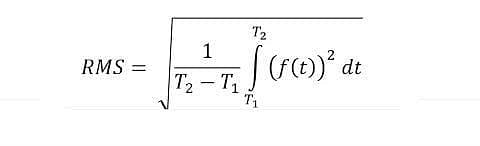
The RMS of a periodic function is always equal to the RMS of the single period of the function. The RMS value of a continuous function can be approximated by obtaining the RMS of a sequence of evenly spaced entities. The RMS value of various waveforms can also be computed without the use of calculus.
Calculation of Root Mean Square
The following are the steps to find the root mean square for a given set of values:
Step 1: Calculate the squares of all the values.
Step 2: Figure out the average of the squares that are obtained.
Step 3: Finally, calculate the average's square root.
Also Read:
Root Mean Square Error
The Root Mean Square Error, or RMSE, is a commonly used metric for comparing numbers (population values and samples) that is predicted by an estimator or a mode. The sample standard deviation of the variations between predicted and observed values is described by the RMSE. When these differences are calculated over the data sample that was used to estimate, they are referred to as residuals, and when calculated out of sample, they are referred to as prediction errors. The RMSE is a measure of predictive power that combines the magnitudes of errors in predicting different times into a single number.
Root Mean Square Error Formula
The square root of the mean squared error is the RMSE of a predicted model with respect to the estimated variable xmodel.

xobs refers to observed values, and xmodel represent the simulated values at time t.
Things to Remember
- The square root of mean square, RMS, is defined as the arithmetic mean of the squares of integers, where mean square is the arithmetic mean of the squares of numbers. The quadratic mean is another name for RMS.
- The square root of the arithmetic mean of squared observations can be used to obtain the RMS (Root Mean Square) value.
- The root-mean-square deviation (RMSD) or root-mean-square error (RMSE) is a commonly used metric for comparing predicted and observed values (sample or population values) by a model or estimator.
- The lower RMSE values suggest a better fit.
- The RMS value of a continuous function can be approximated by obtaining the RMS of a sequence of evenly spaced entities.
Also Read:
Sample questions
Ques: Find out the root mean square RMS of the given data set; 1, 3, 5, 7, 9 (3 marks)
Ans: The given set of data is:
1, 3, 5, 7, 9
Step1: Calculate the squares of all the values.
So 1, 9, 25, 49, 81
Step 2: Figure out the average of the squares that are obtained.
(1 + 9 + 25 + 49 + 81)/5 = 33
Step 3: Finally, calculate the average's square root.
RMS= \(\sqrt{33}\)= 5.745
Ques: Find out the root mean square RMS of the given data set; 2, 3, 5, 7, 11 (3 marks)
Ans: The given set of data is:
2, 3, 5, 7, 11
Step1: Calculate the squares of all the values.
So 4, 9, 25, 49, 121
Step 2: Figure out the average of the squares that are obtained.
(4 + 9 + 25 + 49 + 121)/5 = 41.6
Step 3: Finally, calculate the average's square root.
RMS= \(\sqrt{41.6}\) = 6.45
Ques: Find out the root mean square RMS of the given data set; 6, 5, 4, 2, 7 (3 marks)
Ans: The given set of data is:
6, 5, 4, 2, 7
Step1: Calculate the squares of all the values.
So 36, 25, 16, 4, 49
Step 2: Figure out the average of the squares that are obtained.
(36 + 25 + 16 + 4 + 49)/5 = 26
Step 3: Finally, calculate the average's square root.
RMS= \(\sqrt{26}\) = 5.09
Ques: Find out the root mean square RMS of the given data set; 6, 5, 4, 3, 7 (3 marks)
Ans: The given set of data is:
6, 5, 4, 3, 7
Step1: Calculate the squares of all the values.
So 36, 25, 16, 9, 49
Step 2: Figure out the average of the squares that are obtained.
(36 + 25 + 16 + 9 + 49)/5 = 27
Step 3: Finally, calculate the average's square root.
RMS= \(\sqrt{27}\) = 5.19
Quest: Find out the root mean square RMS of the given data set; 6, 5, 10, 3, 11 (3 marks)
Ans: The given set of data is:
6, 5, 10, 3, 11
Step1: Calculate the squares of all the values.
So 36, 25, 100, 9, 121
Step 2: Figure out the average of the squares that are obtained.
(36 + 25 + 100 + 9 + 121)/5 = 58.2
Step 3: Finally, calculate the average's square root.
RMS= \(\sqrt{58.2}\) = 7.62
Ques: Find out the root mean square RMS of the given data set; 1, 2, 3, 7, 8(3 marks)
Ans: The given set of data is:
1, 2, 3, 7, 8
Step1: Calculate the squares of all the values.
So 1, 4, 9, 49, 64
Step 2: Figure out the average of the squares that are obtained.
(1 + 4 + 9 + 49 + 64)/5 = 25.4
Step 3: Finally, calculate the average's square root.
RMS= \(\sqrt{25.4}\) = 5.03
Ques: Find out the root mean square RMS of the given data set; 1, 2, 3, 7, 8(3 marks)
Ans: The given set of data is:
9, 2, 3, 7, 8
Step1: Calculate the squares of all the values.
So 81, 4, 9, 49, 64
Step 2: Figure out the average of the squares that are obtained.
(81 + 4 + 9 + 49 + 64)/5 = 41.4
Step 3: Finally, calculate the average's square root.
RMS= \(\sqrt{41.4}\) = 6.43
Ques: Find out the root mean square RMS of the given data set; 1, 2, 3, 7, 8(3 marks)
Ans: The given set of data is:
9, 6, 3, 7, 8
Step1: Calculate the squares of all the values.
So 81, 36, 9, 49, 64
Step 2: Figure out the average of the squares that are obtained.
(81 + 36 + 9 + 49 + 64)/5 = 47.8
Step 3: Finally, calculate the average's square root.
RMS= \(\sqrt{47.8}\) = 6.91



Comments