



Content Curator
Saddle joint derives its name from the fact that the bone that forms one part of the joint is concave (bent inward) at one end and resembles a saddle. The opposite bone's end is convex (curved outward) and resembles a saddled rider.
Sellar's joints are another name for saddle joints. These very flexible joints can be found in a variety of locations throughout the body, including the thumb, shoulder, and inner ear.
| Table of Content |
What is a Joint?
A joint is formed when two bones come together. One of the three types of joints in the body is the synovial joint. Synovial joints are distinguished by the presence of a fibrous joint capsule filled with synovial fluid. Synovial joints include a hinge and ball-and-socket joints. Another type of synovial junction is the saddle joint.
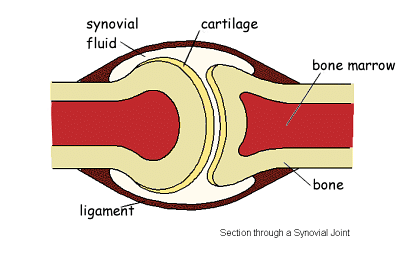
Types of Joints
The human body consists of a network of bones connected via different types of joints. Joints allow for the variety of movement made possible.

Pivot Joints: One bone has tapped into the opposite bone in such a way that full rotation is impossible in this type of joint. This joint aids in side-to-side and back-and-forth movement. The neck joint is an example of a pivotal joint.
Hinge Joints: Hinge joints are joints that function similarly to door hinges, allowing only back and forth movement. Ankle, elbow, and knee joints are examples of hinge joints.
Saddle Joints: The saddle joint is a biaxial joint that allows movement in two directions: flexion/extension and abduction/adduction. The thumb, for example, is the only bone in the physical body that has a saddle joint.
Ball-and-Socket Joints: In this case, one bone is hooked into the hollow of another. This type of joint facilitates rotatory movement. The shoulders are an example of a ball and socket joint.
Condyloid Joints: They are the joints having two axes that allow for up-and-down and side-to-side motion. Condyloid joints are frequently located near the bottom of the index finger, carpals of the wrist, elbow, and thus wrist joints. This joint is also known as a condylar joint or an ellipsoid joint.
Gliding Joints: They are a common type of articulatio synovialis. It is also known as a plane or planar joint. This joint allows two or more round or flat bones to move freely together without rubbing or crushing. This joint is particularly common in areas where two bones contact and glide on each other in any direction. The two prominent examples of gliding joints are the lower leg to the ankle and, consequently, the forearm to the wrist.
What are Saddle Joints?
A saddle joint is a type of movable line joint that allows movement in two planes–flexion or extension and abduction or motion. This joint is uniquely designed between the bones, with umbilicate and umbellate areas on their articulating surfaces.

Saddle joints, commonly known as sellar joints, are very flexible joints. In human bodies, there are only a few saddle joints. These include the joints at the base of the thumb finger, the upper section of the breastbone, and hence the incudomalleolar joint, which is located within the inner human ear.
Features of Saddle Joints
- Saddle joints and condyloid joints are the same things.
- The word saddle joint is derived mostly from its shape or construction.
- This joint has the same appearance as a saddle seat, thus the name saddle joint.
- The connecting bones are fashioned in the shape of interlocking saddles.
- This joint has a wider range of motion than other joints.
- Saddle joints, unlike ball and socket joints, do not provide complete rotation.
- Saddle joints have a lot more flexibility and also interlocking than other types of secretory joints.
- Saddle joints can have a construction that is a hybrid of a hinge joint and a ball and socket joint.
Saddle Joints: Physiology
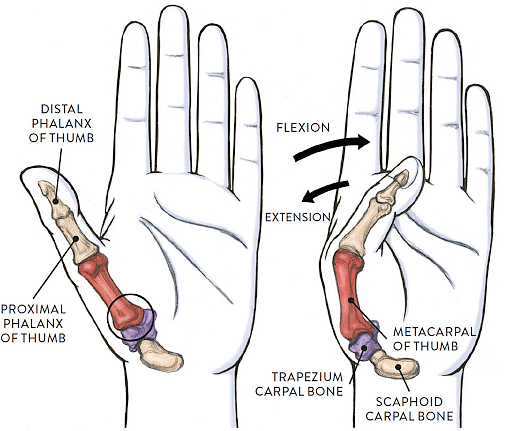
Saddle joints, unlike hinge joints such as those found between the bones in your fingers, have a far larger range of motion than a simple backward and forward movement. There are two primary forms of movement in saddle joints: flexion-extension and abduction-adduction.
Flexion-Extension
Flexion and extension are diametrically opposed actions, but they are simple to visualize. When you bend your elbow, you reduce the angle formed by your upper arm and forearm. Flexion is demonstrated here. Straightening your arm extends it, increasing the angle between your upper and lower arms.
Abduction-Adduction
Abduction and adduction are movements connected to a structure's midline. Spreading your fingers, for example, moves them away from the midline down the center of your hand. Adduction is a movement back toward the midline.
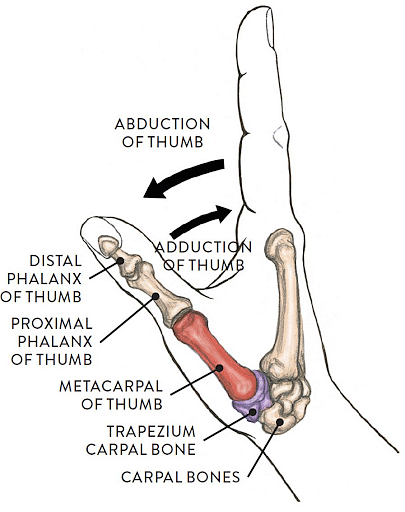
Some saddle joints may also do flexion-extension and abduction-adduction movements at the same time.
Things to Remember
- Joints are those locations where bones and cartilage are connected to each other. They aid movement and also play a load bearing role in the skeletal structure.
- Joints are of three types; the synovial joint refers to the flexible and movable joints. They aid in locomotive movements such as walking, running, typing etc.
- Saddle joints are biaxial, movable joints that allow movement on two planes: Flexion-extension and Abduction-adduction.
- Saddle joint has the same appearance as a saddle seat, thus the name saddle joint.The connecting bones are fashioned in the shape of interlocking saddles.
Sample Questions
Ques. What exactly are Joints? (2 marks)
Ans - Joints are the sites or locations within the body where two or more bones come together to aid in the smooth functioning of the body's parts.
Ques. What Are the different joint types? (3 marks)
Ans. There are three types of joints, which are distinguished primarily by their mobility:
- Fixed Joints vs. Fibrous Joints
- Freely Movable Joints or Synovial Joints
- Cartilaginous Joints, also known as Slightly Moveable Joints.
Ques. What are the Functions of the Joints? (2 marks)
Ans. The primary purpose of joints is to link bones in our bodies. It also allows us to move, rotate, and carry the weight of our bodies.
Ques. What Are the Different Synovial Joint Types? (3 marks)
Ans. Synovial joints are further categorized into six types depending on their shape and structure:
- Planar joints
- Hinge joints
- Pivot joints
- Condyloid joints
- Saddle joints
- Ball-and-socket joints.
Ques. What are some Synovial Joint Examples? (2 marks)
Ans. Elbow, Neck, Knee, Shoulder, Thumb, Hip, Wrist, and Intercarpal joints are examples of ball-and-socket joints.



Comments