



Education Journalist | Study Abroad Lead
Sampling Error means the difference between the sample mean and the population mean. Sampling error represents the uncertainty related to the test statistic as a result of taking an incomplete sample from a population instead of an entire population. Sampling error is also termed sampling variability or insampling variability. Sampling Error describes the variation that might be expected by taking different sets of observations in a study. The larger the sample size, the easier it is to calculate sampling error, but the smaller the impact of sampling error is likely to be. In statistical surveys, we find sampling error is observed when the true value of the population parameter differs from the estimated value. The difference between these two values is called ‘Sampling Error’.
| Table of Contents |
Key Terms: Sampling Error, Sampling, Sample Size, Variation, Mean, Population, Census, Statistical Error, Deviation
Definition of Sampling Error
[Click Here for Sample Questions]
A sampling error means that the results obtained from a sample are different from the actual results that can be obtained from the entire population. This can often occur when an analyst decides not to survey an entire population and instead selects a small sample of subjects. The results that are returned by analyzing this small sample are not necessarily identical to what would be obtained if the entire population were surveyed rather than a sample.
It is important to consider whether there is likely to be any significant impact on the results of your study given its scale and the characteristics of those you are surveying; if not, then there may be little or no benefit in calculating sampling error.
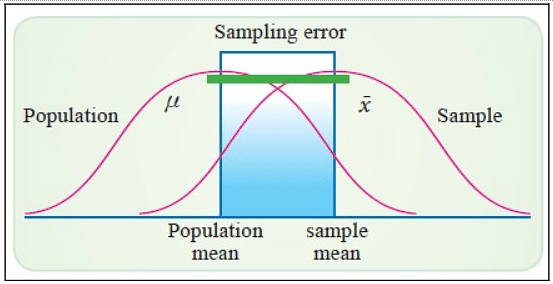
Sampling Error
Read More: Mean and Variance of Random Variable
Role of Sample Size
[Click Here for Sample Questions]
The biggest difference between a sample study and a full census of the population is the size of the statistical error. The smaller your sample, the greater the difference between the result and what it would be if you had asked everyone in the population. With a larger sample, that error gets smaller but only in proportion to the square root of n. For example, doubling your sample size will reduce your sampling error by 40%.
Formula For Sampling Error
[Click Here for Sample Questions]
Calculations of the sampling error is vital while you are drawing the statistical inference from a huge population but cannot afford to test it physically. This is because many organizations, governments, etc. don't conduct census due to their large population size and depend on a sample of the population for their decision-making process.
Sampling error is the difference between the sample statistic and the parameter of the population. Estimating this error gives you some idea of how close your sample estimate is to the true population value. This formula is easily understandable.
Sampling Error = Z × σ/√n Where
- Z score value based on the confidence interval
- σ denotes the population standard deviation
- n denotes the sample size
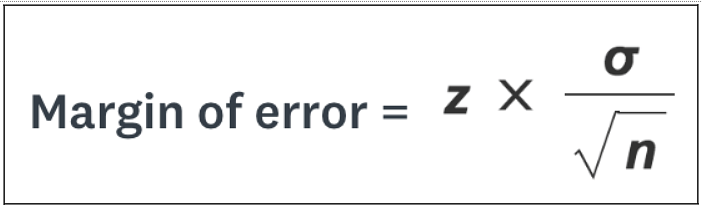
Sampling Error Formula
Read More: Difference Between Variance and Standard Deviation
Step By Step Calculation of Sampling Error
[Click Here for Sample Questions]
The sample error is a form of error that occurs in experiments and surveys when the data which is collected doesn't represent and depict the whole population. For example, it is essential to obtain data from various parts of the country whereas you only focus on one specific region. This mistake can be corrected by accurately determining the representative sample size with knowledge and information while eliminating biases.
- First, the population is defined and the sampling frame is determined. Then a sample size is chosen which should be greater than 10% of the value of the population.
- Next, the precise frequency isn’t important because it is too cumbersome to calculate so one just approximates. Finally, probability sampling techniques are used to obtain a random sample
- The size of a population is referred to as n. Sampling error refers to the differences that exist between sample means and the true population mean.
- When sampling error is small, then this would indicate a closer resemblance between sample means and the true population mean. In order to realize this, we must obtain information through sampling and consequently analyze results by making inferences on those results using statistics.
- Sampling error is a measurement of the individual errors in a sample.
- A high standard deviation is an indicator that the data points are more spread out, and hence indicate less precision.
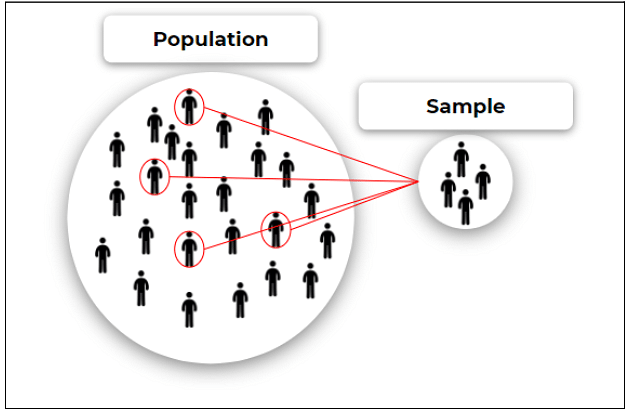
Population and Sample
The amount of sampling error depends on the sampling method used, along with its size. There are four main steps to determining sampling error:
- defining your population,
- selecting a sample size,
- selecting a sampling method
- calculating the margin of error in your sample
Things to Remember
- Sampling error means that a number of the observations or data picked out of a list will vary on where they are chosen, which lead to two types of sampling errors which are an estimation and non-sampling errors.
- In a sample survey, the difference between the sample statistic and the population parameter is known as sampling error. A larger population size reduces the margin of error.
- Calculating sampling error becomes simple when it is taken as the first step towards the calculation of the confidence interval.
- It is done by comparing an estimated value to a chosen theoretical value and describing the error in terms of missing values, known values and estimated values.
- Sampling error is an error that occurs due to the use of unavailable population data in the sample.
- Non-sampling errors happen because of a multitude of factors, including limited resources, such as time and budget, inaccurate data collection procedures, and problems with questionnaires or survey design.
Solved Questions
Ques. Mind Laboratories is a research company that is willing to calculate the sampling error for one of its studies. They had a sample size of 100 people. The standard deviation of the population is given as 0.50. For a 99% confidence level, the score is 2.58. (3 Marks)
Ans. From the given data, σ= 0.50
Sample size (n) = 100
Value of z at confidence level 99% = 2.58
Formula of sampling error = Z × σ/√n
= 0.50 / √100 × 2.58
= 0.50 / 10 × 2.58
= 0.05 × 2.58
= 0.129
Ques. Suppose that the population standard deviation given is 0.40 and the size of the sample is equal to 2500 then find the sampling error at a confidence level equal to 95%. (3 Marks)
Ans. Let’s list down from the given data, σ = 0.40
Sample size (n) = 2500
Value of z at confidence level 95% = 1.96
Formula of sampling error =Z × σ /√n
= 0.40/ √2500 × 1.96
= 0.40 / 50 × 1.96
= 0.008 × 1.96
= 0.01568
Ques. A sample consists of (3 Marks)
(a) All units of the population
(b) 5% units of the population
(c) 10% units of the population
(d) Any fraction of the population
Ans. (d) Any fraction of the population
In Sampling, the population indicates the entire group from which you want to draw conclusions about while the sample refers to the specific group from which one will collect data. One must note that the size of the sample is always less than the total size of the population.
Ques. Sampling is used in the situations(3 Marks)
(a) Blood test of the patients
(b) Cooking rice in a utensil
(c) Purchase of food commodity from the shopkeeper
(d) All the above
Ans. All of the above
The Sampling process is used in order to quantify a system, process, issue, or problem. There are many real-world applications for sampling such as teams for a game are chosen by putting everyone's name into a jar, employees are assigned a random number using computer software, etc.
Ques. For the N population size in SRSWOR, the number of possible samples of size n is equal to(1 Marks)
(a) Ncn
(b) Nn
(c) (N-n)/N
(d) n/N
Ans. (a) Ncn
Ques. Find the sampling error of the sample size equal to 100 of the population with a standard deviation equal to 0.5 at a 90% confidence level. (3 Marks)
Ans. From the given data, σ= 0.5
Sample size (n) = 100
The value of z at 90% of confidence level = 1.645
Formula of sampling error = Z × σ / √n
0.5/√100 × 1.645
0.5/10 × 1.645
0.08225
Note: Z-value at 90% confidence level is equal to 1.64.
Ques. Suppose that the population standard deviation is 0.30, and the size of the sample is 100. What will the sampling error be at a 95% confidence level? (3 Marks)
Ans. Here we have given the population standard deviation as well as the size of the sample. Therefore, the below formula calculates the same.
Use the following data for the calculation
- Z Factor Value at 95%: 1.96
- Population of Standard Deviation: 0.3
- Sample Size: 100
Thus, the calculation of the sampling error is mentioned below
Formula of sampling error = Z × σ / √n
= 0.3/ √100 × 1.96
= 0.3 / 10 × 1.96
= 0.03 × 1.96
= 0.0588
Ques. What will be the number of possible samples of size 2 out of 5 population size in SRSWOR? (1 Marks)
(a) 10
(b) 4
(c) 2
(d) 12
Ans. 10
Ques. Give one example for sample, population and variable each. (3 Marks)
Ans. A study was conducted to know the average weight of students of class seventh in Delhi. There were a total of 2860 students in class seventh. From this, 200 students were randomly selected and their weight was recorded.
In this example
- Here, the population indicates the the number of students of class seventh in Delhi, the total number of which is equal to 2860.
- The sample is the 200 students selected whose weight was recorded.
- The weight of the students is the Variable that is under study.
Ques. For the N population size in SRSWR, the number of possible samples of size n is equal to ( 1 Marks)
(a) Ncn
(b)Nn
(c) (N-n)/N
(d) n/N
Ans. Nn
Ques. What is meant by simple random sampling? (3 Marks)
Ans. The random sampling method is considered to be the simplest of the methods of probability sampling. Here, an equal probability of selection is given to all the available unit of the population at the first and then to each subsequent draw. Thus, here in this case, the number of units in the population is N, so, the probability of selection of any unit at the first draw is 1/N and at the second draw is 1/N-1 etc, which are ultimately equal to 1/N.
Also Read:



Comments