



Education Journalist | Study Abroad Lead
Sin, the trigonometric function, denotes the ratio between the leg opposite the angle and the hypotenuse when an acute angle is considered part of a right triangle. Sin is a trigonometric function equal to the sine of an angle of measure in radians and is provided by the sum of the alternating series for all real numbers. Trigonometry in mathematics deals with determining the relationship between the three sides and the three angles that make up every triangle. Every right triangle has one 90-degree angle and two other angles that range from 0 to 90 degrees, with the sum of all three angles being 180 degrees.
| Table of Content |
Key Takeaways: Sine, degrees, triangle, right triangle, hypotenuse, sin law, sin 90 degrees
Sin 90 Degrees Value
[Click Here for Sample Questions]
Sin of angle 90 degrees is the sin value when the angle of a right triangle equals 90 degrees. According to the sexagesimal system, it is expressed as sin 90° in mathematics.
\(\sin 90^{\circ} = 1\)
The value of sin at 90 degrees is exactly 1, and it is commonly referred to as a trigonometric function (or ratio) for standard angles.
The ratio of the length of the side of the triangle opposite the angle to the length of the triangle's hypotenuse is called the sine of a right triangle (commonly abbreviated "sin").
According to the sine law, the sides of a triangle are proportional to the sine of the opposite angles.

How to Calculate Sin 90 Degrees?
[Click Here for Sample Questions]
Let's use the unit circle to determine the Sin 90 degree value. The circle's radius depicted below is of one unit, and the circle's center is a point in the origin.
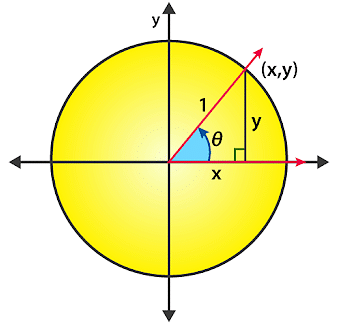
In a right-angled triangle, the sine function is equal to the ratio of the length of the opposite side or perpendicular to the size of the hypotenuse when the adjacent side of ‘x’ unit and perpendicular of ‘y’ unit is measured. Using trigonometry, we can calculate sin. Hence,
\(\sin \theta = \frac{y}{1}\)
Now we'll calculate the angle between the first quadrant and the positive 'y' axis, or up to 90 degrees. Because it is touching the circle's circumference, the value of y will now be 1. As a result, we can claim that the value of y is 1.
\(\sin \theta = \frac{y}{1} = \frac{1}{1}\)
As a result, Sin 90° will be equal to its fractional value, 1/1. The value of Sin 90 degrees = 1.
\(\sin 90^{\circ} = 1\)
The most commonly used Sin functions in trigonometry are:-
- \(\sin (90^\circ+\theta) = \cos\ \theta\)
- \(\sin (90^\circ-\theta) = \cos\ \theta\)
Some sin identities are as follows:
- \(\sin\ x = \frac{1}{cosec\ x}\)
- \(\sin^2x + \cos^2x = 1\)
- \(\sin(-x) = -\sin x\)
- \(\sin 2x = 2\sin x \cos x\)
Trigonometry Ratio Table
[Click Here for Sample Questions]
The different values for different Trigonometric Functions are as given below:

Value of Cos 0 Degree
[Click Here for Sample Questions]
Value of cos 0 degree is equal to sin 90 degree, which is 1.
So, \(\cos 0^\circ = \sin 90^\circ = 1\)
Things to Remember
- The value of sin 90 degrees is 1, the same as the radian sin of 90 degrees. 90 degrees in radian is obtained by multiplying 90 degrees by π /180 degrees.
- Trigonometric functions are generally defined as the ratio of two sides of a right triangle containing angles less than a right angle.
- For every right-angled triangle, measured with any angles, sine equals the ratio of the length of the opposing side to the length of the hypotenuse side.
- The y-coordinate(1) of the point of intersection (0, 1) of the unit circle and r equals the sin of 90 degrees.
- To represent sin 90°, we can utilize trigonometric Identities like,
\(\sin(180^\circ - 90^\circ) = \sin 90^\circ\)
\(-\sin(180^\circ + 90^\circ) = -\sin 270^\circ\)
\(\cos(90^\circ - 90^\circ) = \cos 0^\circ\)
\(-\cos(90^\circ + 90^\circ) = -\cos 180^\circ\)
Sample Questions
Ques. How is trigonometry used in daily life? (3 Marks)
Ans. Trigonometry can be used in many fields such as:
- At a crime scene, trigonometry can be used to estimate the angles of bullet courses, the reason for an accident, or the direction of a falling object by investigators.
- NASA employs the sine, cosine, and tangent functions. Its physicists and astronauts frequently utilize robotic arms to do tasks in space, and they use trigonometry to figure out where and how to maneuver the arm.
- Sine, cosine, and tangent are sometimes employed in marine biology to estimate the size of enormous sea creatures from afar and compute light levels at various depths to examine how they affect photosynthesis.
Ques. Use trigonometry formulae and trigonometric identities to represent sin 90 degrees. (5 Marks)
Ans. We may represent the sin 90 degrees using trigonometric formulas as:
- \(\pm \sqrt{1-\cos^2(90^\circ)}\)
- \(\pm \frac{\tan 90^\circ}{\sqrt{1 + \tan^2(90^\circ)}}\)
- \(\pm \frac{1}{\sqrt{1 + \cot^2(90^\circ)}}\)
- \(\pm \frac{\sqrt{(\sec^2(90^\circ) - 1)}}{\sec 90^\circ}\)
- \(\frac{1}{cosec\ 90^\circ}\)
The final value of sin 90° will be positive because 90° is on the positive y-axis.
To represent sin 90°, we can utilize trigonometric identities like,
- \(\sin(180^\circ - 90^\circ) = \sin 90^\circ\)
- \(-\sin(180^\circ + 90^\circ) = -\sin 270^\circ\)
- \(\cos(90^\circ - 90^\circ) = \cos 0^\circ\)
- \(-\cos(90^\circ + 90^\circ) = -\cos 180^\circ\)
Ques. Find the values of (3 Marks)
(a) sin 135°
(b) tan 150°
Ans. (a) sin 135°
= sin (90 + 45)°
= cos 45°
we already know that sin (90° + θ) = cos θ
\( = \frac{1}{\sqrt{2}}\)
(b) tan 150°
tan 150° = tan (90° + 60)°
= - cot 60°
we already know that tan (90° + θ) = - cot θ
\( = -\frac{1}{\sqrt{3}}\)
Ques. Using the unit circle, how can you find the value of sin 90 degrees? (3 Marks)
Ans. Using the unit circle, we can find the value of sin 90 degrees:
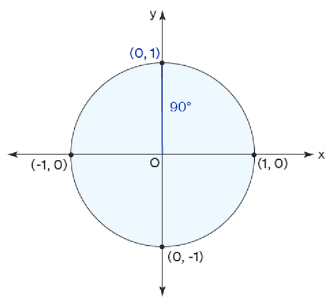
To make a 90° angle with the positive x-axis, rotate 'r' anticlockwise.
The y-coordinate(1) of the point of intersection (0, 1) of the unit circle and r equals the sin of 90 degrees.
As a result, the value of sin 90° is y = 1.
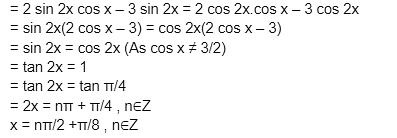
Ques. Find the general solution of the given equation. (5 marks)
sin x - 3 sin 2x + sin 3x = cos x - 3 cos 2x + cos 3x
Ans. We have, (sin x + sin 3x) – 3 sin 2x = (cos x + cos 3x) – 3 cos 2x
Ques. Prove that an angle's sine equals its complement's cosine. (3 Marks)
Ans. We wish to show that an angle's sine matches its complement's cosine.
sin θ = cos (90° - θ)
Let's begin by making a right triangle. It's worth noting that the sharp angles are complementary and add up to 90 degrees.

The cosine of one acute angle and the sine of the other acute angle represent the same ratio. Both functions, sin a and cos(90° - a), produce the same side ratio in a right triangle.
We've established that sin(θ) = cos(90° - θ)
In other words, an angle's sine equals its complement's cosine.
Ques. What is the sin formula? (2 Marks)
Ans. The sin function is classified as a periodic function in trigonometry. In a right-angled triangle, the sine function can also be defined as the ratio of the perpendicular length to the hypotenuse length. Sin is a periodic function having a period of 2π and a domain of (−∞, ∞) and a range of -1,1. The Sin formula can be found using the triangle's sides. Consider a right-angled triangle: the sine of an angle is the ratio of the angle's perpendicular (opposite the angle) to the hypotenuse.
Formula is sin(−θ) = − sin θ
Ques. Calculate the minimum value of 3 cos x + 4 sin x + 8. (2 Marks)
Ans.
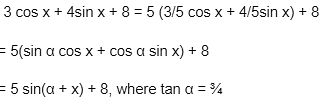
So, the minimum value of 3 cos x + 4 sin x + 8 is 5 sin(α + x) + 8
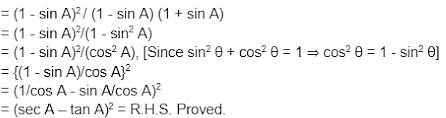
Ques. Prove that (1 - sin A)/(1 + sin A) = (sec A - tan A)2 (2 Marks)
Ans. L.H.S = (1 - sin A)/(1 + sin A)
Multiply both numerator and denominator by (1 - sin A); we will get
Related Articles:



Comments