



Content Curator
Zeroes of Polynomial are the values of the variables in a polynomial equation. The zeros of a polynomial are also known as the equation's roots. The degree of the polynomial expression is equal to the number of zeros in the polynomial. Grouping, factorization, and algebraic expressions are some of the approaches used to locate the zeros of a polynomial. If P(x) = 0 at that point, we say that x = an is the polynomial's root. The procedure of determining zero is essentially the same as the process of determining the solutions to any polynomial problem.
| Table of Content |
Read More: Quadrant
What is a Polynomial?
The name polynomial is derived from the Greek words poly, which means "many," and nominal, which means "terms," thus it means "many terms." A polynomial can have any number of terms, but it cannot have an infinite number of terms.

Polynomial
Polynomials are algebraic formulas with variables and coefficients. Variables are sometimes known as indeterminates. For polynomial expressions, we can do mathematical operations such as addition, subtraction, multiplication, and positive integer exponents, but not division by variable. An example of a polynomial with one variable is,
x2 + x - 12
A polynomial with the value zero (0) is referred to as a zero polynomial. In fact, the word 0 is a zero polynomial. It is a constant polynomial with all coefficients equal to zero. A polynomial may have a few (one or more) values of the variable for which the polynomial returns zero. These values are referred to as polynomial zeros.
The zeroes of a polynomial are defined as the places at which the polynomial equals 0 on the whole. A polynomial in x has the usual form
anxn + an-1xn-1 +..... + a1x + a0
Where,
an, an-1,....., a1, a0 → Constants
a0 and n → Whole integer
Algebraic formulas such as x + x + 5, x2 + 1/x2 are not polynomials since the exponents of x in the expressions are not whole integers.
The video below explains this:
Polynomials Detailed Video Explanation:
Read More:
What Are The Zeros Of Polynomials?
A polynomial's zeros are the values of x that fulfil the equation y = f(x). Here, f(x) is a function of x, and the polynomial zeros are the x values for which the y value is equal to zero. The degree of the equation y = f determines the number of zeros in a polynomial (x).
The zeros of the polynomial are all domain values of the function for which the range is equal to zero. The zeros of the polynomial are the locations on the graph where the graph of y = f(x) intersects the x-axis.
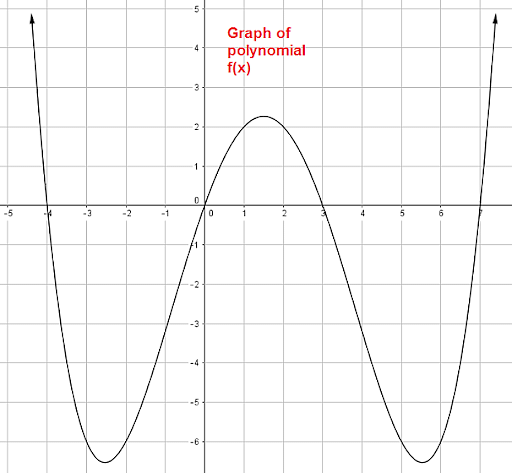
Graph of f(x)
Polynomial zeroes are the real values of the variable for which the polynomial value becomes zero. So, if p(m) = 0 and p(n) = 0, real numbers ‘m' and ‘n' are zeroes of polynomial p(x).
Function Of Zeros Of Polynomial
The polynomial function with the value zero is known as the zero-polynomial function. There is no non-zero term in a zero polynomial. It is written as
P(x) = 0
As a result, a polynomial function equal to zero is known as a zero-polynomial function. It is also known as a zero map. The X-axis represents the graph of the zero polynomial.
Also Read:
Finding Zeroes Of Polynomial
A polynomials zero is the value of which polynomial produces zero. To determine the zeros of a polynomial, just equal the polynomial to zero and get the possible values of variables.
Assume P(x) is a given polynomial. Set this polynomial to zero to find zeros. In other words, P(x) = 0. This is now a polynomial equation. By factoring the polynomial equation, you can solve this problem and obtain all potential variable values.
These are the x values that make polynomial equal to zero; hence, they are known as polynomial P zeros (x). If and only if P(z) = 0, a number z is said to be a zero of a polynomial P(x).
There are several ways to find the zeros of a polynomial. The degree of the polynomial equation determines the number of zeros in the polynomial. The equations are categorised as linear equations, quadratic equations, cubic equations, and higher degree polynomials, and each equation is separately examined to determine the polynomial zeros.
Equations To Find Zeros Of Polynomial
The following are the many types of equations and methods for finding polynomial zeros.
Linear Equation
Linear equation is written as,
y = ax + b
By inserting y = 0, we can compute the zero of this equation, which simplifies to ax + b = 0, or
x = -b/a.

Linear Equation
Also Read: Permutations and Combinations
Quadratic Equation
A quadratic equation can be factored in two ways. The quadratic equation is in the form of
ax2 + bx + c = 0
It may be factorised as (x + a)(x + b) = 0, and the polynomial zeros are x = -a and x = -b.

Quadratic Equation
For an unfactorizable quadratic equation, the zeros may be computed using the formula technique.
Cubic Equation
The remainder theorem may be used to factorise the cubic equation
y = ax3 + bx2 + cx + d
We may substitute any lower values for the variable x = a, and if y = 0, then (x - a ) is one root of the equation. We may also divide the cubic equation with (x - a) using long division to get a quadratic equation. Finally, the quadratic equation may be solved using either factorization or the formula technique to produce the needed two roots.

Cubic Equation
Higher Degree Polynomial
The higher degree polynomial equation is given by,
y = axn + bxn-1 + cxn-2 +..... px + q
The remainder theorem may be used to factor these higher degree polynomials to get a quadratic equation. Furthermore, the quadratic equation may be factored to yield the last two necessary components.

Higher degree polynomial function
Also Read:
Sum And Product Of Zeros Of Polynomial
The zeros of a polynomial can be readily computed bu using the following formulas.
Quadratic Equation
The sum and product of zeros of a polynomial with the coefficients a, b, and c for a quadratic equation is given by,
Sum of Zeros of Polynomial → α + β = -b/a = - coefficient of x/coefficient of x2
Product of Zeros of Polynomial → αβ = c/a = constant term/coefficient of x2
Cubic Equation
The sum and product of zeros of a polynomial with the coefficients a, b, and c for a cubic equation is given by,
Sum of Zeros of Polynomial → α + β + γ = -b/a = - coefficient of x2/coefficient of x
Sum of Zeros of Polynomial → αβ + βγ + γα = c/a = coefficient of x/coefficient of x3
Product of Zeros of Polynomial → αβγ = -d/a = -constant/coefficient of x3
Zeros Of Polynomials On Graph
The zeros of a polynomial can be discovered by locating where the polynomial's graph crosses or touches the x-axis. A graph across the coordinate axis can represent a polynomial expression of the type y = f(x). The x value is shown on the x-axis, while the f(x) or y value is shown on the y-axis.

Linear Equation graph
Based on the degree of the polynomials, the polynomial expression might be a linear expression, quadratic expression, or cubic expression. A line is represented by a linear expression, a curve by a quadratic equation, and a curve with unequal bends by a higher degree polynomial.

Quadratic Equation graph
The graph may be used to find the zeros of a polynomial by examining the places where the graph line intersects the x-axis. The zeros of the polynomial are the x-coordinates of the locations where the graph intersects the x-axis.

Cubic Equation graph
Example: Consider the polynomial f(x) shown below. What are the polynomial's zeros?

You need to identify the x-intercepts to answer this question. Look for places where the graph crosses the x-axis to identify these (the horizontal axis).

This demonstrates that the polynomial's zeros are: x = –4, 0, 3, and 7.
Also Read: Types of Probability
Importance Of Zeros Of Polynomial
- A polynomial's "geometry" refers to the geometry of its zero sets. In reality, a polynomial is equal to its zero set for algebraic geometry.
- The initial definition of an algebraic variety in algebraic geometry is using zero sets. An affine algebraic set is defined as the intersection of the zero sets of multiple polynomials in a polynomial ring. A zero set is also known as a zero locus in this context.
- When a linear factor appears numerous times in the factorization of a polynomial, the associated zero multiplicity is obtained.
- The multiplicity of zero is significant because it tells us how the polynomial graph will behave around zero.
Read More: Scalene Triangle
Things to Remember
- Zeroes of Polynomial are the values of the variables in a polynomial equation.
- A polynomial can have any number of terms, but it cannot have an infinite number of terms.
- A polynomial's zeros are the values of x that fulfil the equation y = f(x).
- Linear equation, quadratic equation, cubic equation and higher degree polynomial are the different types of polynomial equations.
- The polynomial function with the value zero is known as the zero-polynomial function.
- Sum of Zeros of quadratic Polynomial → α + β = -b/a = - coefficient of x/coefficient of x3.
- Product of Zeros of quadratic Polynomial → αβ = c/a = constant term/coefficient of x2.
- Sum of Zeros of cubic Polynomial → α + β + γ = -b/a = - coefficient of x3/coefficient of x
- Sum of Zeros of cubic Polynomial → αβ + βγ + γα = c/a = coefficient of x/coefficient of x3
- Product of Zeros of cubic Polynomial → αβγ = -d/a = -constant/coefficient of x3
Also Read:
Sample Questions
Ques. What is the significance of a polynomial's zeros? (2 marks)
Ans. This is because it was discovered that the equations, we want to solve may be converted into comparable equations with one side set to zero. So, if we can solve that instance, we should be able to handle other cases as well!
Ques. How to Determine the Complex Zeros of a Polynomial Function? (2 marks)
Ans. Polynomial complex zeros may be computed using the complex number formula i2 = -1. The negative roots of complex numbers can also be simplified by utilising the value of i. Finding the square root of a negative integer is impossible for an equation of the type (x + 3)2 = -25. We use i2 = -1 to write (x + 3)2 = 25i2, which simplifies to (x + 3) = + 5i, and the polynomial zeros are -3 + 5i and -3 -5i.
Ques. What is a polynomial's multiplicity? (2 marks)
Ans. The multiplicity is the number of times a particular factor appears in the factored form of a polynomial equation. Because the component (x2) appears twice, the zero associated with this factor, x=2, has multiplicity 2.... This is known as a triple zero, or a zero with multiplicity 3.
Ques. How many polynomial zeros does y = f(x) have? (2 marks)
Ans. The degree of the polynomial expression y = f(x) determines the number of zeros in a polynomial. We only have one root for a linear equation with one variable. We have two and three zeros of a polynomial for a quadratic and cubic polynomial, respectively.
Ques. Is the function zero a polynomial? (2 marks)
Ans. The value 0 can be thought of as a (constant) polynomial, known as the zero polynomial, just like any other constant value. It has no nonzero terms and hence, technically speaking, no degree. As a result, its degree is frequently unclear.
Ques. How many zeros does the polynomial have? (2 marks)
Ans. A polynomial function can have 0 zeros, 1 zero, or many zeros. Positive, odd-order polynomial functions must have at least one zero, but positive, even-order polynomial functions may or may not contain a zero. Any polynomial of positive order, whether odd or even, can have a maximum number of zeros equal to its order.
Also Read:
Ques. Evaluate p(x) = 5x3 – 2x2 + 3x -2. (2 marks)
Ans. When we find the value of the polynomial(x) at x = 1,
p(1) = 5(1)3 – 2(1)2 + 3(1) – 2 = 5 – 2 + 3 – 2 = 4.
Thus, we can say that the value of the polynomial p(x) at x = 1 is 4.
Next, let’s find the value of the polynomial(x) at x = 0,
p(0) = 5(0)3 – 2(0)2 + 3(0) – 2 = 0 – 0 + 0 – 2 = – 2.
Therefore, we can say that the value of the polynomial p(x) at x = 0 is – 2.
Ques. If the sum of zeroes of the quadratic polynomial 3x2 – kx + 6 is 3, then find the value of k. (CBSE 2012) (2 marks)
Ans. Here a = 3, b = -k, c = 6
Sum of the zeroes, (α + β) = −b/a = 3 …..(given)
⇒ −(−k)/3 = 3
⇒ k = 9
Ques. Form a quadratic polynomial whose zeroes are 3 + √2 and 3 – √2. (CBSE 2012) (2 marks)
Ans. Sum of zeroes,
S = (3 + √2) + (3 – √2) = 6
Product of zeroes,
P = (3 + √2) x (3 – √2) = (3)2 – (√2)2 = 9 – 2 = 7
Quadratic polynomial = x2 – Sx + P = x2 – 6x + 7
Also Read: Pascal’s Triangle
Ques. Find a quadratic polynomial, the sum and product of whose zeroes are 0 and -√2 respectively. (CBSE 2015) (2 marks)
Ans. Quadratic polynomial is
x2 – (Sum of zeroes) x + (Product of zeroes)
= x2 – (0)x + (-√2)
= x2 – √2
Ques. If the zeroes of the polynomial x2 + px + q are double in value to the zeroes of 2x2 – 5x – 3, find the value of p and q. (CBSE 2012) (3 marks)
Ans. We have, 2x2 – 5x – 3 = 0
= 2x2 – 6x + x – 3
= 2x(x – 3) + 1(x – 3)
= (x – 3) (2x + 1)
Zeroes are:
x – 3 = 0 or 2x + 1 = 0
⇒ x = 3 or x = −1/2
Since the zeroes of the required polynomial are double of a given polynomial.
Zeroes of the required polynomial are:
3 × 2, (−1/2 × 2), i.e., 6, -1
Sum of zeroes, S = 6 + (-1) = 5
Product of zeroes, P = 6 × (-1) = -6
Quadratic polynomial is x2 – Sx + P
⇒ x2 – 5x – 6 …(i)
Comparing (i) with x2 + px + q
p = -5, q = -6
Also Read:



Comments