



Content Curator
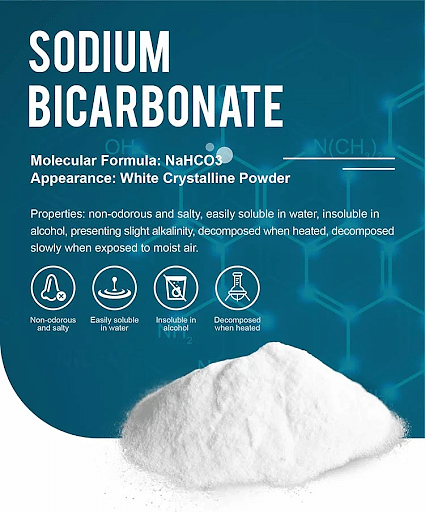
NaHCO3 is the chemical formula for Sodium Bicarbonate or Sodium Hydrogen Carbonate. This is a commonly present chemical compound found in households across the world. It is known by its more familiar name: Baking Soda. Sodium bicarbonate has a monoclinic crystalline structure and is present in the form of a white solid crystalline powder. NaHCO3 is a weak base and has a pH value of about 8.31.
| Table of Content |
Read Also: Difference between Baking Soda and Baking Powder
Sodium Bicarbonate (NaHCO3): Baking Soda
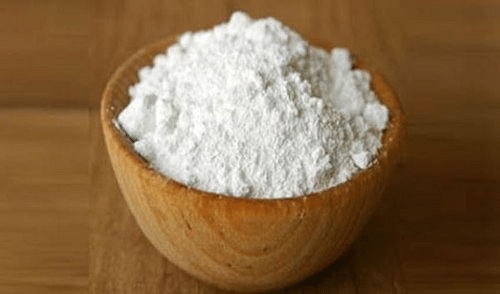
Sodium Bicarbonate (NaHCO3) is a chemical compound made up of carbon, sodium, oxygen, and hydrogen. It's a carbonic acid monosodium salt. It's a bitter-tasting white crystalline substance with no odor. Baking soda, cooking soda, bread soda, and bicarbonate of soda are all common names for sodium bicarbonate. It's a frequently used ingredient in baking and pharmaceuticals.
Sodium Bicarbonate: Structure
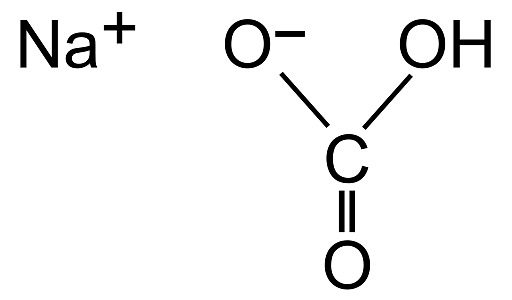
- The chemical formula for sodium bicarbonate is NaHCO3.
- It is made up of the sodium cation (Na+) and the bicarbonate anion (BaCO3) (HCO3-).
- Its lattice structure is monoclinic.
- One sodium atom, one carbon atom, one hydrogen atom, and three oxygen atoms make up this compound.
History of NAHCO3
Nicolas Leblanc, a French chemist, invented sodium carbonate, sometimes known as soda ash, in 1791. Fishermen utilized sodium and potassium bicarbonates to preserve fish in the 1800s. Austin Church and John Dwight, two American bakers, initially produced baking soda from sodium carbonate and carbon dioxide in their workshop in 1846.
Also Check:
Occurrence of NAHCO3
Natural sodium hydrogen carbonate is found in the mineral nahcolite. It is the compound's natural source, and it may also be found in many mineral springs.
Sodium Bicarbonate Production
It may be made on a wide scale by mixing cold and concentrated brine (sodium chloride) solutions with ammonia and carbon dioxide. The Solvay technique is used to produce sodium carbonate (washing soda).
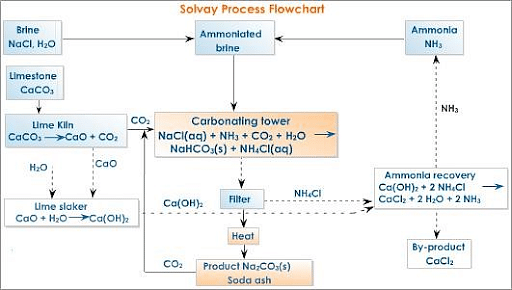
The following is an example of a reaction:
NH4Cl + NaHCO3 = NaCl + H2O + CO2 + NH3
This technique produces sodium hydrogen carbonate as an intermediate product. It decomposes around 373K, releasing carbon dioxide gas and forming sodium carbonate.
Na2CO3 + H2O + CO2 = 2NaHCO3
Also Read:
Sodium Bicarbonate: Properties
- Its nature is weakly basic. Because sodium bicarbonate is hydrolyzed, a solution of sodium bicarbonate is moderately alkaline.
H2CO3 + NaOH = NaHCO3 + H2O
CO2 + H2O = H2CO3
- The pH of a sodium bicarbonate solution is 8.3.
- It has no color change when using phenolphthalein, however, it turns yellow when using methyl orange.
- It's only slightly soluble in water.
- It has a boiling point of 8510 degrees Celsius and a melting point of 500 degrees Celsius.
- The molecular weight or molar mass is 84.0066 g/mol.
- It decomposes when heated, releasing carbon dioxide gas and forming sodium carbonate.
Na2CO3 + H2O + CO2 = 2NaHCO3
- When baking soda is heated during the cooking process, this reaction occurs. It's used to make baking powder and carbonated beverages.
Sodium Bicarbonate: Applications
Baking soda is a chemical that can be used in a variety of ways. It is relatively inexpensive, and because of its use, it has become a typical household item. It can be used for a variety of purposes, including:
Medical Applications
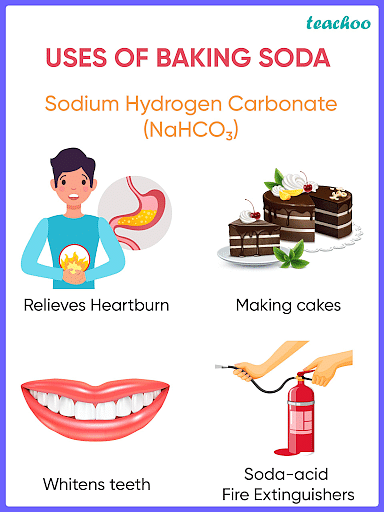
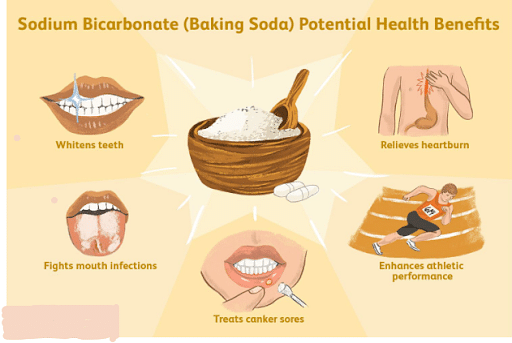
- It is used as an antacid to treat indigestion and heartburn. Its fast action reduces stomach acid, providing brief relief. Its alkaline composition helps to reduce indigestion by neutralizing excess hydrochloric acid in the stomach.
- In medical crises such as serious renal failure, heart stroke, or uncontrolled diabetes, a 5% sodium bicarbonate infusion injection is given.
- It's utilized in the manufacture of beauty care, cosmetics, and personal hygiene goods.
- It's utilized in the production of ear drops.
- It's given intravenously to help with chemotherapy side effects.
- Because of its antibacterial characteristics, it is used to clean the mouth and teeth.
At Home
It's a household wonder chemical that's typically utilized as a cleaning agent, a cooking component, and a disinfectant. It can be used for a variety of purposes, including:
- It is used to raise flour batter as a baking soda. Baking soda is used to make baking powder, which is made by mixing baking soda with a moderate acid-like tartaric acid. In creating bread, cakes, cookies, pancakes, patties, and other baked goods, baking powder is used as a leavening agent (a chemical that releases gas and causes the dough to rise and expand).
- Sodium bicarbonate interacts with tartaric acid to form carbon dioxide gas when baking powder is mixed with water in cake dough:
CO2 + H2O + Sodium tartrate = NaHCO3 + H+ (from tartaric acid) CO2 + H2O + Sodium tartrate. The carbon dioxide gas created aids in the ‘rise' of the cakes and bread, making them soft and spongy. Without baking powder, the cake will be hard and small in size.
- Baking soda is frequently used to speed up the cooking of foods such as grams.
- It's used to make aerated soda water and carbonated beverages.
- Soda acid fire extinguishers include baking soda. Inside this extinguisher are two separate canisters containing sodium hydrogen carbonate solution and sulphuric acid. When the extinguisher's knob is pressed, the acid reacts with the soda solution, releasing a large amount of carbon dioxide gas. Along with the pouring liquid, CO2 gas escapes. It falls on the burning substance, blocking the supply of oxygen and putting out the fire.
- The liquid that falls on the burning substance cools it and assists in lowering the ignition temperature, putting out the fire.
- It's used to clean floors, sinks, and kitchen utensils, among other things.
- Baking soda is used to disinfect surfaces and kill microorganisms.
- It is used to kill cockroaches and other pests as a pesticide.
- It can be used to counteract corrosion's effects.
- It may be used to freshen up old carpets, rugs, cupboards, shoes, refrigerators, and vacuum cleaners by using it as a deodorizer.
- It helps get rid of difficult stains on the floor, clothing, and furniture.
- It is used to remove dirt from textiles and as a water conditioner/softener.
Read Also: Electronegativity
Outside in the Garden
- Baking soda can be used as a natural pesticide in the garden to kill dangerous insects and fungi that attack plants.
- It can be mixed into the soil to raise the pH level and make the soil alkaline. Alkaline soils are preferred by several plants.
- It's also good for cleaning garden tools.
Read More: Electrochemical Cells

As can be seen, baking soda is a vital sodium molecule that has a specific place in our homes and lives.
Also Read:
Difference Between Baking Soda and Baking Powder
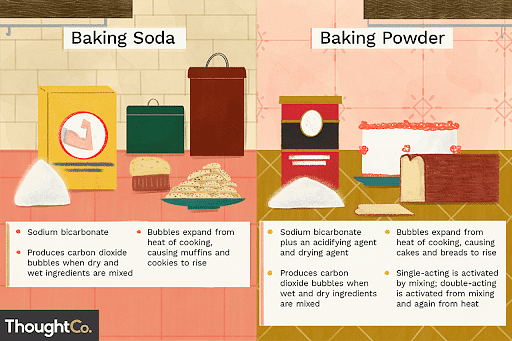
| Baking Powder | Baking Soda |
|---|---|
| Cream of tartar + sodium bicarbonate | Bicarbonate of sodium |
| Baking soda has tartaric acid added to it so that it does not taste harsh when used in cooking. It has a non-aggressive effect. | If it isn't combined with an acidic medium like buttermilk, it gives food a bitter taste. |
| It has a long leavening time and progressively releases CO2 during baking. | Its leavening process is quick, and it releases CO2 as soon as it comes into contact with an acidic medium. |
Side Effects of Baking Soda
The eyes and skin are severely irritated by concentrated sodium bicarbonate solution. It is not poisonous or hazardous under normal circumstances. A sodium bicarbonate overdose can cause shortness of breath, muscle spasms, mood swings, jerks, and fits. When delivering sodium bicarbonate to individuals with kidney failure, high blood pressure, heart failure, or kidney stones, extreme vigilance is required.
Things to Remember
- Sodium bicarbonate is also known as baking soda, cooking soda, bread soda, and bicarbonate of soda. It's commonly used in baking and healthcare.
- Sodium Bicarbonate is composed of carbon, sodium, oxygen, and hydrogen.
- It has a weakly basic nature. A solution of sodium bicarbonate is mildly alkaline because it has been hydrolyzed.
CO2 + H2O = H2CO3
H2CO3 + NaOH = NaHCO3 + H2O
- Its leavening process is fast, and as soon as it comes into touch with acidic media, it produces CO2.
- NaHCO3 is the chemical formula for sodium bicarbonate.
Read Also: Sodium Bisulphate
Sample Questions
Ques: What are the sodium bicarbonate contraindications? (4 marks)
Ans: The contraindications of Sodium Bicarbonate are mentioned below:
- Hypersensitivity, metabolic or respiratory alkalosis, hypocalcemia, and excessive chloride (Cl-) loss from vomiting or GI suctioning are all possible contraindications of Sodium bicarbonate.
- Patients at risk of hypochloremic alkalosis caused by diuretics.
- Hypercarbic acidosis is a condition in which there is an excess of carbon dioxide in the blood.
- Unidentified abdominal pain.
Ques: When sodium bicarbonate is combined with water, what happens? (2 marks)
Ans: When baking soda, also known as sodium bicarbonate (NaHCO3), interacts with water, carbonic acid is produced. The reaction is exothermic, meaning it expels heat. Sodium bicarbonate is what baking soda is made of. Because sodium bicarbonate is alkaline, it will dissolve in water, making it slightly more basic.
Ques: What are the risks associated with sodium bicarbonate? (3 marks)
Ans: The following health hazards are associated with sodium Bicarbonate:
- If a large concentration of dust has been inhaled, coughing and sneezing may occur.
- If a substantial amount is consumed, it might cause gastrointestinal irritation.
- Contact with the eyes might cause minor discomforts, such as redness and pain.
Ques: Is sodium bicarbonate beneficial for the kidneys? (2 marks)
Ans: In fact, persons with kidney problems should avoid taking sodium phosphate as a medicine. Sodium bicarbonate (a.k.a. baking soda) is, on the other hand, beneficial to some patients with renal disease. Baking soda reduces the acidity of the blood in their bodies, slowing the progression of kidney disease.
Read More: Etard Reaction
Ques.:What is sodium bicarbonate's pH? Is sodium bicarbonate an acidic or basic substance? (2 marks)
Ans: The pH of Sodium bicarbonate is 8.5
The white powder sodium bicarbonate has the chemical formula NaHCO3 and a pH of 8.5 (1 percent aqueous solution, 25°C). It is one of the chemicals with the lowest alkalinity among sodium compounds.
Sodium bicarbonate is a basic salt because it can deprotonate water and produce a basic solution.
Ques: What does NaHCO3 break down into? Is sodium bicarbonate a non-toxic substance or neutral? (3 marks)
Ans: Sodium bicarbonate dissociates into sodium and bicarbonate ions. Ion generation raises blood pH by increasing plasma bicarbonate and buffering excess hydrogen ion concentration. Sodium bicarbonate is a white crystalline powder or lumps with no odor
Sodium bicarbonate is neither basic nor neutral as a dry salt. When sodium is mixed with water, it separates from the bicarbonate, which functions as a weak base.
Ques: What causes NaHCO3 to form? What is the function of NaHCO3? (3 marks)
Ans: Carbon, sodium, hydrogen, and oxygen molecules are mixed together to make sodium bicarbonate. Baking soda, often known as baking powder, is a form of salt.
By neutralizing excess stomach acid, sodium bicarbonate, popularly known as baking soda, is used to treat heartburn, sour stomach, or acid indigestion. When used, for this reason, it is classified as an antacid, a type of medicine. It may be used to alleviate stomach or duodenal ulcer symptoms.
Ques: What makes NaHCO3 such a weak acid? (2 marks)
Ans: Why does aqueous NaHCO3 solution turn basic? The weak acid, such as H2CO3, remains mostly unionized in the solution, resulting in a final solution with more OH– ions than H+ ions. Baking soda (NaHCO3) solution becomes basic due to the presence of extra OH– ions in the aqueous solution.
Ques: Why Is Sodium Bicarbonate Called Baking Soda? Who came up with the idea for sodium bicarbonate? (2 marks)
Ans: Baking soda creates twice as much carbonate (CO3) per sodium as washing soda, resulting in the bi- prefix. So, even though HCO3– only has one carbonate, it became bicarbonate, and CO32– became carbonate.
In 1801 in Berlin, pharmacist Valentin Rose the Younger is credited with discovering sodium bicarbonate. John Dwight and Austin Church, two American bakers, founded the first plant in the United States to make baking soda from sodium carbonate and carbon dioxide in 1846.
Checkout Important Links for Physical Properties of Aldehydes
Ques: Where can you find NaHCO3? Is it okay to use sodium bicarbonate on a daily basis? (4 marks)
Ans: Sodium bicarbonate is discovered in the Piceance Basin of Colorado, in the Eocene-age Green River Formation. Sodium bicarbonate was accumulated in beds in the basin during periods of high evaporation. Bore, drum, and other mining processes are used to extract it.
For up to 2 weeks, the FDA recommends a maximum daily sodium and bicarbonate dosage of 200 mEq sodium and 200 mEq bicarbonate in people under 60 years old, and a maximum daily sodium and bicarbonate dosage of 100 mEq sodium and 100 mEq bicarbonate in people over 60 years old. Taking excessive doses of sodium bicarbonate by mouth could be dangerous.
Ques: What are two applications for NaHCO3 mixtures? What products are generated when NaHCO3 is ignited? (3 marks)
Ans: Sodium hydrogen carbonate is used in medicine (most commonly as an antacid), baking (as "baking soda"), and in the production of sodium carbonate, Na2CO3. Baking powder is a combination mostly made up of sodium hydroxide (NaHCO3).
NaHCO3 is the chemical formula for sodium hydrogen carbonate. It produces water, carbon dioxide, and sodium carbonate when heated.
Ques: Is baking soda a flammable substance? What is the effect of sodium bicarbonate on the heart? (2 marks)
Ans: Baking soda (sodium bicarbonate) is a non-flammable substance that will not catch fire. Some fires can even be put out with it.
Baking soda, an alkaline material, has been administered to heart attack victims to prevent lactic acidosis or a build-up of harmful acids in the blood. However, the researchers discovered that sodium bicarbonate solutions harmed patients' heart and liver functions.
Related Chemistry Links:



Comments