



Education Journalist | Study Abroad Lead
Tangential Velocity is part of the speed line of any object moving in a circular motion. If an object travels in a circular motion at a distance ‘r’ from the centre, then the body speed is automatically adjusted at any time. This is called tangential velocity. Also, we can say that line speed is its tangential speed at any time. Tangential Velocity is a vector quantity as it has both magnitude and direction. The direction will remain tangent in the movement circle.
Key Terms: Speed, Tangential Acceleration, Circular Motion, Tangential Acceleration, Angular Velocity
What is Tangential Velocity?
[Click Here for Sample Questions]
Tangential velocity can be defined as the linear component of a moving object in circular motion. Imagine a small object tied to a rope, around a fixed place. An object cannot go farther than the length of the thread, so if it continues in a constant motion, its movement will be circular. From the top to the bottom, the object is just a circle, and the string is the width of that circle. We can hence say that the object possesses angular velocity as it rotates in a circular motion with a certain number of radians per second.
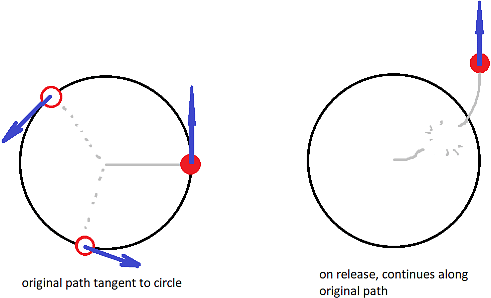
Circular Motion of Object and Tangential Velocity
Read More: Equation of Motion
Tangential Velocity Formula
[Click Here for Sample Questions]
Tangential Velocity formula is mathematically represented as,
Vt = ω r
where, r is the radius of the circular path and ω is the angular velocity.
The given formula is applied in calculating the tangential velocity of any object moving in a circular path. It is expressed in metre per second (m/s).
Tangential Acceleration
[Click Here for Sample Questions]
Tangential Acceleration is the rate of change of speed in an area where indirect movement occurs. It remains perpendicular to the centripetal acceleration at that time. Therefore, the rate of change of tangential velocity somewhere in a circular orbit is called tangential acceleration. Mathematically,

where, at is the tangential acceleration, dv / ds is change in tangential velocity with respect to change in displacement and d2s / ds is change in displacement with respect to time.
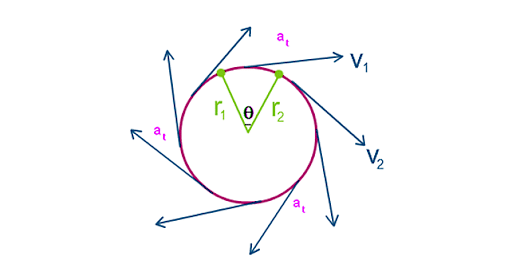
Tangential Acceleration
Things To Remember
- An object speed is systematically directed at any time when an object moves in a circular motion at a distance from the centre known as tangential velocity.
- Angular velocity is related to tangential velocity as the latter is the product of angular velocity ‘ω’ and ‘r’ is the radius of the circular path.
- The angular velocity is represented by ‘ω’ and tangential velocity is represented by ‘Vt’.
- A line that touches a non-line curve in only one place is called a tangent. It represents the relationship and number between the ‘x’ and ‘y’ links in the graph.
- Tangential speed can be calculated by dividing the circumference of the circular path by the amount of time the object takes to complete one rotation.
Solved Examples
Ques. If the angular velocity of the wheel is 40 rad / s, and the wheel width is 60 cm, calculate the tangential velocity. (2 marks)
Ans. Given,
Radius, r = ½ x 60 cm = r = 30 cm = 0.30 m
Angular velocity, ω = 40 rad / s
The tangential velocity formula is given by
Vr = rω
Substituting the values, we get,
Vr = 40 x 0.30 = 12 m / s
Ques. If the wheel is moving at 10 m / sec, and the angular speed is 5 radians / second, calculate the wheel radius. (2 marks)
Ans. Given,
Tangential Velocity, Vr = 10 m / sec
Angular velocity, ω, = 5 radians / second
Using the tangential velocity formula,
Vr = ω r
Vr / ω = r = 10/5 = 2 m
Ques. The body runs in the same way on a circular road with a speed of 10 m / s to 20m / s in 4s. Calculate its tangential acceleration. (2 marks)
Ans. Given,
Initial velocity = 10 m / s,
Final velocity v = 20 m / s,
Speed change dv = v - u = 20 - 10 = 10 m / s
Time taken dt = 4s
Tangential acceleration = at = dv / dt = 10/4 = 2.5 m / s2.
Ques. If the angular velocity of a rotating bicycle wheel is 42 rad / s, and the wheel width is 68 cm, what is the tangential velocity? (2 marks)
Ans. Given,
Radius, r = 1/2 x 68 cm = 34 cm = 0.34 m.
Angular velocity, ω = 42 rad / s.
Using equation of tangential speed, we get,
Vt = ω r
Vt = (42 rad / sec) x 0.34 m = 14.28 m / s
Ques. Tangential velocity, Vt = 12 m / sec. Angular velocity, ω, is 6 radians / second. Use the tangential velocity formula to find the radius, r. (2 marks)
Ans. Given,
Vt = ω r
Vt / ω = r
Substituting the given values in equation, we get,
(12 m / sec) / (6 radians / sec) = r = 2 m.
Ques. The angular velocity of the circular ring is 20 rad / s, and its diameter is 20 cm. Find its tangential speed. (2 marks)
Ans. Given,
Angular velocity, ω = 20 rad / s,
Round diameter, d = 20 cm.
Therefore, Radius, r = 20 cm / 2 = 10 cm = 0.1 m
Tangential velocity = Vt = r × ω
= 0.1 m × 20 rad / s
= 2 m / s
Ques. Determine tangential disk speed with an angular velocity of 10 rad / s and a radius of 5 m. (2 marks)
Ans. Given,
Angular velocity, ω = 10 rad / s
Disc radius, d = 5 m
Tangential velocity formula = Vt = r × ω = 5 m × 10 rad / s = 50 m / s
Ques. What is the radius of a wheel rotating at a speed of 10 m / s, and its angular speed of 5 rad / s? (2 marks)
Ans. Given,
Tangential velocity, Vt = 10 m / s
Angular velocity, ω = 5 rad / s
Tangential velocity, Vt = r × ω
10 m / s = r × 5 rad / s
r = 2 m
Ques. What is the radius of the ring with a tangential velocity of 50 m / s, and its angular velocity is 5 rad / s? (2 marks)
Ans. Given,
Tangential velocity, Vt = 50 m / s
Angular velocity, ω = 5 rad / s
Tangential velocity = Vt = r × ω
50 m / s = r × 5 rad / s
r = 10 m
Ques. When the wheel rotates at a speed of 12 m per second, and the angular speed is 6 radians per second. Then find its radius. (2 marks)
Ans. Given,
Vt = 12mpersec.
Angular velocity, ω, is 6 radians / second.
Tangential velocity = Vt = r × ω
To rearrange it,
r = Vt / ω
= 12/6
= 2 m
Therefore, the radius is 2 metres.
Read Also:



Comments