



Content Curator
Angular Velocity Formula is used to calculate the distance traveled by a body in terms of rotation and revolutions per unit of time.
- Angular velocity is the time rate at which an object rotates or circles around an axis, or the rate at which the angular displacement between two bodies varies.
- The angular velocity of an object moving on a circular path applies to the entire object.
- The angle traced by a particle during circular motion is known as angular displacement.
- Angular displacement is an axial vector since its direction is along the axis.
- The SI unit of angular velocity is radian per second (rad/s).
Read Also: Angular Acceleration
| Table of Content |
Key Terms: Angular Speed, SI Unit, Linear Velocity, Angular Displacement, Radius, Angular acceleration, Instantaneous angular velocity, Average angular velocity
Angular Velocity
[Click Here for Sample Questions]
Angular velocity is a vector number that indicates the angular speed or rotational speed of an object and the axis around which the object is revolving.
- The amount of change in the particle's angular displacement over time is known as angular velocity.
- The angular velocity vector's course is vertical to the plane of rotation, as indicated by the right-hand rule.
- An example of angular velocity is a roulette ball on a roulette wheel, a race car on a circular circuit, or a Ferris wheel.
- Furthermore, the object's angular velocity is its angular displacement with respect to time.
- Additionally, as an object moves along a circular path, the central angle that corresponds to the object's position on the circle shifts.
- Furthermore, the angular velocity, denoted by the symbol ω, is the rate at which this angle changes with respect to time.

Also Read:
SI Unit of Angular Velocity
The SI unit of angular velocity is radians per second, with the radian having a dimensionless value of one, hence the SI units of angular velocity are 1/s or s-1. The symbol omega (ω, sometimes Ω). is commonly used to signify angular velocity.
Physics Related Links:
Angular Velocity Formula
[Click Here for Sample Questions]
Let θ be the angular displacement of a body in time t, then the formula of angular velocity is given by
\(\omega=\frac{\theta}{t}\)
Where
- The change in angular displacement is denoted by θ.
- The shift in time t is represented by t.
Positive angular velocity indicates counterclockwise rotation, whereas negative indicates clockwise rotation.
Average Angular Velocity Formula
The ratio of the angular displacement to the time interval represents the average angular velocity of a rotating rigid body. It is given by the formula
\(\omega_{avg}=\frac{\Delta \theta}{\Delta t}=\frac{\theta_2-\theta_1}{t_2-t_1}\)
Instantaneous Angular Velocity Formula
The limit of the average angular velocity as the time interval approaches to zero is known as the instantaneous angular velocity.
\(\omega_{ins}=\lim_{\Delta x \to 0}\frac{\Delta \theta}{\Delta t}=\frac{d\theta}{dt}\)
Also Check:
Linear Velocity
[Click Here for Sample Questions]
Linear velocity describes the motion of an object or particle in a straight line.
- It also refers to the rate at which an object's location changes over time.
- Furthermore, the most typical example is the speed with which you drive along the road.
- Furthermore, the speedometer displays your linear velocity, which is measured in kilometers per hour (km/h).
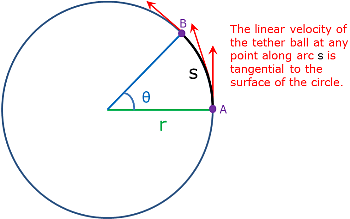
Relation Between Linear and Angular Velocity
[Click Here for Sample Questions]
The relation between linear and angular velocity for a body moving in a uniform circular motion is:

where,
- The linear velocity is denoted by the letter v.
- The radius of the circular path is denoted by r.
The linear velocity (v) is proportional to the particle's distance from the circular path's center and its angular velocity, according to this equation.
- The linear velocity varies depending on where you are in the circle.
- At the center, it's zero.
- The distance between the center and any point on the circumference is the shortest.
- It reaches its apex at the circle's circumference. The angular velocity, on the other hand, is constant along the circular journey.
Also Read:
Solved Examples
Ques. Determine the angular velocity if 4.6 revolutions are completed in 4 seconds.
Ans. Given
- Total number of revolutions, n = 4.6
- Time taken to complete 4.6 revolutions, t = 4 seconds
The frequency of the revolution is given by f = n/t
⇒ f = 4.6/4 = 1.15 Hz
Angular velocity is given by
ω = 2πf
⇒ ω = 2 x 3.14 x 1.15 = 7.2 rad/s
Ques. Determine the linear velocity of a point rotating at an angular velocity of 16 π radians per second at a distance of 8 cm from the center of the rotating object.
Ans. Given
- Angular velocity, ω = 16 π rad/s
- Radius of the circular path, r = 8 cm = 0.08 m
The relation between angular velocity (ω) and linear velocity (v) is given
v = rω
⇒ v = 0.08 x 16 π = 4.01 m/s
Things to Remember
- S = rθ simplifies the computation by putting the value of in radians in the equation.
- The angular velocity, like the displacement, is an axial vector quantity. Using the Right-hand Thumb Rule, we can determine its direction. The following rule applies:
- Curl your fingers counterclockwise, and the direction of angular motion is the thumb pointing outwards (along the axis). Similarly, curling your fingers clockwise gives you the direction of your thumb pointing inwards.
- This equation holds for any particle with a rigid body at any given time.
- The speed (velocity isn't really right here; that's a vector) will increase if the radius is changed by gently reducing the string. Again, when the radius decreases, velocity increases, but in order to stay in orbit, one must fire engines to accelerate the satellite!
Also Read:
Sample Questions
Ques. What is angular velocity? (2 Marks)
Ans. Angular velocity is the pace at which an object rotates or circles around an axis, or the angle between two bodies changes. This displacement is depicted in the image by the angle formed by a line on one body and a line on the other.
Ques. In real life, what is an example of angular velocity? (2 Marks)
Ans. An example of angular velocity is a roulette ball on a roulette wheel, a race car on a circular circuit, and a Ferris wheel. Furthermore, the object's angular velocity is the object's angular displacement with respect to time.
Ques. What is the best way to employ angular velocity? (2 Marks)
Ans. ω = v/r, where omega ω is a Greek letter. Radians per second are angular velocity units; you can also refer to this unit as "reciprocal seconds" because v/r equals m/s divided by m, or s-1, indicating that radians are a unitless quantity.
Ques. What is the formula for calculating angular velocity? (2 Marks)
Ans. The rate of change of an angle is defined as angular velocity. In symbols, this is ω=Δθ/Δt, where t is the time it takes for an angular rotation to occur. The angular velocity increases as the rotation angle increases in a certain length of time. Radians per second (rad/s) are the units for angular velocity.
Ques. What factors have an impact on angular velocity? (3 Marks)
Ans. Three factors are taken into account:
- The extent to which edge transitions of surface elements determine perceived angular velocity.
- The extent to which instantaneous linear velocities of surface elements influence angular velocity estimates.
- Whether element-velocity effects are related to three-dimensional (3-D) tangential velocities or two-dimensional (2-D) image velocities.
Ques. Is there a relationship between radius and angular velocity? (2 Marks)
Ans. In a circular path, linear/tangential velocity increases with increasing radius and drops with decreasing radius. As a result, the angular velocity remains constant regardless of the radius change (W=V/r).
Ques. Does angular velocity increase as the radius of the circle shrinks? (2 Marks)
Ans. If mass and angular momentum are both constant, then a decrease in radius necessitates an increase in angular velocity while the mass's speed remains constant (the same speed in a smaller circle means a faster rate of rotation).
Ques. What causes angular velocity to increase? (2 Marks)
Ans. The angular velocity increases as the rotation angle increases in a certain length of time. Radians per second (rad/s) are the units for angular velocity. The terms angular velocity and linear velocity v are interchangeable.
Ques. Determine the angular velocity if 7.2 revolutions are completed in 5 seconds. (3 Marks)
Ans. Given
- Total number of revolutions, n = 7.2
- Time taken to complete 7.2 revolutions, t = 5 seconds
The frequency of the revolution is given by f = n/t
⇒ f = 7.2/5 = 1.44 Hz
Angular velocity is given by
ω = 2πf
⇒ ω = 2 x 3.14 x 1.44 = 9.04 rad/s
Ques. Determine the linear velocity of a point rotating at an angular velocity of 20 π radians per second at a distance of 6 cm from the center of the rotating object. (3 Marks)
Ans. Given
- Angular velocity, ω = 20 π rad/s
- Radius of the circular path, r = 6 cm = 0.06 m
The relation between angular velocity (ω) and linear velocity (v) is given
v = rω
⇒ v = 0.06 x 20 π = 3.768 m/s
Ques. Is angular velocity a vector or scalar quantity? (1 Mark)
Ans. Angular velocity is a vector quantity. Its direction is along the axis of rotation.
Ques. A car tyre revolves at 180 rpm. Find its Angular Velocity in rad/sec.
Ans. Given, the frequency of the revolution, f = 180 rpm = 180/60 rps = 3 rps
Angular velocity, ω = 2πf
⇒ ω = 2 x 3.14 x 3 = 18.84 rad/s
Ques. What is the similarity and difference between Angular Speed and Angular Velocity? (2 Marks)
Ans. The similarities and differences between these two quantities are as follows.
- Similarity: The unit of measurement of both quantities is radians per second (rad/s)
- Difference: Angular velocity (ω) is a vector quantity, whereas angular speed (v) is a scalar quantity.
Also Read:



Comments