



Education Journalist | Study Abroad Lead
Taylor Series Formula can be defined as the illustration of any function as an infinite sum of terms. These terms are computed from the values of the function’s derivatives at a single point. The idea of the Taylor series was formulated by James Gregory who was a Scottish mathematician. But, it was formally introduced in the year 1715 by an English mathematician Brook Taylor. It is extensively used for the elaboration of mathematical series. A function can be approximated by using a finite number of terms of its Taylor series. Taylor’s theorem provides quantitative estimations on the error which were introduced by the usage of such an approximation.
| Table of Content |
Key Terms: Taylor Series Formula, Derivatives, Mathematical Series, Approximation, Quantitative Estimation, Polynomials, Convergence, Matrix, Notation, Logarithms, Operators, Constraints, Multivariate Taylor Series, Maclaurin Series Expansion
Also read: Isosceles Triangle Theorems
What is Taylor Series?
[Click Here for Sample Questions]
In Mathematics, the Taylor series of a function is an indefinite total of terms represented in forms of the function's derivatives at a single point. Primarily, for typical functions, the function and the sum of its Taylor series are equivalent about this point.
A Taylor series is also named a Maclaurin series if at any point the derivatives are considered 0. In other terms, the Taylor series of a function is the limitation of that function’s Taylor polynomials as the degree increases, provided that the limit exists. Even if at every point, the Taylor series of a function converges, the function might not be equivalent to its Taylor series. A function that is equivalent to its Taylor series in an open interval is termed as an analytic function in that interval.
We can take two hypotheses. First, suppose that the function f(x) does have a power series expressed about x=a,

Next, we will consider that the function, f(x), has derivatives of every order and that we can discover efficiently.
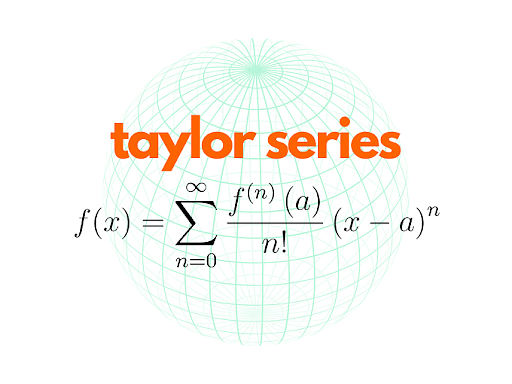
Taylor Series
Also Read: Applications of Derivatives
Formula for Taylor Series
[Click Here for Sample Questions]
Taylor Series is used to illustrate functions and "operators" in various regions of mathematics. In particular, this is valid in regions where the classical descriptions of functions break down. For instance, using the Taylor series, one may expand analytic functions to sets of matrices & operators, such as the matrix exponential/matrix logarithm.

To discover a condition that must be true for a Taylor series to exist for a function, we foremost specify the nth degree Taylor polynomial equation of

The above polynomial is of degree at most n. If we have to write some without the summation notation then it would be an nth degree polynomial.
Also Read: Differential Equation
Theorem For Taylor Series
[Click Here for Sample Questions]
According to Taylor's theorem, any function, say f(x) which satisfies specific conditions can be represented as a Taylor series. Taylor's theorem provides quantitative estimations on the error introduced by the use of approximations.
We now have the following:

On |x-a| < R
Maclaurin Series Expansion
[Click Here for Sample Questions]
When the Taylor Series is centred at 0, then the series is referred to as the Maclaurin series. This implies that if we assume the value of a= 0 in the Taylor series, then we will obtain the following outcome,

The above equation is termed as Maclaurin Series Expansion.
In other words, a Maclaurin series is a power series that helps to compute an approximation of a function f(x) for input values close to 0, given that one knows the values of the successive derivatives of the function at 0. In multiple practical applications, it is equivalent to the function it defines.

Taylor and Maclaurin Series
Also Read: List of Integral Formulas
Steps Involved in the Taylor Series
[Click Here for Sample Questions]
The steps involved in determining the Taylor series have been mentioned below:
- Step 1: In the first step, compute the first few derivatives of f(x).
In the Taylor series general Taylor formula, f(a). This is f(x) which can be evaluated at x = a. Then, we see f '(a) which is the first derivative of f(x) evaluated at x = a.
- Step 2: Now, estimate the function and its derivatives at x = a.
Consider each outcome from the earlier step and replace a for x.
- Step 3: Using the Taylor formula of the Taylor series we have discussed above, fill in the right-hand side of the Taylor series expression:
Using the Taylor formula of Taylor series:-

- Step 4: At last, write the outcome of the equation using a summation.
Including a summation of a general term will be helpful when specifying the interval of the intersection or the set of x-values where a series converges/intersects.
Also Read:
Applications of Taylor Series
[Click Here for Sample Questions]
The applications of the Taylor series have been mentioned in the list below:
- Taylor series is used for estimating the value of a complete function in each point if the functional values and derivatives are identified at a single point.
- The expression of the Taylor series reduces numerous mathematical explanations.
- The aggregate of partial series can be utilized as an approximation of the entire series.
- The multivariate Taylor series can be used in multiple optimization techniques.
- The Taylor series is also used in the power flow analysis of electrical power techniques.
Things to Remember
- A Taylor Series is the expansion of a function into an indefinite sum of terms, where every term possesses a larger exponent such as x, x2, x3, etc.
- It's a special type of power series specified only for the functions which are infinitely differentiable on some open interval.
- Taylor's theorem provides an approximation of a k-times differentiable function about a given point by a polynomial of degree k, named the kth-order Taylor polynomial. For a smooth function, Taylor polynomial is described as the truncation at the order k of the Taylor series of the function.
- The elaboration or expansion of the Taylor series of a function around 0 is referred to asthe Maclaurin series
- All the functions which are infinitely differentiable at a given point 0, have a Taylor series at that point. In case a function is holonomic (analytic), then it follows the Cauchy Riemann equations.
Solved Questions
Ques. Determine the Taylor series at x = 0 for f(x) = ex (3 Marks)
Ans. Given in the question, f(x) = ex
On differentiating the equation given,
f’(x) = f’’(x) = f’’’(x) = ex
At x = 0, we will get
f’(0) = f’’(0) = f’’’(0) = e0 =1
Hence, the Taylor series for f(x)=ex about x=0 will be

Ques. For the hyperbolic cosine function f(x) = cosh x, find the Taylor series with center x0 = 0 using cosh x as the derivative of the hyperbolic sine function (sinh x), that has as its Taylor series expansion.  (3 Marks)
Ans.

From the previous step, we can conclude that:

Ques. State the differences between the Taylor Series and Maclaurin Series? (2 Marks)
Ans. The major differences between the Taylor series and the Maclaurin series are mentioned below:
- In the mathematics domain, the Taylor series is the representation of a function as an indefinite sum of terms that are evaluated from the values of the function’s derivatives at one point.
- When the Taylor series is centred at a point of 0, then the series becomes a Maclaurin series. The Maclaurin series is an expansion/evolution of the Taylor series of a function about 0.
Ques. Evaluate the Taylor Series for the case of f ( x ) = x3 − 10x2 + 6 at x = 3. (3 Marks)
Ans. In the first step, we need to find the derivatives of the given function
f(x) = x3 − 10x2 + 6 ⇒ f(3) = -57
f’(x) = 3x2 − 20x ⇒ f’(3) = 33
f’’(x) = 6x – 20 ⇒ f’’(3) = -2
f’’’(x) = 6 ⇒ f’’’(3) = 6
f’’’’(x) = 0
Thus, now the desired series will be

Ques. Explain what is the requirement of the Taylor Series? (2 Marks)
Ans. A Taylor series is a concept widely used in the fields of computer science, calculus, chemistry, physics, and different categories of higher-level mathematics. It's a series used to create an estimation of what a function really looks like. It can be used to calculate the value of a whole function at every point, if the value of the function, and all of its derivatives, are known at a single point.
Taylor Series along with Maclaurin Series is very essential when we want to define a function as a power series. For instance, ex and cos x can be represented as a power series.
Ques. Does Taylor Series Always Converge? (2 Marks)
Ans. Since the Taylor series is a form of power series, each Taylor series likewise possesses an interval of convergence. When this interval is the whole set of real numbers, we can use the series to find the value of f(x) for every true value of x.
However, when the interval of convergence for a Taylor series is specified, it can be manipulated to determine the value of f(x) exclusively on its interval of convergence.
Ques. Explain the term Tylor polynomial? (2 Marks)
Ans. The partial sum formed by the first n + 1 terms of a Taylor series is a polynomial of degree n called the nth Taylor polynomial of the function. The Taylor polynomials are the approximations of a function, which generally become better as the value of n increases.
Ques. Define what is understood by the radius of the convergence of the Taylor series? (3 Marks)
Ans. The radius of convergence of a power series is half the length of the interval; it is also the radius of the circle within the complex plane in which the series converges.
The radius of convergence is can either be a non-negative real number or infinity. When it is positive, the power series entirely and uniformly converges on compact sets inside the open disk of radius equivalent to the radius of convergence. Also, it is the Taylor series of the analytic function to which the radius converges.
For a power series f is expressed as 
Where,
- a = complex constant. It is the centre of the disk of convergence
- cn = nth complex coefficient
- z = complex variable.
The radius of convergence r is a non-negative real number or infinity such that the series converges or diverges depending upon the value of |z-a|. This means that the series converges if |z-a| < r and diverges if |z-a| > r.
Ques. Evaluate the Taylor series for the case of f ( x ) = cos ( x ) for x = 0. (3 Marks)
Ans. Here, we have to take the derivatives of the cos x and evaluate them at x = 0
f(x) = cos x ⇒ f(0) = 1
f’(x) = -sin x ⇒ f’(0) = 0
f’’(x) = -cos x ⇒ f’’(0) = -1
f’’’(x) = sin x ⇒ f’’’(0) = 0
f’’’’(x) = cos x ⇒ f’’’’(4) = 1
f(5)(x) = -sin x ⇒ f(5) (0) = 0
f(6) (x) = -cos x ⇒ f(6)(0) = -1
Therefore, in accordance with the Taylor Series Expansion

Ques. Explain the term Taylor’s Inequality. (3 Marks)
Ans. Taylor's inequality is an evaluated outcome for the value of the remainder term Rn(x) in any n-term finite Taylor series approximation.
If f is any function satisfying the hypotheses of Taylor's theorem and for which there exists a real number M satisfying |f(n+1) (x)| <= M on some interval I=[a,b], the remainder Rn satisfies

on the exact interval I.
The above result is an immediate consequence of the Lagrange remainder of Rn and can likewise be subtracted from the Cauchy remainder as well.
| Related Links | |



Comments