



Education Content Expert
Set Operations are a list of mathematical operations performed on Sets and their types. Set Operation is a concept that is very similar to the fundamental operations on numbers like addition and subtraction. Operations on sets are done to establish the relationship between two or more sets. Sets are defined as a well-organized collection of elements in Maths such as numbers, alphabets, or any other real-world objects.
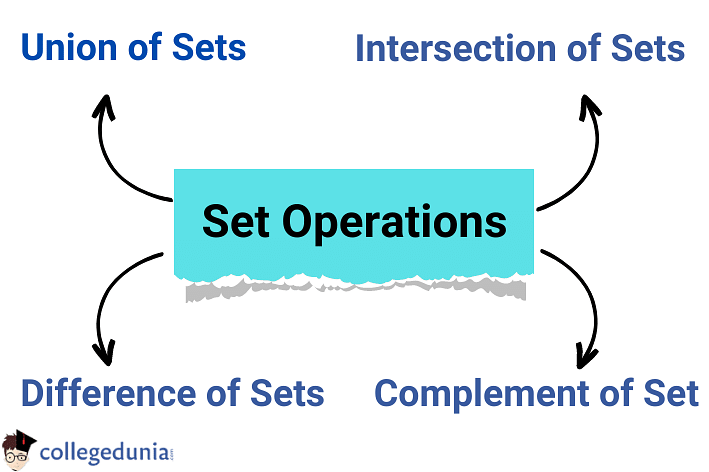
There are four main Set Operations which are as follows:
- Union of Sets (∪)
- Intersection of Sets (∩)
- Difference of Sets (–)
- Complement of a Set (A′ or Ac)
Read More: NCERT Solutions for Class 11 Maths Sets
Key Terms: Set Operations, Intersection of Sets, Union of Sets, Difference of Sets, Complement of a Set, Sets, Commutative Law
What are Set Operations?
[Click Here for Sample Questions]
Set Operations are mathematical operations performed on two or more sets in order to create a single set that contains items from both of the sets being operated on. Set operations are basically the fundamental operations that are applied to two or more sets to develop a relationship between them.
In Set Theory, there are four different types of Set Operations:
- Union of Sets (∪)
- Intersection of Sets (∩)
- Difference of Sets (–)
- Complement of a Set (A' or Ac)
Given below is a detailed explanation of each set operation with examples.
Union of Sets
[Click Here for Previous Years' Questions]
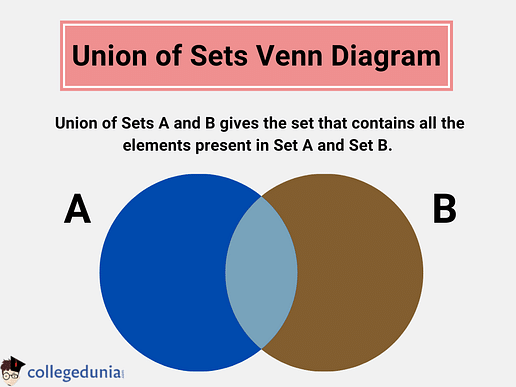
If two sets A and B are given, Union of Sets A and B gives the set that contains all the elements present in set A and set B. It is denoted as A∪B and read as A union B. The operation of Union of Sets is expressed as
| A ∪ B = {x: x ∈ A or x ∈ B} |
Where x are the elements that are present in both Set A and Set B.
Solved ExampleExample: What will be the Union of Sets: Set A = {1,2,3,4} and Set B = {6,7}? Solution: Given Sets are:
Union of Sets will be, A ∪ B = {1,2,3,4,6,7}. |
The number of elements in A ∪ B is given as:
| n(A∪B) = n(A) + n(B) − n(A∩B) |
Where n(X) is the number of elements in set X.
Properties of Union of Sets
The properties of Union of Sets is as follows:
- Commutative Law: If there are two Sets A and B, then A∪B = B∪A.
- Associative Law: If there are three sets A, B, and C, the associative law states that (A∪B)∪C = A∪(B∪C).
- Identity Law: When an empty set is combined with any set A, the result is the set itself, i.e. A∪∅ = A.
- Idempotent Law: Any set A can be combined with itself to form the set A, i.e. A∪A = A
- Domination Law: If there is a union of a universal set U with one of its subsets A, we will get the universal set itself. A∪U = U.
Read More:
Intersection of Sets
[Click Here for Sample Questions]
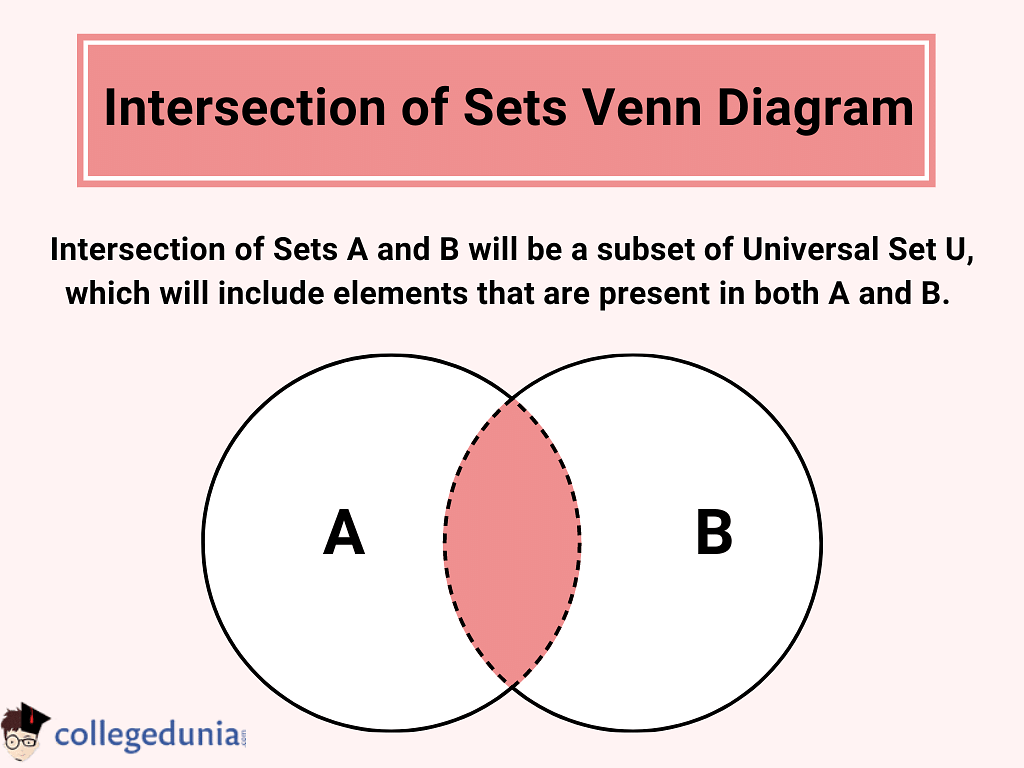
Consider A and B to be two sets, then the Intersection of Sets A and B will be a subset of Universal Set U, which will include elements that are present in both A and B. The symbol ‘∩’ is used to represent the Intersection of Sets. Intersection of Sets is expressed as:
| A∩B = {x : x ∈ A and x ∈ B} |
Where x is the elements present in both Sets A and B.
The intersection of Sets A and B can also be written as:
| A∩B = n(A) + n(B) – n(A∪B) |
Where,
- n(A): Cardinal Number of Set A
- n(B): Cardinal Number of Set B
- n(A∪B): Cardinal Number of Union of Set A and B
Solved ExampleExample: What will be the Intersection of Sets: Set A = {1,2,3} and Set B = {3,4,5}? Solution: Given Sets are:
Intersection of Sets will be, A ∩ B = {3} as 3 exists in both sets A and B. |
Properties of Intersection of Sets
The properties of the Intersection of Sets are as follows:
- Commutative Law: If there are two sets A and B, then A ∩ B = B ∩ A.
- Associative Law: If there are three sets A, B, and C, then the associative law states that (A ∩ B) ∩ C = A ∩ (B∩C).
- Identity Law: When an empty set intersects with any set A, the result is the empty set itself, i.e. A ∩ ∅ = ∅
- Idempotent Law: Any set A intersecting with itself yields the set A, i.e. A ∩ A = A
- Law of U: It states that if the universal set U interacts with one of its subsets A, we will get the set A itself. A ∩ U = A
- Distributive Law: This law states that A ∩ (B ∪ C) = ( A ∩ B ) ∪ (A ∩ C).
Check Also: De Morgan’s Law
Set Detailed Video Explanation
Difference of Sets
[Click Here for Previous Years' Questions]
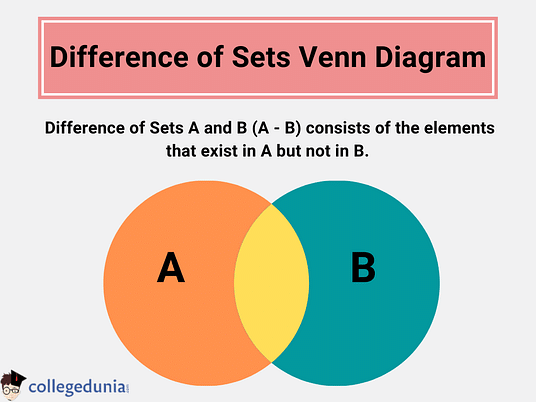
Difference of Sets involves subtracting the elements from a set and is quite similar to the concept of the difference between numbers. The set of components that are present in A but not in B is called the difference between two sets A and B. It's written as A – B.
Solved ExampleExample: What will be the Difference of Sets: Set A = {1,2,3,4,5,6,7} and Set B = {6,7}? Solution: Given Sets are:
Difference of Sets will be given as: A – B = {1,2,3,4,5} |
Difference of Set A and Set B is also equal to the intersection of Set A with the complement of Set B. Thus,
| A−B = A∩B’ |
Read More: Sets Important Questions
Complement of a Set
[Click Here for Sample Questions]
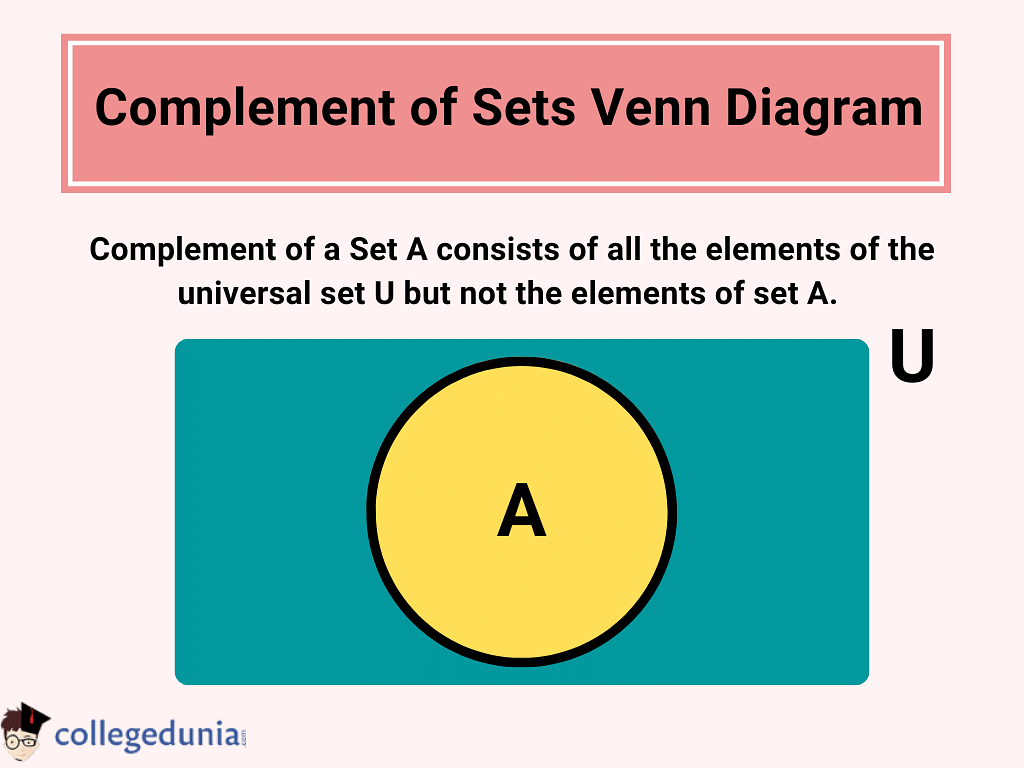
If U is a Universal Set and A is one of its subsets, the complement of A will be all the elements that exist in U but are not present in A. Complement of a set A is represented symbolically as
| X′ = {a : a ∈ U and a ∉ A} |
Solved ExampleExample: Find the complement of a set A when U = {1, 2, 3, 4, 5, 6, 7, 8, 9} and A = {1, 2, 3, 4}. Solution: Given Sets are:
Thus, the complement of Set A will be A' = {5, 6, 7, 8, 9} |
Properties of Set Operations
[Click Here for Previous Years' Questions]
The properties of set operations are almost similar to the properties of fundamental operations on numbers in Maths. Given below are the important properties of Set Operations:
Commutative Law
Consider two sets, Set A and Set B. Then, according to the Commutative Law,
Union of Sets is commutative, i.e.
| A ∪ B = B ∪ A |
Similarly, the Intersection of Sets is also commutative:
| A ∩ B = B ∩ A |
Associative Law
Consider three Sets A, B, and C. Then, according to the Associative Law,
Union of Sets is associative, i.e.
| (A ∪ B) ∪ C = A ∪ (B ∪ C) |
In the same manner, the Intersection of Sets is also associative:
| (A ∩ B) ∩ C = A ∩ (B ∩ C) |
Distributive Property
Consider three Sets A, B, and C. Then, according to the Distributive Property:
- A ∪ (B ∩ C) = (A ∪ B) ∩ (A ∪ C) [Union of Sets]
- A ∩ (B ∪ C) = (A ∩ B) ∪ (A ∩ C) [Intersection of Sets]
De-Morgan's Law
According to De Morgan's Law, for any two sets A and B,
| (A ∪ B)' = A' ∩ B' and (A ∩ B)' = A' ∪ B' |
- A ∪ A = A
- A ∩ A = A
- A ∩ ∅ = ∅
- A ∪ ∅ = A
- A ∩ B ⊆ A
- A ⊆ A ∪ B
Check More:
| Related Topics | ||
|---|---|---|
| Venn Diagrams | Data Sets | Equal Sets |
| Relations and Functions | Permutation | Group Theory |
Things to Remember
- Set Operations are mathematical operations performed on Sets in Set Theory.
- They are used to establish the relationship between two or more sets.
- Union, Intersection, Difference, and Complement of a Set are the four main Set Operations.
- Union of Sets A and B would be a set that consists of all the elements from sets A and B.
- Intersection of Sets A and B consists of all the common elements of sets A and B.
- Difference of Sets A and B (A - B) consists of the elements that exist in A but not in B.
- Complement of a Set A consists of all the elements of the universal set U but not the elements of set A.
For Latest Updates on Upcoming Board Exams, Click Here: https://t.me/class_10_12_board_updates
Previous Years’ Questions
- Let A, B, C be finite sets. Suppose that n(A) = 10, n(B) = 15… (BITSAT - 2017)
- If A and B are events such that P(A) = 0.42, P(B) = 0.48 and P(A and B)... (VITEEE - 2018)
- Two finite sets A and B have m and n elements respectively. If… (KEAM)
- The set of all real numbers x for which… (JEE Advanced - 2002)
- Two finite sets have m and n elements. The total number of subsets…
- In a certain town 25% families own a cell phone, 15% families own… (KEAM)
- In a class of 140 students numbered 1 to 140, all even-numbered students… (JEE Main - 2019)
- A survey shows that 63% of Americans like cheese where as… (JKCET - 2013)
- If a class of 175 students the following data shows the number… (COMEDK UGET - 2015)
- If a set A has 4 elements, then the total number of proper subsets of set… (COMEDK UGET - 2015)
Sample Questions
Ques. Given a universal set (U) that consists of all the natural numbers from 1 to 20. Set A and B are subsets of U, which are A = {2,5,9,15,19} and B = {8, 9, 10, 13, 15, 17}. Find A ∪ B. (3 Marks)
Ans. Given Sets are:
- U = {1,2,3,4,5,6,7,8,9,10,11,12,13,14,15,16,17,18,19,20}
- A = {2,5,9,15,19}
- B = {8,9,10,13,15,17}
Then,
A ∪ B = {2,5,8,9,10,13,15,17,19}
Ques. If A = {a, b, c, d, e}, B = {a, e, i, o, u}, U = {a, b, c, d, e, f, g, h, i, j, k, l, o, u}. Find
(a) A ∪ B
(b) A ∩ B
(c) A′
(d) A - B (3 Marks)
Ans. The given sets are:
- A = {a, b, c, d, e}
- B = {a, e, i, o, u}
- U = {a, b, c, d, e, f, g, h, i, j, k, l, o, u}
(a) A ∪ B = {a, b, c, d, e, i, o, u}
(b) A ∩ B = {a, e}
(c) A' = {f, g, h, i, j, k, l, o, u}
(d) A - B = {b, c, d}
Ques. Let A = {y,z} and B = {x,y,z} . Find
(a) A ∩ B
(b) A ∪ B
(c) A - B
(d) A' (3 Marks)
Ans. Given Sets are
- A = {y,z}
- B = {x,y,z}
(a) A ∩ B = {y,z}
(b) A ∪ B = {x,y,z}
(c) A − B = ∅
(d) A' = {x}
Ques. If the universal set is given by S = {1,2,3,4,5,6}, and A = {1,2}, B = {2,4,5}, C = {1,5,6} are three sets, find the following:
(a) A∪B
(b) A∩B
(c) A'
(d) B' (3 Marks)
Ans. The given sets are as follows:
- S = {1,2,3,4,5,6}
- A = {1,2}
- B = {2,4,5}
- C = {1,5,6}
(a) A ∪ B = {1,2,3,4,5}
(b) A ∩ B = {2}
(c) A' = {3,4,5,6}
(d) B' = {1,3,6}
Ques. If A = {1, 3, 5, 7}, B = {5, 7, 9, 11} and C = {1, 3, 5, 7, 9, 11, 13} then, prove that (A∩ B) U (A ∩ C) = A ∩ (B U C). (3 Marks)
Ans. Given Sets are:
- A = {1, 3, 5, 7}
- B = {5, 7, 9, 11}
- C = {1, 3, 5, 7, 9, 11, 13}
Now,
B U C = {1, 3, 5, 7, 9, 11, 13}
A ∩ (B U C) = {1, 3, 5, 7}
Hence, A ∩ B = {5, 7}
A ∩ C = {1, 3, 5, 7}
(A∩ B) U (A∩ C) = {1, 3, 5, 7}
Hence Proved.
Ques. Explain the intersection of an Empty Set. (1 Mark)
Ans. Empty set is a set that has no elements. Thus, in the Intersection of Sets, if one of the two sets is an empty set, then the two sets would have no element in common.
Ques. Given that A and B are two finite sets as n(A) = 15, n(B) = 24, and n(A ∪ B) = 30. Find n(A ∩ B). (3 Marks)
Ans. Given that
- n(A) = 15
- n(B) = 24
- n(A ∪ B) = 30
We know that,
n(A U B) = n(A) + n(B) – n(A ∩ B)
Substituting the values in above equation,
= 15+24 – 30
= 9
Thus, n(A ∩ B) is 9.
Ques. What are Set Operations? (3 Marks)
Ans. Set Operations are the operations in Set Theory that are usually applied to two or more sets to develop a relationship between them. There are four main set operations which are listed below:
- Union of Sets (∪)
- Intersection of Sets (∩)
- Difference of Sets (–)
- Complement of a Set (A′ or Ac)
Ques. If A = {2, 3, 4}, B = {3, 4, 5} and universal set, U = { 1, 2, 3, 4, 5} then find the Complement of sets A and B. (3 Marks)
Ans. Given that,
- A = {2, 3, 4}
- B = {3, 4, 5}
- U = {1, 2, 3, 4, 5}
Now,
A’ = U – A
= {1, 2, 3, 4, 5} – {2, 3, 4}
= { 1, 5}
Similarly,
B’ = U – B
= {1, 2, 3, 4, 5} – {3, 4, 5}
= { 1, 2}
Ques. Given that n(A – B) = 28, n(A ∪ B) = 80, and n(A ∩ B) = 35. Find the value of n(B). (3 Marks)
Ans. It is given that
- n(A – B) = 28
- n(A ∪ B) = 80
- n(A ∩ B) = 35
We know that,
n(A∪B) = n(A – B) + n(A ∩ B) + n(B – A)
80 = 28 + 35 + n(B – A)
80 = 63 + n(B – A)
n(B – A) = 80 – 43
n(B – A) = 37
As, n(B) = n(A ∩ B) + n(B – A)
= 35 + 37
= 72
Thus, the value of n(B) is 72.
Check-Out:



Comments