



Education Journalist | Study Abroad Lead
Time dilation is something that is well known to popular scientists and physicists as everyone is familiar with the time and its importance. Einstein’s popular theory of relativity gave the energy mass equivalence formula and is mostly related to time dilation. Einstein had made one of the most important contributions to physics and had the concept of space-time explained. A simple explanation of space-time can be that it is a mathematical model that fuses the three dimensions of space along with the one dimension of time into a single four-dimensional continuum. But it is very important to understand and to differentiate between the general theory of relativity and the special theory of relativity. In this article, we will discuss the time dilation formula and its derivation, and also its applications.
Key Terms: Time dilation, Internal reference frames, Time Dilation Formula
What is Time Dilation?
[Click Here for Sample Questions]
The laws of physics are the same in the inertial reference frames the speed of light in a vacuum is the same in internal reference frames. The time dilation refers to the special relative state of the time in which the time can pass at diverse rates in diverse reference frames. Also, the time dilation will depend upon the velocity of one reference frame with respect to another.
In simple words, time dilation is defined as the measure of the time elapsed that we would measure using two clocks. Moreover, there are two reference frames referred to as per the proper time, which is a one-time position. As we know that time dilation is due to the effect of the gravitational potential of their location or because of the effect of the velocity. It is caused mostly due to the effect of the relative velocity in the corresponding reference frame.

Time Dilation
History of Time Dilation
[Click Here for Sample Questions]
There was a conflict between the ideas of Newton and Maxwell which can be demonstrated with another work of Einstein’s brilliant thought experiments. A measurement of the speed of light made in different frames, differs in magnitude. Einstein called this absurdity “time dilation” and his newfound theory “special relativity”. He finally mentioned that time stretches and contracts vary with velocity. Time will form a four-dimensional fabric or continuum called space-time. In this way, time dilation and special relativity were discovered by Einstein. The time dilation is a matter of nanoseconds and very infinitesimally small.
Time Dilation Formula
[Click Here for Sample Questions]
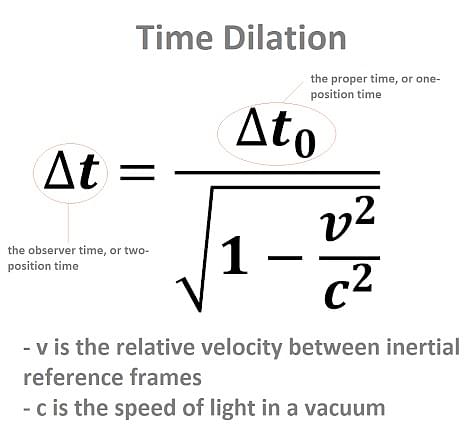
Time Dilation Formula is depicted below:
Time Dilation Formula Derivation
[Click Here for Sample Questions]
Suppose that in a reference frame, the proper time or the one-position time is known as the time between two events which is labelled as Δt0. Moreover, in another different reference frame, the person who is observing the two events occurs in different positions. Furthermore, according to the observer’s reference frame, the time difference between two events is known as the observer time and two-position which is Δt0.
Besides, the observer’s time will be greater than the proper time which will also be considered. One would refer to this effect of time as the time dilation. Most noteworthy, we measure both Δt0 and Δt in seconds. The above interpretation can be given in the form of a formula given below:

where,
t/ = the observer time/ two-position time (in sec).
t = the proper time/ one-position time (in sec).
v = velocity (in m/s).
c = speed of light (3.0 x 10⁸ m/sec)
The speed of time dilation can be calculated as follows:
The time of the object as seen by an observer in a frame within the other frame having the time taken as t’2, t’1. Hence, the proper time of the certain event can be given as
t’ = t’2 – t’1……..(1)
The apparent or the dilated time of the same event from reference at the same position x will be:
t = t2 – t1……….(2)
Now using the Lorentz inverse transformation equations,
t1 = (t’1 + x’v / c2) / (√1 – v2/c2).........(3)
t2 = (t’2 + x’v / c2) / (√1 – v2/c2)............(4)
Substituting equations (3) and (4) in equation (2) and solving, we get:
t = (t’2 – t’1) / (√1 – v2/c2)
From Eq 1,
t = t’ / (√1 – v2/c2)
This is the relation of the time dilation formula.
Applications of Time Dilation Formula
[Click Here for Sample Questions]
Generally, dilation refers to the increase of something. Whenever we divide t’ with a value which is less than 1, we would get t, which will always be greater than t’. This is the reason that it is called time dilation and the general clock will appear to be slower.
- Time dilation will be useful in the GPS satellite along with the individual satellites. This is because due to high altitude, the gravity effect becomes low on GPS satellites which further becomes the cause of the fast ticking of the clock.
- This total effect of time dilation on the clock in the GPS satellite is the flow of 38 microseconds faster per day than the time on the surface of the earth.
- The clock paradox effect also had been substantiated by the experiments by comparing the elapsed time of an atomic clock on the earth with that of an atomic clock that is flown in an aeroplane.
Things to Remember
- A clock moving with a relativistic speed relative to a stationary observer appears to go slow. This is due to the time dilation.
- The time interval of an event measured by a stationary observer is more than the time interval of that event measured by the moving observer.
- The apparent time interval of the event is more than the actual time interval.
- Hence, the clock frame appears to go slow to the observer of another relative frame, which is moving relative to the frame of the clock. This effect is called time dilation.
- This time dilation will be effective when a reference frame is moving with a relative velocity equal to the speed of the light in a vacuum.
- When the velocity is equal to the speed of light, the proper time will reach a negligible value then the clock will remain still on the other reference frame.
Sample Questions
Ques. What is meant by proper time? (3 marks)
Ans. Proper Time is the path through space-time that represents a clock, observer, or any test particle that will further go up to the metric structure of the spacetime.
- The proper time between any two different events can depend on the events along with the world line that connects both of them. Hence this can be assumed as the motion of the clock between the two different events.
- The twin paradox is a good application of this proper time.
Ques. What is the formula to find the time dilation? (3 marks)
Ans. The Time Dilation Formula is

Δt = the observer time/ two-position time (in sec).
Δt0 = the proper time/ one-position time (in sec).
v = velocity (in m/s).
c = speed of light (3.0 x 10⁸ m/sec).
Ques. Assume that Amit boards a spaceship and flies away from the earth at 0.800 times the speed of light. Moreover, her twin sister Rani stays on the earth. In addition, the instant Amit’s ship passes the earth both the sisters start timers. Furthermore, Amit watches her timer and stops it when the timer passes 60.0 seconds. Now, calculate the time that would have passed in rani’s timer? (3 marks)
Ans. From the equation of the time dilation,
t = t’/(√1 – v2/c2)
substituting the values:
t’ = 60.0 sec
v = 0.8c
we get, Δt = 60.0s√1−(0.800c)2
Δt = 60.0s√1–0.640
Δt = 60.0s√0.360
Δt = 100 s.
When Amit is in a reference frame moving at 0.800 c relative to rani’s reference frame, and Amit observes that 60.0 s had passed then his sister rani will observe that 100 s have been passed in her timer.
Ques. A certain process requires 106 to occur in an atom at rest in a laboratory. How much time will this process require an observer in the laboratory, when the atom is moving with the speed of 5×10⁷ m/sec? (3 marks)
Ans. From the equation of the time dilation,
t = t’/(√1 – v2/c2)
substituting the values:
t’ = 10-6 sec
v = 5 × 10⁷ m/sec
We get, Δt = 10-6 √1− (5 × 10⁷/ 3 × 10⁸)2
Δt = 10-6 √(1 - 25 / 900)
Δt = 1.028 × 10⁻⁶ sec
Ques. A certain particle called mesons has a lifetime of 2×10⁻⁶ sec. What is the mean lifetime when the particle is travelling with the speed of 2.994×1010 cm/sec ? How far can it go during one full mean life? (3 marsk)
Ans. substituting the values,
t’ = 2 × 10⁻⁶ sec
v = 2.994 × 1010 cm/sec
From the equation of the time dilation,
t = t’ / (√1 – v2/c2)
we get, Δt = 2 × 10⁻⁶ √[1 − (2.994 × 10⁸ / 3 × 10⁸)2]
Δt = 31.7 × 10⁻⁶ sec
The distance travelled by the particle in one mean life is S = v × t’
S = 2.994 × 1010 cm/sec × 31.7 × 10⁻⁶ sec
S = 9150mt.
Ques. A person in a train moving at a speed of 3 x 10⁷ m/s sleeps at 10.00 p.m. by his watch and gets up at 4.00 a.m. How long could he sleep depending on the clocks at the stations? (5 marks)
Ans. From the equation of the time dilation,
t = t’ / (√1 – v2/c2)
substituting the values:
t’ = 6 hrs
v = 3 × 10⁷ m/sec
we get, Δt = 60 x 60 x 60s√1 − (3 × 10⁷ / 3 × 10⁸)2
Δt = 21600 / 0.9945
Δt = 21719.457 sec
Δt = 6.033 hrs.
Ques. Determine the relativistic time, if T0 is given as 7 years and the velocity of the object is also given as 0.55c? (3 marks)
Ans. From the equation of the time dilation,
t = t’ / (√1 – v2/c2)
Substituting the values,
t’ = 7 years
v = 0.55c
we get, Δt = 7√1 − (0.55 c / c)2
T = 7 / 0.835
T = 8.386 years
Ques. The period of a pendulum is measured to be 3.0s in the inertial frame of reference of the pendulum. What is its period measured by an observer moving at speed of 0.95c with respect to the pendulum? (3 marks)
Ans. We know that the formula for the time dilation is
t = t’/(√1 – v2/c2)
Substituting the values:
t’ = 3 sec
v = 0.95c m/sec
we get, Δt = 3s /√1 − (0.95c / c)2
Δt = 3s /√1 − (0.95)²
Δt = 9.6 sec
Hence the observed time dilation observed is 9.6sec
Ques. A spacecraft travels at a constant speed of 0.90c towards a star outside our solar system. The star is 4.24 light-years away from earth. How long does this trip take i) according to a person on earth ii) according to a person on the spacecraft? (5 marks)
Ans: We know that, v = s / t
T = v / s = 4.01 × 10⁶ / 0.9 × 3 × 108 sec
T = 1.486 × 10⁸ sec
T = 4.71 years
Hence, according to the person on the earth, it takes for him 4.71 years.
By using the formula of time dilation for the person from the spacecraft, the time comes out to be
t = t’/ (√1 – v2/c2)
t = 4.71 years / (√1 – 0.9c/c)²
t = 4.71 years / 2.294
t = 2.05 years
Hence for the person who is in the spacecraft, the time appears to be 2.05 years.
Ques. Person X is on a train that is moving at a constant speed of 0.90c. A pendulum on the train has a time period of 1.50s. Person Y is standing on the platform and observes the pendulum in the train swinging. Determine how long the time period of the pendulum is according to a) person X and b) person Y. (4 marks)
Ans. The time appears to be the same as the time with which the train moves.
Hence the time period of the pendulum according to the pers0n X is 1.5 sec
The person standing on the platform appears to be on the other reference frame.
t = t’/ (√1 – v2/c2)
t = 1.5 sec / (√1 – 0.9c / c)²
t = 1.5 sec × 2.294
t = 3.441 sec
Hence the person standing on the platform will see the time period of the pendulum as 3.441 sec.
Ques. Determine the relativistic time, if T0 is given as 30 mins and the velocity of the object is also given as 0.8c? (3 marks)
Ans. From the equation of the time dilation,
t = t’/(√1 – v2/c2)
Substituting the values:
t’ = 30 mins
v = 0.8c
We get, Δt = 30 mins √(1 − (0.8c / c)2
T = 30 mins / 0.6
T = 50 mins
Hence the relativistic time is 50 mins for the object moving at a very high speed.
Read Also:



Comments