



Content Curator
A trajectory is the flight path or course followed by an object that is shot in the air under the influence of gravity. This object is termed as a projectile and it undergoes a two dimensional motion by forming a parabolic curve. The real-life examples of trajectory in sports include football, soccer, hockey, and javelin throw, etc. The projectile is propelled with an initial velocity, which keeps it in motion, irrespective whether that projectile is thrown upwards or downwards, the only force acting on it is the gravitational force. The two components of motion here are independent of each other.
| Table of Content |
Key Terms: Trajectory, Path, Projectile, Parabolic, Gravity, Velocity, Motion, Horizontal, Vertical, Gravitation, and Force.
Projectile
[Click Here for Sample Questions]
A projectile is an object set in flight by applying an external force. The projectile may be thrown up vertically or at an angle to the horizontal. It may be dropped from a position of rest. The only force acting on the projectile during its motion along the flight path is the gravitational force and it is in motion due to its own inertia.

Types of Projectiles
Examples of projectile are a ball hit by a bat, bullet fired from a gun, shell launched from a launcher, bomb dropped from a plane, etc. It must be noted that a rocket or a missile cannot be considered as a projectile as they are propelled by power.
Also Read: Displacement vector
Trajectory path / projectile motion
[Click Here for Sample Questions]
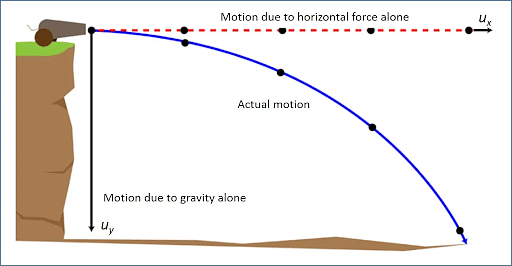
Motion Components along a trajectory path
The path of flight of a projectile is called its trajectory. It is a parabolic curve. In order to analyze the projectile motion or the trajectory, it is split into two components namely - vertical and horizontal. The projectile moves horizontally under the influence of the horizontal force acting on it and it moves downwards under the effect of the gravitational pull exerted on it. The projectile follows a parabolic curved path under the influence of a combination of these forces as seen in the image above.
It can be seen in the image that the projectile path will be a straight horizontal line if it is only acted upon by the horizontal component. Whereas, the path will be a vertical line if it is only under the influence of gravitational acceleration. Thus, the parabolic curved path is achieved only under the combined horizontal and vertical components of velocity.
Also Read: Uniform Circular Motion
Trajectory Formula Derivation
[Click Here for Sample Questions]

Trajectory formula derivation
When a ball is kicked from the ground, it starts its journey at an initial velocity and angle of launch with respect to the horizontal ground. The flight of the ball as gravity acts upon it follows a curved path or a parabola, this curve is called trajectory of the ball.
- The ball trajectory will have two dimensional components namely horizontal (x) and vertical (y) position.
- Considering the initial velocity of Vo and launch angle θ, the vertical position component can be calculated based on the horizontal position by applying the following trajectory formula:
Vertical position = (horizontal position) (tangent of launch angle) – \(\frac{(\text{acceleration due to gravity})(\text{horizontal position})^2}{2(\text{initial velocity})^2 (\text{cosine of launch angle})^2}\)
y =xtanθ – \(\frac{gx^2}{2v^2cos^2\theta}\)
Where,
y is the vertical position component
x is the horizontal position component
g= gravitational acceleration (9.80 m/s2)
v= initial velocity,
θ = angle of launch
The Trajectory related equations are:

Where,
Vo is the initial Velocity,
Sinθ is the y-axis vertical component,
Cosθ is the x-axis horizontal component.
Also Read: Resultant Vector Formula
Explanation of the projectile motion
[Click Here for Sample Questions]

Projectile motion
As shown in the image above the path followed by the projectile is parabolic. Under the effect of the initial velocity the projectile reaches the maximum height it can attain and then under the influence of gravitational acceleration it begins its downward motion.
- The falling projectile now gains a downward acceleration affecting the vertical component of velocity.
- It must be noted that under negligible air resistance which accounts for zero horizontal forces, the horizontal component of velocity remains constant throughout.
- The horizontal motion of the projectile is due to its own inertia as it follows Newton’s first law of motion.
Also Read: Centripetal Acceleration
List of equations for projectile motion
[Click Here for Sample Questions]
| Trajectory formula (vertical component) | y =xtanθ – \(\frac{gx^2}{2v^2cos^2\theta}\) |
| Trajectory formula (horizontal component) | x= V0xt = (V0 cosθ) t |
| Time of Flight | t = (2V0sinθ) / g |
| Time to reach maximum height | tmax = (V0sinθ) / g |
| Maximum Height Reached | H = (V02sin2θ) /2g |
| Horizontal Range | R = (V02sin2θ) / g |
| Horizontal Range (maximum) | Rmax = Vo2 / g |
Things to Remember
- The path followed by a projectile is a parabolic curve.
- The trajectory motion of a projectile is two dimensional.
- The motion of projectiles is analyzed in terms of two independent motions perpendicular to each other.
- The range (R) of the projectile is the distance from the point of launch to the point on ground where it ends its journey.
- The initial velocity is dependent upon the initial acceleration force with which the projectile is launched
Sample Questions
Ques. A batsman drives a shot by hitting a ball at a velocity of 45.0 m/s, and an angle of 66.4° with reference to the ground pitch. The boundary line of the cricket ground is 140 m away in the direction of the ball. Determine the height of the ball when it will reach the boundary line. (5 Marks)
Ans. The horizontal position component at the boundary line is x = 140.0 m.
In order to determine the height of the ball, we need to find the vertical position component y for the initial velocity vo and the angle of launch θ
Applying the trajectory formula to solve for y:

y ≅ 24.2 m.
The vertical component y or the height of the ball at the boundary line (x = 140.0 m) is y ≅ 24.2 m.
Ques. A motorcyclist performs a stunt by jumping over a barrier placed at a distance of 4 m away from the ramp which is inclined at an angle of 36.9° with respect to the horizontal ground. The height of the barrier is set as 1.00 m higher than the ramp. Will the motorcyclist successfully jump over the barrier if he takes off at a velocity of 9.00 m/s? (5 Marks)
Ans. The position of the barrier w.r.t ramp is the horizontal x position, x = 4.00 m.
The angle of launch is θ = 36.9°
The initial velocity v0 = 9 m/s
To find the vertical position y, we shall use the trajectory formula:

y ≅ 1.49 m
The vertical position of the motorcyclist with respect to the horizontal component x=4m will be y ≅ 1.49 m which is higher than 1.00 m height of the barrier, so he will be able to perform the stunt of jumping over the barrier successfully.
Ques. A girl is capable of throwing a small rock up to a maximum height of 10 m. What will be the maximum horizontal distance up to which she can throw the same rock? (1 Marks)
a. 20√2 m
b. 10 m
c. 10√2 m
d. 20 m
Ans. Option (d) 20 m
Explanation:
We know that,
H = \(\frac{V_o^2sin^2\theta}{2g}\)
R= \(\frac{V_o^2sin2\theta}{2g}\)
Hmax is possible if \(\Theta\) = 90o, sin (90) = 1
Hmax = Vo2 / 2g = 10
Vo2 = 10 x g x 2
For maximum Range the projectile must be thrown at angle of 45o
Rmax = \(\frac{V_o^2sin2\theta}{g}\) = \(\frac{V_o^2}{g}\)= \(\frac{10 X g X 2}{g}\)=10*2 =20 m
Ques. A ball launcher vehicle shoots a ball vertically in the air. If the launcher vehicle is moving at a constant velocity, then what will be the landing position of the ball under negligible resistance of air? (1 Marks)
in front of the vehicle
behind the vehicle
in the vehicle
Ans. The answer is C.
Explanation: The ball will land in the vehicle. The horizontal motion of the falling ball remains constant, and as such, the ball will always be positioned directly above the launcher vehicle. The ball will slow down under the influence of gravity and then return back to the ground, but this does not affect the horizontal motion of the ball.
Ques. If an object is thrown at an angle of 35°with the horizontal, what should be the initial velocity so that the object touches a desired point which is 1.8 high from the ground at a distance of 30m. Determine the time of flight. (3 Marks)
Ans. To find the initial velocity of object,
x = V0 cos (35°) t
30 = V0 cos (35°) t
t = 30 / V0 cos (35°)
1.8 = -(1/2) 9.8 (30 / V0 cos (35°))2 + V0 sin (35°) (30 / V0 cos (35°))
V0 cos (35°) = 30 √ [ 9.8 / 2(30 tan (35°)-1.8)]
V0 = 18.3 m/s
To find the total time of flight to reach the desired point.
t = x / V0 cos (35°) = 2.0 s
Ques. A ball is thrown from the top of a 45 m high building with an initial velocity of 15 m/s in a horizontal direction as shown in the image below. What time will the ball take to land on the ground? Also, determine the distance at which it will land on the ground with respect to the building. (5 Marks)
Ans. The ball needs to travel 45 m downward to reach ground level.
The formula governing vertical component of motion is
S= V.t + \(\frac{1}{2}\)g.t2
Where, v = 0 m/s = initial velocity
S = 80 m = displacement.
Gravitational acceleration, g = 9.8 m/s
80=0×t + \(\frac{1}{2}\)(9.81) t2
Substituting these values, we have t = 4 s
Now, the time taken for the ball to reach the ground is 4 seconds.
So, horizontal distance at which the ball will land on ground will be
S= V.t + \(\frac{1}{2}\)g.t2
Where,
Initial velocity in horizontal direction, v = 30 m/ s.
For traveling time, t = 4 seconds.
Since horizontal velocity is constant, acceleration, a, is 0 m/s
Substituting these values, we have S = 120 m.
Ques. Determine where the ball will land if it is launched at an angle of 45 degree with an initial velocity of 25 m /s. (2 Marks)
Ans. Range of the ball for initial velocity 25 m/s and launch angle 45 degree:
R = \(\frac{V_o^2sin2\theta}{g}\) =\(\frac{(25)^2sin2(45)}{9.81}\) =\(\frac{(625)(1)}{9.81}\) = 63.71m
Ques. At which point of the trajectory is the speed of the motion minimum? (2 Marks)
Ans. The minimum speed of the projectile in flight is when maximum height is reached in the trajectory path as the vertical component of velocity at this point is zero.
Ques. A bomber plane drops a bomb when it is at a position directly above the target. Will the bomb hit the target? (2 Marks)
Ans. No, the bomb will not hit the target. The bomb after being dropped is having the same horizontal velocity as the plane. This horizontal velocity ‘v’ will make it fall at a distance of v(\(\sqrt{2h/g}\)) ahead of the target, where h is the height of the plane at the time the bomb is dropped.
Ques. If an object is fired at an angle of 30 degrees with an initial velocity of 5 m/s, when will it achieve the lowest speed on its trajectory path? (3 Marks)
Ans. The object will have minimum speed when it reaches the highest point on the trajectory path. At this point the vertical component of velocity will be zero and there will be only horizontal component. So, the minimum speed of the object on its trajectory path is
V0 cos (\(\theta\)) = (5 cos30) m/s, i.e., 5×√3/2 = 4.33 m/s



Comments