



Content Curator
The velocity of an object refers to the rate of change of the displacement of an object with time. It is a measurement of how faster or slower an object is moving.
- Velocity is a vector quantity i.e. it has both magnitude and direction.
- The SI unit of velocity is meter-per-second (m/s).
- The other unit of velocity is kilometre-per-hour (km/h), miles-per-hour (mph), etc.
- We can also say that the speed of a body along a particular direction is called velocity.
- Speed is a scalar quantity and it only has magnitude.
- Therefore, velocity is the speed of the body moving in a particular direction.
| Table of Content |
Key Terms: Speed, Acceleration, Motion, Instantaneous velocity, Initial and final velocity, Equations of motion, Angular velocity, Escape velocity, Vector quantity.
Also Read: Relative Velocity
What is Velocity?
[Click Here for Sample Questions]
The velocity of an object is its rate of change in position as observed from a particular frame of reference with respect to time. It is a branch of classical mechanics that describes the motion of the body.
- Since velocity have both magnitude and direction, therefore it is a vector quantity.
- The scalar value or magnitude of velocity is known as speed.
- The velocity of the body changes if either its magnitude or direction or both will change.
- The rate of change in velocity is called acceleration.
- If there is a change in the magnitude of velocity but the direction remains constant then the overall velocity vector of the body changes that leads to the production of acceleration. For example, a car moving in a straight path.
- If there is a change in the direction of the body but the magnitude of velocity remains constant, then also overall velocity vector of the body changes, and acceleration is produced. For example, a car moves in a circular path with constant speed.
- For a body to have a constant velocity, it has to move in a straight path with constant speed.
- Velocity is a derived physical quantity and its SI unit is meters-per-second (ms-1 or m/s).
- The dimensional formula of velocity is [M0LT-1]
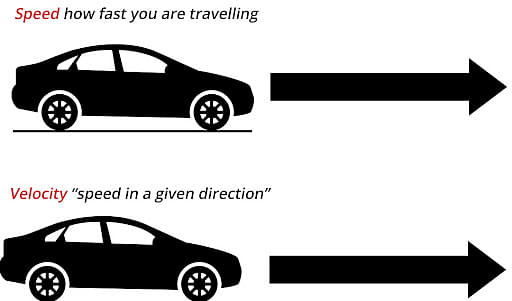
Speed and Velocity
Also Read: Speed & Velocity
Velocity Formula
[Click Here for Sample Questions]
Consider a body is moving in a straight line with velocity v. Let it is at position x0 at time t0, after time t the reaches position x, then the displacement of the body is given by
Δx = x – x0
And, the time taken by the body to change its position is given by
Δt = t – t0
Therefore, the velocity of the body (also called average velocity) with which the body moves from position x0 to x is given by the rate of change of its position and is represented as:
\(v=\frac{x-x_0}{t-t_0}=\frac {\Delta x}{\Delta t}\)
Instantaneous velocity
Instantaneous velocity gives the velocity of a particle at a particular instant of time. The instantaneous velocity of a body at a given instant of time is defined as the limit of average velocity as the time interval Δt becomes infinitesimally small. It is given as
\(v_{ins}= \lim_ {\Delta t\to 0} \frac {\Delta x}{\Delta t}=\frac{dx}{dt}\)
Where dx/dt is called the derivative of x with respect to t.
Initial and Final Velocity
The initial velocity of a body refers to the velocity at time t = 0 with respect to a frame of reference. It may be zero if the body is at rest or have some finite value at t = 0. Whereas the final velocity of a body refers to the velocity at time t = t with respect to a frame of reference. It may be zero if the body after travelling some distance comes to rest.
The initial and final velocity of a body can be calculated using equations of motion:
- S = ut + 1/2 at2
- v2 = u2 + 2as
- v = u + at
Where
- u = initial velocity of the body
- v = final velocity of the body
- a = constant acceleration
- t = time taken
- S = displacement of the body
Also Read: Velocity Selector
Angular Velocity
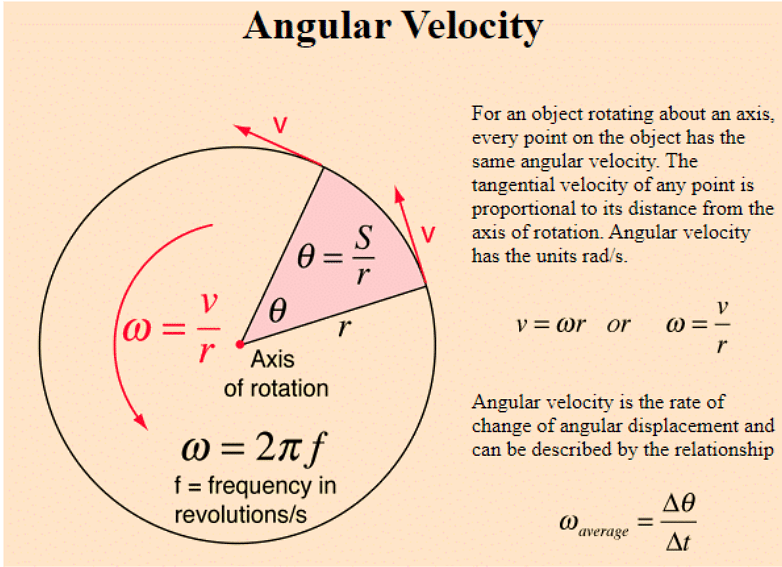
Angular velocity is defined as the velocity of a body moving in a circular path. It is the rate of rotation of the body moving in a circular path about a fixed point.
- SI unit of angular velocity is radian-per-second (rad/s or rad s-1).
- Mathematically, it is given by the change in position about a fixed point in a circular path or angular displacement divided by the total time in which the change in angular position takes place. i.e.
\(\omega=\frac {d\theta}{dt}\)
Where
- ω = angular velocity
- dθ = change in angle of rotation or angular displacement
- dt = time in which angular displacement takes place
Also Read: Value of c: Speed & Velocity of light, Importance, Consistency
Escape Velocity
Escape Velocity refers to the minimum velocity required by an object to escape from the gravitational influence of a massive body. It is given by
\(v_e= \sqrt {\frac {2GM}{R}}=\sqrt {2gR}\)
Where
- ve = Escape Velocity
- G = Universal Gravitational Constant
- M = Mass of the massive body
- r = Distance of the object from the centre of mass of the massive body
The escape velocity of Earth is 11.2 x 10³ m/s or 11.2 km/s.
Also Read: Derivation of Drift Velocity
Difference Between Speed and Velocity
[Click Here for Sample Questions]
A detailed comparison between speed and velocity is given below:
| Speed | Velocity |
|---|---|
| Speed is defined as the distance covered by a body in a unit of time. | Velocity is defined as the displacement per unit time. |
| It is a scalar quantity. | It is a vector quantity. |
| The speed of a body can never be negative. | The velocity of a body can be negative. |
| Speed is a measure of how fast or slow a body is moving. | Velocity defines the direction of the motion of the body. |
| It is the rate of change of distance. | It is the rate of change of displacement. |
Also Read: Drift Velocity
Solved Examples
Ques. A car travelling in a straight road 60 km in 3 hours. What is the Velocity of the car?
Ans. Given,
- displacement of the car, s = 60 km = 60000 m
- time taken, t = 3 hours = 3 x 60 x 60 = 10800 seconds
We have,
Velocity = s/t
= 50000 / 7200
= 5.56 m/s
Ques. Calculate the final velocity of a car if it starts from rest and travels for 20 sec with a constant acceleration of 4 m/s2.
Ans. Given
- The initial velocity of the car, u = 0 m/s
- Acceleration, a = 4 m/s2
- time, t = 20 sec
From the equation of motion, we have
Final Velocity (v) = u + at
= 0 + 4 x 20
= 80 m/s
Things to Remember
- The velocity of an object refers to the rate of change of the object’s position to a frame of reference.
- Velocity is a vector quantity.
- The scaler counterpart of Velocity is called Speed.
- The SI unit of Velocity is metres per second (m/s).
- Angular Velocity refers to how fast an object is rotating to another point.
- Average Velocity refers to the constant velocity that would provide the same resultant displacement as a variable velocity over a certain time period.
- Escape Velocity refers to the minimum velocity required by an object to escape from the gravitational influence of a massive body.
- Initial Velocity refers to the velocity at time t=0 and is denoted by ‘u’. It is also the velocity at which an object starts its motion.
Sample Questions
Ques. What is Velocity? (2 Marks)
Ans. The velocity of an Object refers to the rate of change of the object’s position to a frame of reference. The velocity of an object is a function of time. It is a vector quantity i.e. it has both magnitude and direction.
Ques. Give the SI Unit and dimension of Velocity. (2 Marks)
Ans. The SI unit of Velocity is meter per second (m/s). The dimensions of Velocity are as follows:
[M0 L1 T-1]
where
- M = Mass
- L = Length
- T = Time
Ques. What is the difference between Speed and Velocity? (3 Marks)
Ans. Speed is the rate of change of distance covered whereas Velocity is the rate of change of displacement covered. Speed is a scalar quantity and velocity is a vector quantity.
Ques. What is Escape Velocity? (2 Marks)
Ans. Escape Velocity refers to the minimum velocity required by an object to escape from the gravitational influence of a massive body. The escape Velocity for Earth’s surface is 11,186 m/s.
ve = (2GM / r)1/2
where
- ve = Escape Velocity
- G = Universal Gravitational Constant
- M = Mass of the body to be escaped from
- r = Distance from the centre of the mass
Ques. Define Average Velocity. (2 Marks)
Ans. Average Velocity refers to the constant velocity that would provide the same resultant displacement as a variable velocity over a certain time period.
v = Δx / Δt
where
- v = Average Velocity
- Δx = Change in Position
- Δt = Change in Time
Ques. What is Angular Velocity? (2 Marks)
Ans. Angular Velocity refers to how fast an object rotates to another point.
ω = θ/t
where
- ω = Angular Velocity
- θ = Angle in Radians
- t = Time Taken
Ques. A car moves 50 km in 2 hours. What is the Velocity of the car? (2 Marks)
Ans. Given,
- s = 50Km = 50000 m
- t = 2 hours = 2 x 60 x 60 = 7200 seconds
We have,
Velocity = s/t
= 50000 / 7200
= 6.944 m/sec
Ques. Calculate the final velocity of a car if it starts from rest and travels for 30 sec with an acceleration of 5 m/s2. (2 Marks)
Ans. Given
- u = 0 m/s
- a = 5 m/s2
- t = 30sec
We have,
Final Velocity (v) = u + at
= 0 + 5 x 30
= 150 m/s
Also Read:



Comments