



Exams Prep Master
The word “angle” is derived from the Greek word angulus meaning corner. Angles are the basic unit of geometry that has huge importance in engineering, architecture, geography, and astronomy. It is useful in the construction of cities, buildings, roads, dams, types of machinery, finding locations on earth using geographic coordinate system using latitude and longitudes with respect to the center of the earth and also Astronomers use it to find the location of any celestial object in space as well as to measure the size of the celestial objects. Here, we will be learning more about types of angles and discussing some important questions.
| Table of Content |
Keywords: Define Angle, Types of Angle, Complimentary Angle, Alternate Interior Angle, Acute Angle, Obtuse Angle.
Also read: Isosceles Triangle Theorems
Definition of Angle
[Click Here for Sample Questions]
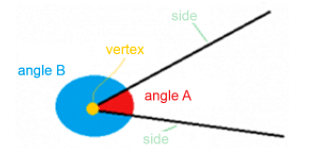
An angle is formed when two rays or lines meet or intersect at a single point. An angle has two components “sides” and “vertex”. The two rays can combine in different ways to form different angles, and each angle has a different measure.

A Right Angle
Parts of Angle
[Click Here for Sample Questions]
Vertex -The point where the rays or lines meet is known as the vertex.
Arms - Two rays or lines intersecting to form an angle are called arms.
Angle - A figure made when two rays meet at a common endpoint.
Types of Angle
[Click Here for Sample Questions]
Angles are divided into two types based on their:
- Magnitude: The rotation about the vertex that causes one of the arms to create an angle is known as the magnitude of an angle. The larger the rotation or gap between the arms, the bigger the magnitude.
The types are:
- Acute angle
- Right angle
- Obtuse angle
- Straight angle
- Reflex angle
- Rotation: Based on the direction you can classify angles into two types:
- Positive Angles
- Negative Angles
Read more:
Acute Angle
Angle that lies between 0 degree to 90 degree is called an acute angle or you can also say that angles less than 90 degree is called an acute angle.

An Acute Angle
Obtuse Angle
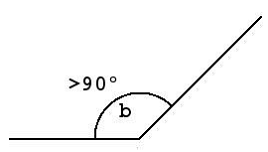
The opposite of an acute angle is an obtuse angle. An obtuse angle is one that is larger than 90 degrees but less than 180 degrees, or in other words, one that is higher than 90 degrees but less than 180 degrees.
An Obtuse Angle
Right Angle
A 90-degree angle is always a right angle. An acute angle is one that is less than 90 degrees, while an obtuse angle is one that is higher than 90 degrees.

A Right Angle
Straight Angle
A straight angle is 180 degree when measured as a result both the arm makes a straight line which is why it is called a straight angle.

A Straight Angle
Reflex Angle
An angle that is greater than 180 degrees but less than 360 degrees is called a reflex angle.

A Reflex Angle
Full Rotation Angle
Full rotation angle refers to an angle that forms 360 degrees. When one of the arms completes a full revolution, this angle is formed
Read More:
Types of Angles based on Rotation
[Click Here for Sample Questions]
There are two types of angles based on rotation:-
Positive Angles
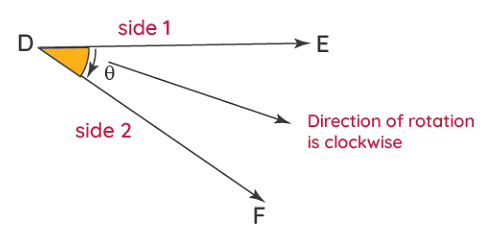
Positive angles are those that are measured from the base in a counterclockwise manner. Positive angles are commonly used to indicate angles in geometry. A positive angle is formed when an angle is drawn in the (+x, +y) plane from the origin.

Negative Angles
Negative angles are those that are measured from the base in a clockwise manner. A negative angle is formed when an angle is drawn from the origin towards the (x, -y) plane.
Also read: Difference between Sequence and Series
Pairs Of Angles
[Click Here for Sample Questions]
There are different types of pair angles:
Complimentary and Supplementary Angles
If the sum is equal to 90°, then It's called complementary angles.
If the sum of two angles is equal to 180°, then It's called supplementary angles.
Linear Pairs Angle
Linear pairs form a straight line when it's distinct arms of adjacent angles are just opposite to each other or extend in the opposite pairs.
Adjacent Angle
Adjacent angles are formed when two angles have one common arm with one common vertex and have distinct arms on either side of the common arm. Simply adjacent angles are two angles next to each other.
Vertical Angle
When two lines intersect each other at a vertex, an angle is formed. This angle formed on either side of the common vertex is called vertical angles or vertically opposite angles.
Also read: First Order Differential Equation
Angles formed by Transversal
[Click Here for Sample Questions]
An angle is formed when a transversal line cuts or intersects two or more lines at distinct points. The angles that are formed at the point of intersection are:-
Alternate Interior or Interior Angles
On the other side of the transversal, there are a pair of internal angles. Identifying a "Z" on the inside side is the quickest approach to detect alternate interior angles and they're equal to one another.
Alternate Exterior or Exterior Angle
It is similar to interior angles, but it's present on the exterior side and they're also equal to one another.
Corresponding Angle
Corresponding angles are angles that are in the same location at the intersection where the straight line intersects two others. If the lines are parallel the corresponding angles are equal.
Things to Remember
- Intersection of two straight lines form an angle at the point of their intersection.
- An acute angle is greater than 0 degree but less than 90 degrees.
- A right angle is equal to 90 degrees.
- Obtuse Angle is greater than 90 degrees but less than 180 degrees.
- The straight angle is equal to 180 degrees.
- A reflex angle is greater than 180 degree but less than 360 degrees.
- An angle equal to 360 degrees is called a full rotation angle.
- Zero angle is formed when both the arms/rays/straight line overlap each other without making an angle.
- Positive angles are those that are measured from the base in a counterclockwise manner.
Read More:
Sample Questions
Ques: Find the complement of 20° and the supplement of 125°. (2 marks)
Ans: Angles that add up to 90 degrees are known as complementary angles.
Because (90° - 20° = 70°), the complement of 20° is 70°.
We can see that 20 degrees plus 70 degrees equals 90 degrees. As a result, both the angles are complimentary.
Angles that add up to 180 degrees are known as supplementary angles.
Because (180° - 125° = 55°), the 125° addition equals 55°.
As we can see, 125° + 55° equals 180°. As a result, both the angles are supplementary.
Ques: Find 'x' , 'y' and 'a'. 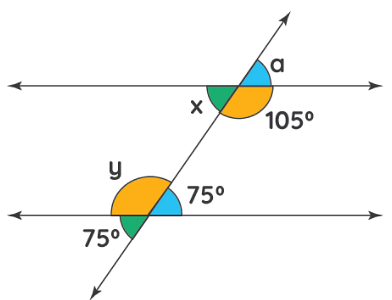 (2 marks)
Ans: The alternative interior and outside angles are formed by a transversal line intersecting two parallel lines, as shown in the diagram. A transversal forms two sets of alternating internal angles that are congruent to each other. As a result, x = 75° and y = 105°.
Angle 'x' is vertically opposed to angle 'a,' and the two angles are congruent. As a result, a = x = 75°.
Ques: Find the angle complementary to the angle 50 degrees. (2 marks)
Ans: The given angle is 50 degree
Here, we need to find the complementary of it.
We know that two angles are complementary when they add up to 90 degrees.
Let the complementary angle be x.
Now, x + 50 degee= 90 degrees
x=90 degree – 50 degree= 40 degree
Hence, the complementary angle is 40 degrees.
Ques: Find the supplementary of the angle 120 degrees. (2 marks)
Ans: The given angle is 120 degree
Here, we need to find a supplementary of it.
We know that two angles are supplementary when they add up to 180 degree
Let the supplementary angle be x
Now, x + 120 degree = 180 degree
x=180 degree – 120 degree = 60 degree
Hence, the supplementary angle is 60 degree.
Ques: Name the angle when the time in a clock is 3: 40 pm? Is it Obtuse or Reflex or Acute Angle? (2 marks)
Ans: The angle is measured in an anti-clockwise manner and thus the angle formed is reflex and not obtuse or acute angle.
Ques: What type of Angle is 120 degrees? (1 mark)
Ans: It is an obtuse angle since it's greater than 90 degrees but less than 180 degrees.
Ques: What kind of angle is 73 degrees? (1 mark)
Ans: Since it is lower than 90 degree hence it's an acute angle.
Mathematics Related Links:



Comments