



Exams Prep Master
An acute angle is less than 90 degrees, i.e., one that is between 0 and 90 degrees. 60 degrees, 30 degrees, 45 degrees, and so on are some examples. An acute triangle is one in which all the inner angles are smaller than 90 degrees. Because the interior angles measure 60 degrees, an equilateral triangle is an acute triangle. In geometry, a triangle is referred to as a closed two-dimensional plane figure with three sides and three angles. A triangle is considered as a three-sided polygon. Here, we will be discussing acute angled triangle in detail along with some important questions.
| Table of Content |
Key Terms: Orthocentre, Pythagoras, Hypotenuse, Circumradius, Perpendicular.
Also read: Isosceles Triangle Theorems
Types of Acute Angled Triangle
[Click Here for Sample Questions]
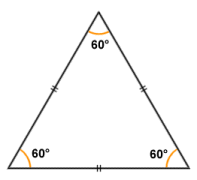
- Equilateral Acute Triangle: An equilateral acute triangle's internal angles are all 60 degrees. The equiangular triangle is another name for it.
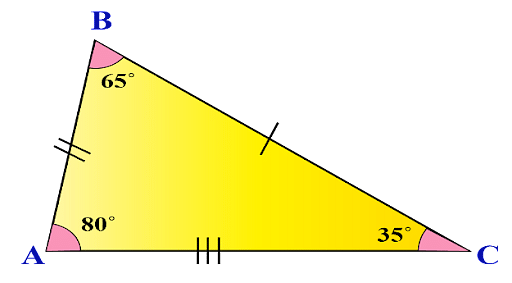
- Scalene Acute Triangle: A scalene acute triangle has three uneven sides and internal angles, all of which are less than 90 degrees.
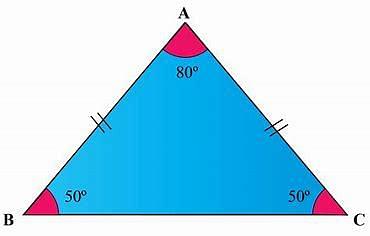
- Isosceles Acute Triangle: An isosceles acute triangle has two angles that measure the same as its two sides.
Properties of Acute Angled Triangle
[Click Here for Sample Questions]
The significant properties of an intense triangle are as per the following:
- At the point when a triangle is delegated intense, every one of its inside points has an action somewhere in the range of 0 and 90 degrees.
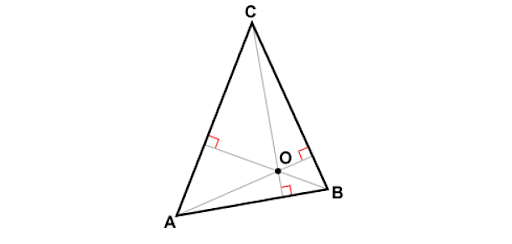
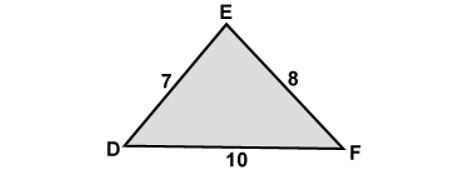
- The orthocentres are where every one of the three elevations of the triangle converges. The orthocentre for an intense triangle is situated within the triangle, as displayed in the figure beneath where O is the orthocentre of triangle ABC.
- The side inverse the biggest point of a triangle is the longest side of the triangle. The more noteworthy the proportion of a point inverse to the side, the more drawn out the side. Alternately, the more drawn out the side the more noteworthy the proportion of the restricting point.
Also read: First Order Differential Equation
The Formula of Acute Angled Triangle
[Click Here for Sample Questions]
The following are the two basic formulas for an acute triangle:
- An acute triangle's perimeter:
The distance covered around a two-dimensional figure is called its perimeter. Whether the form is a triangle, square, rectangle, or circle, it defines the length of the shape. The two most important aspects of a 2D form are its area and perimeter.
Calculating the sum of the sides of an acute-angled triangle yields its perimeter. If the sides of an acute triangle are measured in 'a' unit, 'b' units, and 'c' units, then
a + b + c = perimeter
- The surface area of an acute triangle:
An acute triangle's area is the amount of space it takes up on a two-dimensional surface. So, if you know the length of its base and the equivalent altitude (height), or the length of its three sides, or the length of two sides and the angle between them, you may compute the area of an acute triangle.
Area of Acute angle triangle = ½ * (base) * (height) square units
Pythagoras Formula
[Click Here for Sample Questions]
The Pythagorean Theorem can be used to determine whether a triangle is an acute triangle when the lengths of its sides are known.
The Pythagorean Theorem asserts that for a right triangle with a hypotenuse of length c and leg lengths a and b,
a2 + b2 = c2
In a triangle where a2 + b2 > c2, on the other hand, if side c is likewise the longest side, the triangle is an acute triangle.
Things to Remember
- A three-sided polygon with three edges, three vertices, and three interior angles are known as a triangle. A triangle is a closed two-dimensional figure with three sides and three angles, in other words.
- sinuses of the Angle Sum Property, the angles of an acute triangle add up to 180°.
- At the same time, a triangle cannot be sharp and right-angled.
- A triangle cannot be both obtuse and acute at the same time,
- A-line that goes through the top of a triangle and is perpendicular to the opposing side is called an altitude of a triangle. The orthocentre is where the three elevations of an acute angle intersect, and it is always inside the triangle.
- The distance between the orthocentre and the circumcentre in an acute angle triangle is always less than the circumradius. A segment that divides every angle of a triangle into two halves is known as an angular bisector.
Read More:
Sample Questions
Ques: Is it possible for a triangle to have two angles that are both right? (3 marks)
Ans: Two (or three) straight angles in a triangle are impossible. Only one of the three angles in a right triangle is a right angle; the other two are sharp angles that are less than 90 degrees (as mentioned earlier, their measures must add up to 90 degrees, since they are complementary angles).
The fact that a triangle's three angles sum up to 180 degrees proves the point. The sum of two right angles (equal to 90 degrees) in a triangle is already 180 degrees.
This would indicate that the third angle would be 0 degrees, implying that the opposing side would have no length and thus the triangle would not exist at all.
Ques: When is a triangle considered to be equilateral? (3 marks)
Ans: When all three angles of a triangle are equal, it is said to be equilateral. This also implies that the lengths of the three sides across from those angles are the same.
Let's name A the length of one of the equilateral triangle's angles. The three angles must then sum to 180 degrees, as follows:
A + A + A = 180
3A = 180
A is 60.
As a result, an equilateral triangle has three 60-degree angles. Because three angles are the same, an equilateral triangle is a particular instance of an isosceles triangle (instead of just two being the same).
Ques: Is It Possible to Scalene a Right Triangle? (3 marks)
Ans: It is possible to scalene a right triangle. However, not all scalene triangles are right triangles, and not all right triangles are scalene triangles.
Here are some key points to consider while working with a right scalene triangle:
One angle is 90 degrees - in a right triangle, the greatest angle (the right angle) lies across from the longest side (the hypotenuse), and it measures 90 degrees. No two sides of a scalene triangle have the same length — the three sides of a scalene triangle have distinct lengths; hence no two sides are the same length. That is if the side lengths are a, b, and c, then a ≠ b, a ≠ c, and b ≠ c.
Ques: Is It Possible for A Right Triangle to Be Acute? (3 marks)
Ans: It is impossible for a right triangle to be acute. An acute triangle is defined as a triangle with three angles that are all smaller than 90 degrees (that is, an acute triangle has three acute angles).
A right triangle cannot be acute since its angle measures exactly 90 degrees.
It's worth noting, though, that every equilateral triangle is acute (since its three angles all measure 60 degrees).
Ques: An acute-angled triangle has two angles with measurements of 75 and 35. Calculate the third angle's length. (3 marks)
Ans: Let ∠A be the third angle, and ∠B and ∠C be 70 and 45 respectively. Then, using triangles' inner angle sum property,
∠A + ∠B + ∠C = 180
⇒ ∠A + 70 + 45 = 180
⇒ ∠A + 115 = 180
⇒ ∠A = 180 -115
⇒ ∠A = 65
Ques: Calculate the area of an acute-angled triangle with a base of 40cm and a height of 5cm. (2 marks)
Ans: The base of the acute-angled triangle is 40cm, while the height is 5cm.
Since the area of an acute triangle
= 1/2 × (base) × (height) sq. units
= 1/2 × 40 × 5 sq. cms
= 200 sq. cms
Ques: The ratio of a triangle's sides is 3: 4: 5. Indicate whether or whether the triangle is right-angled. (3 marks)
Ans: Assume that the triangle's sides are 3x, 4x, and 5x units long.
We have a right-angled triangle.
The sum of the squares of the other two sides equals the square of the longer side.
(5x)2 = (3x)2 + (4x)2
⇒ 25x2 = 9x2 + 16x2
⇒ 25x2 = 25x2
Hence, the given triangle is right-angled.
Ques: There are three sides to me. One of my angles is 15 degrees. Another has a 60-degree angle. I'm not sure what sort of polygon I am. What type of triangle am I if I'm a triangle? (3 marks)
Ans: I have three sides because I have three sides.
It's a triangle, which means it's a three-sided polygon.
15° and 60° are two angles.
180° - (15° + 60°) = 180° – 75° (Angle sum property) = 105°, which is more than 90°.
As a result, it's an obtuse triangle.
Ques: Which of the following cannot be a triangle's sides? (3 marks)
(i) 4.5 cm, 3.5 cm, 6.4 cm
(ii) 2.5 cm, 3.5 cm, 6.0 cm
(iii) 2.5 cm, 4.2 cm, 8 cm
Ans: i) The dimensions of the given sides are 4.5 cm, 3.5 cm, and 6.4 cm.
Any two sides added together equal 4.5 cm + 3.5 cm = 8 cm
Because 8 cm is more than 6.4 cm (Triangle inequality)
A triangle is formed by the specified sides.
ii) The dimensions of the given sides are 2.5 cm, 3.5 cm, and 6.0 cm.
2.5 cm + 3.5 cm = 6.0 cm is the sum of any two sides.
Because 6.0 cm equals 6.0 cm,
There is no way to make a triangle with the supplied sides.
iii) 2.5 cm, 4.2 cm, and 8 cm
2.5 cm + 4.2 cm = 6.7 cm is the sum of any two sides.
Since 6.7 cm < 8 cm
The given sides do not form a triangle.
Ques: One of the equal angles of an isosceles triangle is 50°. Find all the angles of this triangle. (2 marks)
Ans: Let the third angle be x°.
x + 50° + 50° = 180°
⇒ x° + 100° = 180°
⇒ x° = 180° – 100° = 80°
Thus ∠x = 80°
Mathematics Related Links:



Comments