



Education Journalist | Study Abroad Lead
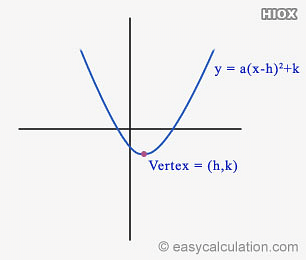
Vertex of the parabola is the intersection point of the parabola and the axis of symmetry. In simpler words, the point at which the parabola crosses the axis of symmetry is called the vertex. Depending on the vertex, the parabola changes its direction. If the vertex is maximum, the parabola opens down. If the vertex is minimum, the parabola opens up. The standard form of the parabola is y=ax2+bx+c. If a > 1, then the parabola is an upward parabola. If a < 1, then the parabola is a downward parabola. As per the equation, the symmetry axis is along the y-axis. If the equation has a y2 term, then the symmetry axis is along the x-axis. The general vertex form of the parabola is y = a(x-h)2 + k.
| Table of Content |
Key Terms: Vertex Formula, Parabola, Coordinates, symmetry acis, vertex, derivation of vertex formula
Introduction to Vertex Formula
[Click Here for Sample Questions]
The vertex formula is used in order to find the vertex of a parabola. The vertex form of the parabola is given below.
y=a(x-h)2+k
Here, h, k are vertex coordinates.
The vertex (h,k) can be determined in two different ways.
- (h,k) = \(\frac{-b}{2a}\), \(\frac{-D}{4a}\)
Here, D is the discriminant which can be determined by D(discriminant)=b2-4ac
h and k are the vertex coordinates
- h = \(\frac{-b}{2a}\)
Here, h is the x-coordinate of the vertex. Later, h can be used to find k by evaluating it in y.
Vertex Formula
Discover about the Chapter video:
Conic Sections Detailed Video Explanation:
Also Read: Parabola Formula
Vertex Formula Derivation
[Click Here for Sample Questions]
Let us derive the first formula y = a(x-h)2 + k
The standard form of the parabola is
y=ax2 + bx + c ...(1)
Subtracting c on both sides,
y – c = ax2 + bx ...(2)
Consider a as common factor,
y – c = a(x2+\(\frac{bx}{a}\)) ...(3)
Here, half the coefficient of x is b/2a. Its square is b2/4a2.
Add and subtract b2/4a2 on the right side of equation (3)
y – c = a( x2 + \(\frac{bx}{a}\) + \(\frac{b^2}{4a^2}\) – \(\frac{b^2}{4a^2}\) ) ...(4)
Here, x2 + \(\frac{bx}{a}\) + \(\frac{b^2}{4a^2}\) can be written as (x+\(\frac{b}{2a}\))2.
Equation (4) becomes
y – c = a((x + \(\frac{b}{2a}\))2 – \(\frac{b^2}{4a^2}\) )...(5)
Distribute a on the right side,
y – c = a(x + \(\frac{b}{2a}\))2 – \(\frac{b^2}{4a}\) ...(6)
Add c on both sides,
y = a(x + \(\frac{b}{2a}\))2 – \(\frac{b^2}{4a}\) + c ...(7)
Write the equation (7) in the given form
y = a(x + \(\frac{b}{2a}\))2 – \(\frac{b^2-4ac}{4a}\) ..(8)
Comparing equation (8) with parabola equation y = a(x-h)2 + k
We get,
h = – b/2a
k = – \(\frac{b^2-4ac}{4a}\)
We know that D(discriminant) = b2 – 4ac.
Therefore, the vertex formula can be written as
(h,k) = (\(\frac{-b}{2a}\), \(\frac{-D}{4a}\))

Vertex of a Parabola
Also Read: Parabola
Things to Remember
- Vertex of the parabola is the intersection point of the parabola and the axis of symmetry. In simpler words, the point at which the parabola crosses the axis of symmetry is called the vertex.
- Depending on the vertex, the parabola changes its direction. If the vertex is maximum, the parabola opens down. If the vertex is minimum, the parabola opens up.
- The vertex form of the parabola is y=a(x-h)2+k. Here, h, k are vertex coordinates.
- When the symmetry axis is along the x-axis, the parabola opens (a) right if x-coefficient is positive and (b) left if x-coefficient is negative. When the symmetry axis is along the y-axis, the parabola opens (a) upward if the y-coefficient is positive and (b) downward if the y-coefficient is negative.
- The vertex (h,k) can be determined in two different ways.
- (h,k) = (\(\frac{-b}{2a}\), \(\frac{-D}{4a}\)) Here, D is the discriminant and h and k are the vertex coordinates.
- h=\(\frac{-b}{2a}\), Here, h is the x-coordinate of the vertex. Later, h can be used to find k by evaluating it in y.
Sample Questions
Ques. Determine the coordinates of the vertex for the given parabola equation: y=3x2-6x+1. (3 Marks)
Ans. The parabola equation is y=ax2+bx+c
Comparing this equation with y=3x2-6x+1, we get
a=3;b=-6;c=1
Discriminant can be found as D(discriminant)=b2-4ac
Ddiscriminant = (-6)2 – 4(3)(1)
D=36-12
D=24
The vertex of the parabola is
(h,k) = (\(\frac{-b}{2a}\), \(\frac{-D}{4a}\))
(h,k) = (\(\frac{-(-6)}{2*3}\), \(\frac{-24}{4*3}\))
h,k=1,-2
The vertex of the given parabola is h,k=1,-2
Ques. Find the vertex of the parabola y=3x2+12x-12. (3 Marks)
Ans. The parabola equation is y=ax2+bx+c
Comparing this equation with y=3x2+12x-12, we get
a=3;b=12;c=-12
Discriminant can be found as D(discriminant)=b2-4ac
Ddiscriminant = 122- 4(3)(-12)
D=144+144
D=288
The vertex of the parabola is
(h,k) = (\(\frac{-b}{2a}\), \(\frac{-D}{4a}\))
h,k= (\(\frac{-(12)}{2*3}\), \(\frac{-288}{4*3}\))
h,k = (\(\frac{12}{6}\), \(\frac{-288}{6}\))
h,k= – 2, – 24
The vertex of the given parabola is h,k = – 2, – 24
Ques. Find the vertex of the parabola whose x-intercepts are (2,0) and (3,0) and whose y-intercept is (0,6). (5 Marks)
Ans. Since the x-intercepts are (2,0) and (3,0), (x-2) and (x-3) are the factors of the parabola equation.
Therefore,
y = a(x-2)(x-3)…. (1)
As given, the y-intercept is (0,6). Substitute x=0;y=6
6 = a(0-2)(0-3)
6 = 6a
a = 1
Substitute a=1 in (1),
y = 1(x-2)(x-3)
y = x2 – 5x + 6
The parabola equation is y = ax2 + bx + c
Comparing this equation with y = x2 – 5x + 6, we get
a=1;b=-5;c=6
Discriminant can be found as D(discriminant)= b2 – 4ac
Ddiscriminant = (–5)2– 4(1)(6)
D=25 – 24
D=1
The vertex of the parabola is
(h,k) = (\(\frac{-b}{2a}\), \(\frac{-D}{4a}\))
(h,k) = (\(\frac{-(-5)}{2*1}\), \(\frac{-1}{4*1}\))
h,k=\(\frac{5}{2}\), \(\frac{-1}{4}\)
h,k = 5/2, – 1/4
The vertex of the given parabola is h,k = 5/2, – 1/4
Ques. Find the vertex of the parabola y = 4x2 + 16x – 16. (3 Marks)
Ans. The parabola equation is y = ax2 +bx + c
Comparing this equation with y = 4x2 + 16x – 16, we get
a=4;b=16;c=-16
x-coordinate is given by
h = – b/2a
h = – 16/(2×4)
h = –16/8
h = – 2
Therefore, x-coordinate is −2.
Substitute x in the given equation
y = 4(- 2)2+16(-2)-16
y = 4×4 – 32 – 16
y = 16 - 32 - 16
y = – 32
The vertex of the given parabola is h,k = – 2,- 32
Ques. Show that the equation y–16=3x – 52 can be rewritten in the form y=ax2+bx+c and find the values of a, b, and c. (5 Marks)
Ans. Given
y-16=3(x-5)2
Add 16 on both sides,
y = 3(x-5)2+16
y = 3(x2-10x+25)+16
y = 3x2-30x+75+16
y = 3x2-30x+91
The parabola equation is y=ax2+bx+c
Comparing this equation with y=3x2-30x+91, we get
a=3;b=-30;c=91
Ques. Convert the following equation into the form of y=a(x-h)2+k. (3 Marks)
f(x)=x2 -24x + 157
Ans. Half the coefficient of x is \(\frac{-24}{2}\).
Squaring half the coefficient of x,
\(\frac{-24^2}{2^2}\) = (-12)2 = 144
Add and subtract the value 144 in the given equation,
f(x) = x2-24x+157+144-144
f(x) = (x – 12)2 + 13
Ques. Find the vertex of the parabola y=-x2+2x+3 by completing the square. (3 Marks)
Ans. Given
y=-x2+2x+3
Factor the negative sign,
y = -(x2-2x-3)
Add and subtract 12 on the right side
y = -(x2-2x+12-12-3)
y=-((x-1)2+4)
Comparing it with the equation
y=a(x-h)2+k
h=1;k=4
Ques. Find the vertex of the parabola y=2x2+4x-3 by completing the square. (3 Marks)
Ans. Given
y=2x2+4x-3
Factor 2,
y=2(x2+2x-3/2)
Add and subtract 12 on the right side
y=2(x2+2x+12-12-3/2)
y= 2((x-1)2- \(\frac{5}{2}\))
Comparing it with the equation
y = a(x-h)2+k
h= – 1; k=\(\frac{-5}{2}\)
Ques. Find the vertex of the parabola y = -3x2+4x by completing the square. (3 Marks)
Ans. Given
y= – 3x2+4x
Factor −3,
y = – 3(x2-\(\frac{4x}{3}\))
Add and subtract (\(\frac{2}{3}\))2 on the right side
y = -3(x2- 2x(\(\frac{2}{3}\)) + (\(\frac{2}{3}\))2 – (\(\frac{2}{3}\))2)
y = -3((x – (\(\frac{2}{3}\))2)2- (\(\frac{2}{3}\))2)
y = -3((x – (\(\frac{2}{3}\))2)2- (\(\frac{4}{9}\)))
y = -3(x – (\(\frac{2}{3}\)))2 + (\(\frac{4}{3}\))
Comparing it with the equation
y = a(x-h)2 + k
h = \(\frac{2}{3}\); k = \(\frac{4}{3}\)
Ques. The profit p of a barber per week depends upon the charge c as per the haircut. It can be represented as per the given equation p = – 200c2+2400c–4700. What price must be charged by him to get the largest profit? (3 Marks)
Ans. We can find the price that should be charged for the largest profit by finding x coordinate of the vertex
p = – 200c2+2400c–4700
x = -b/2a
Here, a = -200, b = 2400 and c = -4700
x= \(\frac{-2400}{2(-200)}\)
= 6
Thus, the barber should charge should charge $6 to earn the largest profit.
Check More:



Comments