



Content Curator
There are two types of mixtures: Homogeneous and Heterogeneous Mixtures. Physical combination of two or more substances or elements is known as a mixture. Because there are no chemical interactions between these chemicals when they are combined, they preserve their unique chemical properties. Melting and Boiling point of a mixture, on the other hand, are impacted by preparation of a mixture.
| Table of Content |
Key Terms: Diffusion, Osmosis, Alloy, Concentration, Pure substance, Impure Substance
Also read: Boiling Point Elevation
What is Mixture?
[Click Here for Sample Questions]
A mixture of salt and water, a mixture of sugar and water, various gases, air, and so on are examples. Various components of any mixture do not form as a result of any chemical changes. As a result, the components' distinct properties are preserved.
Every component in a combination maintains its own chemical identity. Mechanical mixing, in most cases, unite the components of a mixture; however, different processes may result in a mixture (e.g., diffusion, osmosis). A combination may exhibit unexpected physical features in comparison to both of its components, even if the component of the mixture is unaffected. When you mix alcohol with water, for example, mixture has a different melting and boiling temperature than either component.
Read More: Types of Solutions
Characteristics of Mixture
- Separating components from a mixture is simply because none of the components interact chemically with one other.
- In a mixture, the chemical properties of the components remain unchanged.
- Combining substances in any state of matter can result in a mixture. A mixture is a mixture of salt in water, just as the soil is a mixture of particle pebbles.
- The components in a combination may not have to be present in specified concentrations.
- Unlike the synthesis of a new chemical, the production of a mixture is not connected with any change in energy or enthalpy. As an example, the formation of salt requires energy because a link between the elements sodium and chlorine is established.
- A salt solution, on the other hand, requires no energy to prepare since the salt is evenly distributed in the water and there is no chemical reaction between the salt and the water.
Read More:
Homogeneous Mixture
[Click Here for Sample Questions]
Homogeneous mixtures are those that have a consistent composition throughout substance. For example, a salt-water solution, a sugar-water solution, air, lemonade, soft drink water, and so on. Mixing of salt and water is a classic example. This is because limit between salt and water can never be separated here. Path of light is not visible when a beam of light is impacted on a mixture of salt and water.
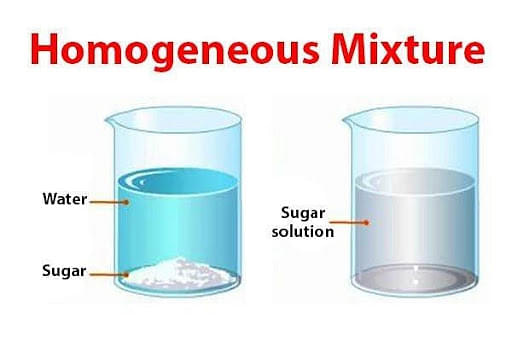
Image: Homogeneous Mixture
Properties of Homogeneous Mixture
- Every solution is an example of a homogenous mixture.
- The particles in this example are smaller than one nanometer in size.
- They don't show Tyndall's influence.
- Particle boundaries cannot be separated.
- You can't use centrifugation or decantation to separate the constituent particles here.
- Alloys are solutions in their own right.
Read More: Ideal Solution
Heterogeneous Mixture
Heterogeneous mixtures are those that are not uniform throughout. A mixture of soil and sand, sulphur and iron filings, oil and water, and so on is heterogeneous because its makeup is not consistent. This is because it contains two or more separate stages in this scenario.

Image: Heterogeneous Mixture
Properties of Heterogeneous Mixture
- Aside from solutions and alloys, most mixes are heterogeneous.
- Here, constituent particles are not evenly distributed.
- You can effectively separate the components.
- In a heterogeneous combination, at least two stages are usually accessible.
- Particles here are between one nanometer and one micrometer in size.
- They demonstrate Tyndall's influence.
Read More:
Difference Between Homogeneous and Heterogeneous Mixture
[Click Here for Sample Questions]
Below table elaborates differences between Homogeneous and Heterogeneous Mixture:
| Homogenous Mixture | Heterogeneous Mixture |
|---|---|
| A homogeneous mixture is one in which the components combine and the composition remains consistent throughout the solution. | A heterogeneous mixture is one whose composition is not homogeneous throughout and in which distinct components are visible. |
| Components of homogenous mixture are invisible to the human eye. | Components of heterogeneous mixtures are visible to naked eye. |
| Component sizes in this mixture are at the atomic/molecular level. | Particles in this mixture are large. |
| Components of a homogenous mixture are difficult to separate. | Heterogeneous mixture's components can be easily separated. |
| Physical properties of constituent particles in a homogeneous mixture are same. | Physical properties of constituent particles in a heterogeneous mixture vary. |
| Example: salt solution, sugar solution, air, etc. | Example: a mixture of salt and sugar, grains and pulses along with some dirt particles (often stone pieces), etc. |
Read More: Solute
Things to Remember
- Smoke is made up of a variety of particles dispersed in the air.
- Water and other particles are mixed in tap water. Distilled water is simply pure water, also known as H2O.
- Many of the things we come into contact with daily are mixtures, including the air we breathe, which is made up of gases such as oxygen and nitrogen.
- Blood is a mixture that can be split into two pieces using a centrifuge machine: plasma and red blood cells.
Read More:
Sample Questions
Ques. What are heterogeneous and homogeneous mixture examples? (3 Marks)
Ans. A mixture is created by blending two or more substances. No matter how you sample a homogeneous solution, it tends to be identical. Water, saline solution, certain metals, and bitumen all come from homogeneous mixes.
Heterogeneous combinations include sand, oil and water, and chicken noodle soup. Air, saline solution, most alloys, and bitumen are examples of homogenous mixes. Sand, oil and water, and chicken noodle soup are examples of heterogeneous combinations.
Read More: Unsaturated Hydrocarbons
Ques. Why is air a heterogeneous mixture? (3 Marks)
Ans. Nitrogen, oxygen, carbon dioxide, and other gases make up the majority of the gas combination in the air. of the world's other gases Temperature can affect one of the gases in the air that takes the form of liquid. As a result, the air is occasionally referred to as a heterogeneous mixture.
Two or more phases of matter are always combined to form a heterogeneous mixture. They can also be easily differentiated from one another. As a result, the air is composed of a variety of gases, including 78.09 nitrogen, 20.95 oxygen, 0.93 argon, 0.04 carbon dioxide, and water vapors.
Read More:
Ques. How would you describe a heterogeneous mixture by an example? (3 Marks)
Ans. In a heterogeneous combination, particles are not evenly distributed. Chocolate chip cookies, iced Coke, a sandwich, pizza, and tossed salad are all examples. A heterogeneous mixture does not have a uniform makeup. In other words, it changes in composition from one location to the next. A heterogeneous mixture does not have a uniform makeup. In other words, it changes in composition from one location to the next.
Ques. What are properties of mixture? (3 Marks)
Ans. A mixture is when two or more substances are combined in any proportion. Because the constituents in a combination do not react chemically, their physical qualities are preserved. The makeup of a homogeneous mixture is consistent throughout. The makeup of a heterogeneous mixture varies. The qualities of the mixture's components are preserved. Physical processes such as evaporation, boiling, and others can separate the constituents of a mixture.
Read More:
Ques. What is a homogeneous mixture and example? (2 Marks)
Ans. Solids, liquids, and gases can all be homogeneous mixtures. Throughout, they share the same look and chemical composition. Water, air, steel, detergent, saltwater mixture, and other homogeneous mixtures are examples. When two or more metals are combined in a specified ratio, an alloy is created.
Ques. What are characteristics of mixture? (3 Marks)
Ans. A mixture's constituents do not exist in a predetermined ratio. The following are some of the features of mixtures:
- Even if there is no chemical force occurring between the two or more combined components, they nonetheless exist together.
- In nature, they might be diverse or homogenous.
- Quantities of the substances can change at any time.
- Mixture's qualities are determined by separate components.
- Physical procedures can be used to separate mixture's ingredients.
- Boiling point and melting point of a mixture are determined by constituents' properties.
- There is no energy change during production of a mixture.
Read More:
Ques. What is a simple mixture? (3 Marks)
Ans. In chemistry, a mixture is a material made up of two or simpler compounds. Compounds or chemical elements can be used as such materials. It is possible to create a mixture of liquids, solids, or gases.
When sugar is mixed with water, it forms a mixture, which subsequently dissolves to form a solution. Cement, sugar syrup, tea, muck, and smog are examples of mixtures. The classification of seawater is that it is a combination. Because seawater is made up of more than two substances, salt, and water, it has a complex composition.
Ques. Is Vinegar a mixture? (2 Marks)
Ans. Vinegar is a homologous mixture of water and acetic acid that is homogenous. It's a solution since the resulting mixture only contains one phase. Mixtures are created by combining two or more chemical components. The material is referred to as a mixture if it has more than one phase. The molecules of water and acetic acid are not bound to each other. The acetic acid molecules could be extracted from the water, and the water could be extracted from the acetic acid molecules.
Read More:



Comments