



Education Journalist | Study Abroad Lead
Volume of Cuboid is the total space occupied by the three-dimensional figure in 3D space. A cuboid has 6 rectangular faces. When the cuboid is hollow, the volume of a cuboid can be understood as its capacity. Cuboid, being a three-dimensional figure, not just has sides, but also has faces, edges and vertices. It has 8 edges and 12 vertices. The six faces of the cuboid exist as 3 parallel faces. Therefore, the measurement of volume of cuboid is done based on the dimension of these faces i.e. length, width, and height. The formula to calculate the volume of a cuboid is equal to length × breadth × height. Some of the examples of cuboids around us include almirahs, books, erasers, etc.
| Table of Contents |
Key Terms: Volume of Cuboid, Surface Area, Volume of Cuboid Prism, Total Surface Area
What is Cuboid?
[Click Here for Sample Questions]
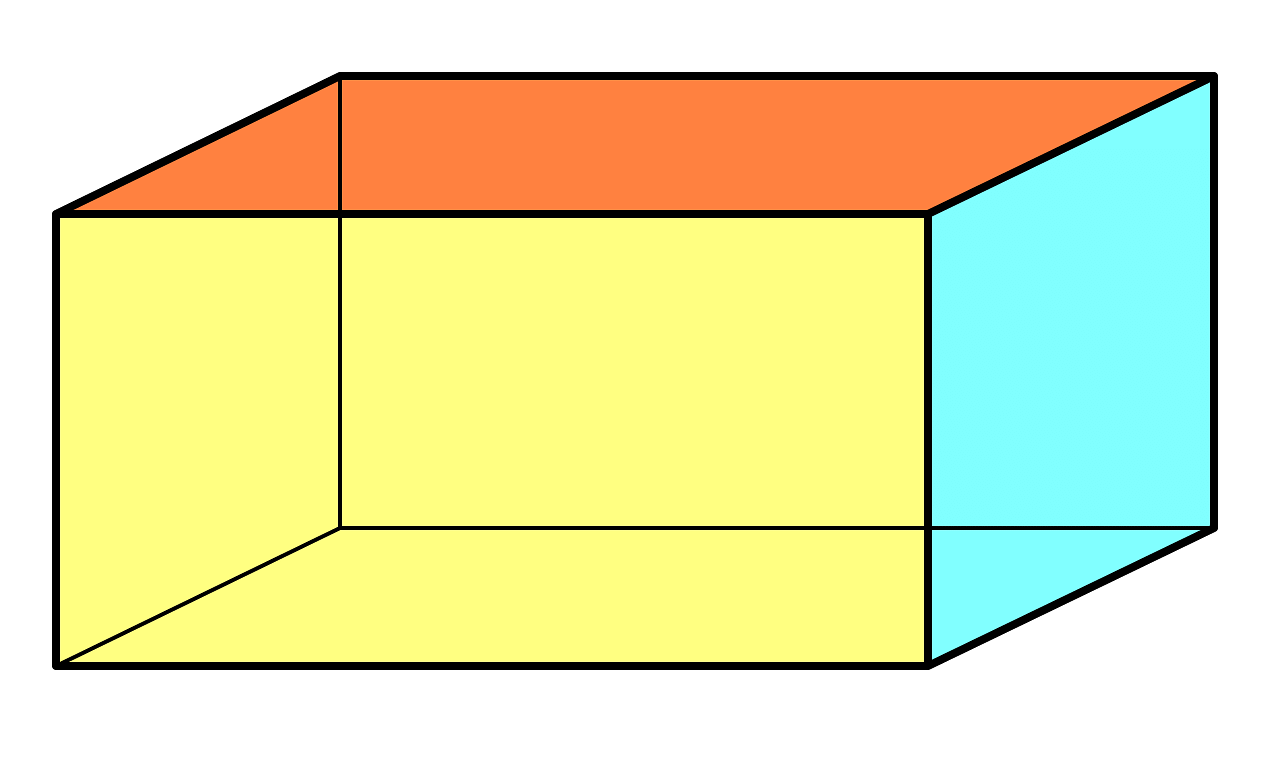
A cuboid is a geometrical figure which has a total of 6 quadrilateral faces. It has a similar structure as that of a cube, as the polyhedral figure of the cuboid is the same as a cube. However, even though cube and cuboid have some similar properties, which include the same number of faces, edges and vertices, the area and volume of both the figures differ from each other.
Read More: Difference Between Cube and Cuboid
Volume of a Cuboid
[Click Here for Sample Questions]
Volume of cuboid is defined as the total space that is occupied by the shape of the cuboid. The volume of a cuboid relies on the three dimensions of cuboids that include its length, breadth and height. The unit of volume of the cuboid is in the form of unit3 or cuboid units. The unit can be m3, cm3, in3 or any other standard unit in the form of cuboid units. Hence,
Volume of cuboid = length × breadth × height
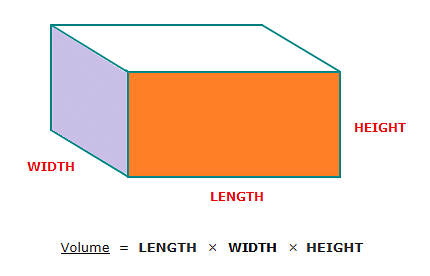
The equation is equal to lbh cubic units. When the hollow cuboid holds a liquid or air in itself, then the liquid or the air stored in the whole cuboid is known to be the capacity of the cuboid. Since the air or the liquid occupies the cuboid space, it is equal to the volume of a cuboid.
Derivation of Volume of Cuboid
[Click Here for Sample Questions]
The sides of the cuboid are made up of faces in the shape of rectangles. These rectangles have a defined area 'A' and a particular height 'h'. As the volume of cuboid is defined as the space occupied, therefore, mathematically,
Volume of Cuboid = Area of the region occupied by the faces × height – 1
The region occupied by the faces is the total area of all the faces, which is 'A'. As we know, the area of a rectangle is the product of length and breadth.
Therefore, A = length × breadth – 2
Now, on putting the value of Equation 2 in Equation 1, the final equation of the volume of the cuboid can be defined as,
Volume of Cuboid = Length × Breadth × Height
Read More: Surface Area and Volume
Volume of a Cuboid Prism
[Click Here for Sample Questions]
Before defining the volume of a cuboid prism, it is vital to determine the meaning and the characteristics of Cuboid Prism at the primary stage. A cuboid prism is similar to a cuboid; the attributes include 6 faces, 8 vertices, and 12 edges. It has a rectangular cross-section. The volume of a cuboid prism is defined as a product of length, breadth and height and the final product in cubic units. Therefore, mathematically,
Volume of Cuboid Prism = length × breadth × height
How to Find the Volume of Cuboid?
[Click Here for Sample Questions]
The volume of a cuboid can be determined when the three lengths, i.e. length, breadth and height, are known. In this case, when one of the above lengths is unknown and the volume is mentioned, then the unknown length can be determined. In order to get standard units in the volume and the accurate volume, all the lengths should be equalised in the same units. Here are the steps involved in determining the volume of the cuboid:
Step 1: Calculate all the three measurements needed, which are length, breadth and height.
Step 2: Make sure that all the three are in the same unit; if not, then make all the three in the same team.
Step 3: After getting all the three in identical units, get the product of the three
Step 4: The value of the product is the volume of cuboid given.
Note: When one measurement is not known, we can determine the unknown length by dividing the product of the two known values by the volume of cuboid.
Solved Examples
Example 1. Find the volume of cuboid of dimensions 14 cm × 12 cm × 8 cm.
Solution. Given: length = 14 cm, breadth = 12 cm and height = 8 cm
We know that,
Volume of cuboid = length × breadth × height.
Substituting the values of l, b and h from above, we get,
Volume of cuboid = 14 × 12 × 8 cubic cm.
= 1344 cm3
Therefore, the volume of the given cuboid is 1344 cm3
Example 2. Michael made a shoebox with a length of 8 cm, breadth of 6 cm and height of 6 cm. Find the volume of the box.
Solution. Given: length = 8 cm, breadth = 6 cm and height = 6 cm
We know that,
Volume of cuboid = length × breadth × height.
Substituting the values of l, b and h from above, we get,
Volume of the shoe box = 8 × 6 × 6 = 288 cubic cm.
Example 3. Find the volume of cuboid of dimensions 14 cm × 50 mm × 10 cm.
Solution. Here, length = 14 cm, breadth = 50 mm and height = 10 cm
We need to convert breadth to the same unit and then solve. We know,
10 mm = 1 cm.
Therefore, 50 mm = 50/10 cm = 5 cm
We know that,
Volume of cuboid = length × breadth × height
= 14 × 5 × 10
= 700 cubic cm.
Therefore, the volume of the given cuboid = 700 cubic cm.
Total Surface Area of a Cuboid
[Click Here for Sample Questions]
The total surface area of a cuboid is calculated by adding the areas of its 6 rectangular faces. Mathematically,
Total Surface Area of a Cuboid = 2 (lw + wh + lh)
where, l represents the length, w represents the width and h represents the height of the cuboid. The unit of total surface area of a cuboid is square units.
The Lateral Surface Area of a Cuboid is the sum of its four rectangular faces
Lateral Surface Area of a Cuboid = 2h (l+b)
Things to Remember
- A cuboid is a geometrical figure which has a total of 6 quadrilateral faces.
- The volume of a hollow cuboid is described to be the capacity of the cuboid.
- All the cuboid faces have a distinct shape of rectangles, which means that each face of the cuboid is a rectangle. The adjacent face of a cuboid can be defined as any two faces of the cuboid which are not opposite.
- The volume of a cuboid can be calculated as the product of its length, breadth, and height.
- Out of the six faces of the cuboid, any one face of the cuboid can be described as the base of the cuboid. The cuboid base is generally the face on which a solid must be resting.
- The line segment between any pair of adjacent vertices is known as an edge. The cuboid has 12 equal edges.
- The point where three edges meet is known as a vertice. A cuboid has a total of 8 vertices.
Sample Questions
Ques. Find the lateral surface area and total surface area of a cuboid length 90 cm, breadth 30 cm and height 15 cm. (5 marks)
Ans. Given: Length = 90cm, Breadth = 30cm and Height = 15 cm
We know,
Lateral Surface Area = 2 × height(length + breadth)
= 2 × 15 (90 + 30)
= 30(120)
=3600 cm2
Total Surface Area = (length × breadth) + (breadth × height) + (height × length)
= (90 × 30) + (30 × 15) +(15 × 90)
= 2700 + 450 + 950
= 4100 cm2
Ques. The length, breadth, and height of a room are 4m, 7m and 2m, respectively. Find the cost of whitewashing the room walls and the ceiling at the rate of Rs 7.50 m2. (5 marks)
Ans. Given: Length = l = 4 m
Breadth = b = 7 m
Height = h = 2 m
Area to be whitewashed = lb + 2(l + b)h
= 4×7 + 2(4+7) 2
=24+ 2(11)2
= 24 + 44
=68 cm2
Cost of whitewashing = 68 × 7.50
= Rs. 510
Ques. Find the Capacity of a Cuboidal Tank having Length 11m, Breadth 9m and Height 6m. (3 marks)
Ans. The capacity of the Cuboid is equal to the volume of the cuboid.
Therefore, the capacity or volume of cuboid = l × b × h
= 11×9×6
=594 m3
Ques. Find the Cost of Digging a Cuboidal Pit 10m long, 8m Broad and 7m Deep at the Rate of Rs 25 per m3. (3 marks)
Ans. The volume of the pit= l ×b×h
= 10×8×7
=560 m3
Therefore, the cost of digging= 560 ×25
=Rs. 14000
Ques. A cuboidal water tank is 12m long, 50 m wide, and 45 m deep. How many litres of water can it hold? (3 marks)
Ans. Litres of water tank can hold = Capacity of volume
The capacity of Tank = 12 × 50 × 45
= 27000 m3
The tank can hold 27000 m3 of water.
Ques. Find the volume of a cuboid whose length is 30 cm, breadth is 20 cm, and height is 10 cm. (3 marks)
Ans. Given,
Length = 30cm
Breadth = 20cm
Height = 10cm
The volume of Cuboid = 30×10×20
= 6000 cm3
The Volume of the cuboid is 6000 cm3
Ques. Find the cost of digging a cuboidal pit 80 m long, 16 m broad and 30 m deep at the rate of Rs 30 per m3. (5 marks)
Ans. Given,
Length = 80m
Breadth = 16m
Height = 30m
The volume of the cuboidal pit = 80 × 16 × 30
= 38,400m3
The volume of the cuboidal pit is 38,400 m3
Cost of digging = 38,400×30
=1,152,000
The cost of digging the pit is Rs. 1,152,000.
Read More:-



Comments