



Content Curator
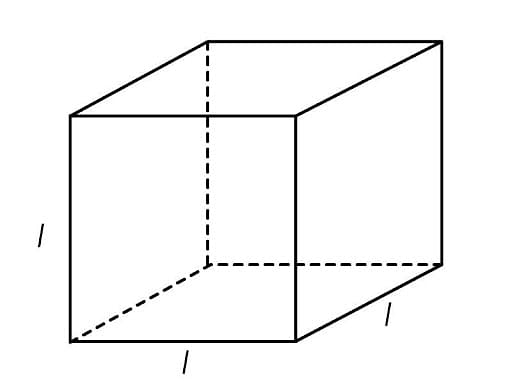
A cube is a three-dimensional solid, which has 12 edges of equal length, joined together at 90 degrees forming 6 squared faces. The cube's opposite edges are parallel and equal in length. It has 8 vertices where three edges meet. It has 12 surface diagonals and 4 internal diagonals. The volume of the cube can be defined as the space it occupies in the larger context. For example, a Rubix cube is a perfect real-life example under the cubes. So the cube is a 3-dimensional solid object made of six perfect squares joined together at right angles to make a closed-form.
| Table of Content |
Key Terms: Cube formula, Volume, Surface Area, Diagonals, cube, lateral surface area, total surface area
Properties of a Cube
[Click Here for Sample Questions]
A cube has various properties which will help us understand the cube formula and the object better. These properties are listed below:
- A cube has 12 edges of equal lengths
- Each edge is connected to 4 edges at an angle of 90 degrees to each other.
- There are 8 vertices.
- A cube has 6 faces, which is square in shape, and is connected to 4 faces on each of its edge at 90 degrees
- All the 12 diagonals on the surface area are equal in length
- Opposite edges are parallel to each other
- There 4 internal diagonals, all of the equal lengths
Surface Areas of a Cube
[Click Here for Sample Questions]
Total Surface Area of a Cube
The total area of the surface of a cube, including all 6 faces, is called the Total Surface Area.
To calculate the surface area of a cube,
Let’s assume an edge of the cube to be of a length ‘a’ unit.
We know that all the edges are equal and each face is a square.
Now area of 1 face of the cube = a x a
Area of 6 such faces = 6 x a x a = 6a2 units2
Lateral Surface Area of a cube
The Lateral Surface Area of a cube is the surface area of a hollow cube, basically only the 4 adjacent faces excluding the top and bottom surface.
To Calculate L.S.A:
Area of 4 squared faces = 4 x a x a = 4a2 units2
Volume of a Cube
[Click Here for Sample Questions]
The volume of the cube can be explained as the total space a cube takes in the whole atmosphere. As we all know that solids occupy space, so volume defines the space it occupies.
To define let’s see it in a different way.
Imagine a 2d plane of the same size as the base with no thickness if stacked in a pile to cover the total height of the cube. The total surface area of all these stacked planes is basically how much the cube can carry and hence the volume.
Let’s assume the edge of a cube is of length “a” units.
From the properties above we can come to the conclusion that height of the cube, length and breadth of the base of the cube are all “a” units.
Area of the base = l x b = a x a
Height of the cube= a
Total surface area of all planes = volume of cube = l x b x h (height of cube)
= a x a x a
= a3 unit3
Diagonals of Cube
[Click Here for Sample Questions]
The diagonals of a face of the cube:
Using the pythagorean theorem = edge2 +edge2 = diagonal2
= a2 + a2 = d2 (d is the length of diagonal)
= √a2 + a2 = d
= √2a2 = d
= √2a = d units
The internal diagonals of cube:
Using the pythagorean theorem = edge2 +(diagonal of base)2 = (diagonal of cube)2
= a2 + (√2a)2 = l2 (l is the length of diagonal of cube)
= a2 + 2a2 = l2
= 3a2 = l2
= √3a2 = l units
Things to Remember
- Cube is a 3d solid object with all equal edges, squared faces
- It has 12 edges, 8 vertices, and 6 faces
- The total Surface area of a cube is 6a2
- The Lateral Surface Area of the cube which is the surface area of the hollow cube excluding the 2 bases of the cube is 4a2
- The diagonal of a face of the cube, with equal edges, is d= √2a
- The diagonal of the cube is l = √3a
Sample Questions
Ques. Find the volume and total surface of a Rubix cube of a length 5 cm. (3 marks)

Ans. Length of a side of cube = 5 cm
a = 5 cm
Total surface area of cube = 6a2
T.S.A of Rubix Cube = 6 x 52 = 6 x 25 = 150 cm2
Volume of Cube = a3
Volume of Rubix Cube = 53 = 5 x 5 x 5 = 125 cm3
Hence the total surface area of Rubix cube is 150 cm2 and volume is 125 cm3
Ques. The volume of a cube is 343 cm3. Find the edge of the cube and the internal diagonal of the cube. (3 marks)
Ans. Volume of Cube = 343 cm3
V = a3
343 = a3
7 = a
Edge of the cube = 7 cm
The internal diagonal of cube = √3a
= √3 x 7
= 7√3 cm
Hence the edge of the cube is 7 cm and the diagonal is 7√3 cm.
Ques. There is a cube with an edge of 4cm. Find the ratio between volume and total surface area of the cube. (3 marks)
Ans. Edge of the cube = 4 cm
The volume of cube = a3
V = 43
V = 64 cm3
Total Surface Area of cube = 6a2
T.S.A = 6 x 42
= 6 x 16 = 96
Ratio of volume of the cube to the surface area of the cube =
V/ TSA = 64/96 = 4/6 = 2/3
Hence the ratio between the volume and surface of the cube is 2:3.
Ques. Below is a structure made of cubes of equal edges of length 6 cm find the volume of the cube and total surface area of the cube. (4 marks)

Ans. Edge of each cube = 6 cm
Total number of cubes = 7
V = a3
The total volume of the cubical structure = volume of one cube x number of cubes
V= 6 x 6 x 6 x 7 = 1512 cm3
Total Surface Area = area of all visible faces
If you see the structure a few faces are hidden as they are used to join cubes with each other.
Total number of invisible faces = 14
Surface area of the structure = t.s.a of all cubes - area of hidden faces
T.s.a of all cubes = 6a2 x 7 = 7?6 (6)2 = 1512 cm2
Area of hidden faces = 14 x a2 = 14 x 6 x 6 = 504 cm2
Surface area of the structure = 1512 - 504 = 1008 cm2
Ques. A cubical tank of edge 50 cm is being filled with water at a speed of 100cm3/s. Calculate the time taken to fill up the tank. (5 marks)
Ans. Edge of the cubical tank = 50 cm
Speed at which the tank is being filled = 100cm3/s
The volume of the tank = a3 = 503 = 125000 cm3
Total time taken to fill the tank = volume/speed = 125000/100 = 1250 s
60 s = 1min
1250s = ? min
= 1250/60 = 20.8 min
Hence, the time taken to fill the tank will be 20.8 mins, approx 21 mins.
Ques. A cubical basement of edge 10m is to be filled with wooden crates of edge 50cm. Calculate the number of crates that can fit into the basement. (3 marks)
Ans. Edge of the basement = 10 m
Edge of the wooden crate = 50 cm = 0.5 m (50/100)
Volume of basement = a3 = 103 = 1000 m3
Volume of crate = a3 = 0.53 = 0.125m3
Total number of crates that can fill the basement = volume of basement/ volume of crate = 1000/0.125 = 8000 crates
Hence a total of 8000 crates can fit in the basement.
Ques. A wall of length 100 cm and height 50 cm, thickness 10 cm is to be built using cubes of edge 5 cm. Find the number of cubes to be used to build the wall (4 marks)
Ans. L of wall = 100cm
H of wall = 50 cm
T of wall = 10 cm
Total volume of wall = L x B x H= 100 x 50 x 10 = 50000 cm3
Edge of cube = 5 cm
Total volume of a cube = 53 = 125 cm3
The total number of cubes to make the wall = Total volume of the wall / Volume of each cube= 50000 / 125 = 400 cubes
Hence we need 400 cubes to build the given wall
Ques. A solid cube of side 12 cm is cut into eight cubes of equal volume. What will be the side of the new cube? Also, find the ratio between their surface areas. (5 marks)
Ans. Edge of cube = 12 cm
Number of cubes it divided into = 8
Volume of whole cube = a3 = 123= 1728 cm3
Volume of all cubes together = 1728 cm3
Volume of each cube = 1728/8
= 216 cm3
= (side of each cube)3
Side of each cube = 6cm
Hence side of each cube is 6 cm
Total surface area of solid cube = 6 x 122 = 6 x 144 = 864 cm2
Total Surface Area of small cube = 6 x 62
= 6 x 36 = 216 cm2
The ratio of their surface areas = surface area of solid cube/surface area of small cubes = 864/216 = 4:1
That means the solid cube is 4 times in the surface area that the small cube cut out of it.
Also Read:



Comments