



Education Journalist | Study Abroad Lead
Wavelength can be defined as the distance between two successive crests and troughs of a wave. It is one of the important characteristics of a waveform. The wavelength is denoted by the symbol λ (Lambda). The standard unit of wavelength is metres. In this article, we will discuss wavelength, various units of wavelength and some related topics like the wave and types of wave.
| Table of Content |
Keyterms: Wavelength, Wave, Waveform, Lambda, Energy, Transmission of energy, Solid, Liquid, gas, Sound
Wave
[Click Here for Sample Questions]
Wave is a conceptual representation of the transmission of energy in a vacuum or a medium. When energy travels in a given medium (solid, liquid, or gas) there can be certain disturbances in the flow, which results in waves.
Some types of energies don’t need a medium to travel so they travel in a vacuum. Sound energy needs a medium to travel whereas light energy can travel in a vacuum.
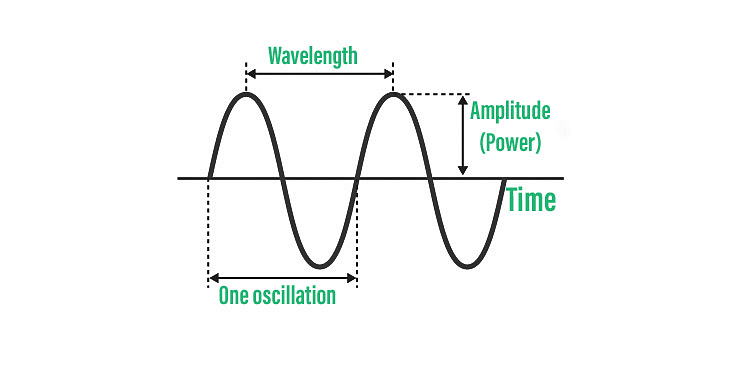
Wave
Types of Waves
[Click Here for Sample Questions]
There are three types of waves:
- Mechanical Waves: A medium is required for the propagation of mechanical waves. Such waves follow all of Newton’s laws of motion. For example, water waves are mechanical waves as they need a medium to travel. Sound waves cannot travel in a vacuum. They require a medium to travel.
- Electromagnetic Waves: Electromagnetic waves don’t need a medium to propagate. They can travel in a vacuum. Electromagnetic Waves are related to magnetic and electric fields. For example x-rays, satellite systems, microwaves, mobile phones, radio, etc.
- Matter Waves: Matter waves are an abstract concept. Matter waves are associated with matter and are composed of small particles. They are related to the movement of protons, electrons, neutrons, and other such particles. For example, atoms, sun, earth, moon, etc.
Read More:
| Related Concepts | ||
|---|---|---|
| Maxwell Equations | Impedance of free space | Scintillation Counter |
| Electromagnetic Waves MCQ | Types of Radiation | Magnetic field lines |
Wavelength
[Click Here for Sample Questions]
A wavelength is the distance between the maximum displacement of amplitude from equilibrium. Wavelength can be short or long.
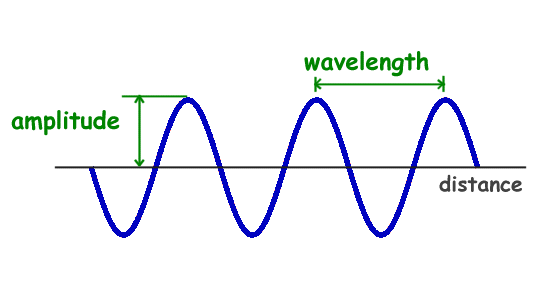
Wavelength
Shorter wavelengths are represented by the use of negative exponential and longer wavelengths are represented by the use of exponential powers of 10.
SI unit of Wavelength
[Click Here for Sample Questions]
Wavelength is denoted by a Greek symbol called Lambda (λ). The SI unit of wavelength is metre.
Read More: Electromagnetic Waves
Other units of Wavelength
[Click Here for Sample Questions]
Wavelengths can have different units.
- The SI unit of wavelength is metre.
- The CGS unit of wavelength is centimetre.
- Wavelength has multiple and submultiple units.
The multiple units of wavelength include-
- Kilometre (Km)
- Megametre (Mm)
- Terametre (Tm)
- Gigametre (Gm)
- Petametre (Pm)
The submultiple units of wavelength include-
- Decimetre (Dm)
- Millimetre (mm)
- Nanometre (nm)
- Centimetre (cm)
- Micrometre (μm)
Do Check Out:
Things to Remember
- Wave is a conceptual representation of the transmission of energy in a vacuum or a medium.
- When energy travels in a given medium, there can be certain disturbances in the flow, which results in the formation of waves.
- A wavelength can be defined as the distance between the maximum displacement of amplitude from equilibrium.
- Wavelength can be short or long. It is denoted by the Greek symbol called Lambda (λ).
- The SI unit of wavelength is metre.
- Wavelengths can have different units. The CGS unit of wavelength is centimetre.
- The multiple units of wavelength are Kilometre (Km), Megametre (Mm), Terametre (Tm), Gigametre (Gm) and Petametre (Pm).
- The submultiple units of wavelength are Decimetre (Dm), Millimetre (mm), Nanometre (nm), Centimetre (cm) and Micrometre (μm)
Sample Questions
Ques: Which of the following is not a submultiple unit of wavelength: (1 Mark)
(a) Decimetre
(b) Megametre
(c) Micrometre
(d) Centimetre
Ans: b) Megametre
Ques: What is Frequency? (1 Mark)
Ans: Frequency refers to the number of waves that pass through one point in one second.
Ques: What is Period in context to wavelength? (1 Mark)
Ans: The time taken by a wave to pass through a point is known as a period. A wave consists of one trough and one crest.
Ques: What is Amplitude? (1 Mark)
Ans: The maximum distance between the central point on the x-axis to the extreme position. This extreme position can be the lowest point of a trough or the highest point of a crest.
Ques: What is Crest and Trough? (2 Marks)
Ans: The part of waves that lies above the x-axis is called Crest. A Crest is also known as heights. The part of waves that lies below the x-axis is called Trough. A Trough is also known as depression.

Crest and Trough
Ques: What is the relation between frequency and wavelength? (2 Marks)
Ans: Wavelength refers to the length of a wave and frequency is the number of waves that pass through one point in one second. Wavelength and frequency are inversely proportional to each other. When there is a decrease in wavelength, the frequency increases. When there is an increase in the wavelength, the frequency decreases.
Ques: Write a note on longitudinal waves. (2 Marks)
Ans: Longitudinal waves consist of a vibration or a periodic disturbance. This disturbance or displacement takes place in the same direction as the advance of the wave. Longitudinal waves consist of rarefactions and compressions. The regions in a longitudinal wave where particles are far apart from each other are known as rarefactions. The regions in a longitudinal wave where particles are close to each other are known as compressions.
Ques. What is the Transverse wave? (2 Marks)
Ans: Transverse waves consist of a vibration or a periodic disturbance. The waves in which the disturbance or displacement that takes place is in the direction perpendicular to the advancement of the wave. So, the movement of particles in transverse waves propagates horizontally.

Transverse wave
Ques. What is the wavelength of the following rays: (4 Marks)
(a) X-rays
(b) Gamma rays
(c) Ultraviolet rays
(d) Infrared rays
Ans:
- X-rays: 0.001 - 10 nm
- Gamma rays: less than 0.001 nanometer or 10-12 metres
- Ultraviolet rays: 10 - 400 nm
- Infrared rays: 700 nm to 1 mm
Ques. Define waves and what are different types of waves? (4 Marks)
Ans. Wave is a conceptual representation of the transmission of energy in a vacuum or a medium.
There are 3 different types of waves:
- Mechanical Waves: A medium is required for the propagation of mechanical waves. Such waves follow all of Newton’s laws of motion. For example, water waves are mechanical waves as they need a medium to travel. Sound waves cannot travel in a vacuum. They require a medium to travel.
- Electromagnetic Waves: Electromagnetic waves don’t need a medium to propagate. They can travel in a vacuum. Electromagnetic Waves are related to magnetic and electric fields. For example x-rays, satellite systems, microwaves, mobile phones, radio, etc.
- Matter Waves: Matter waves are an abstract concept. Matter waves are associated with matter and are composed of small particles. They are related to the movement of protons, electrons, neutrons, and other such particles. For example, atoms, sun, earth, moon, etc.
For Latest Updates on Upcoming Board Exams, Click Here: https://t.me/class_10_12_board_updates
Do Check Out:



Comments